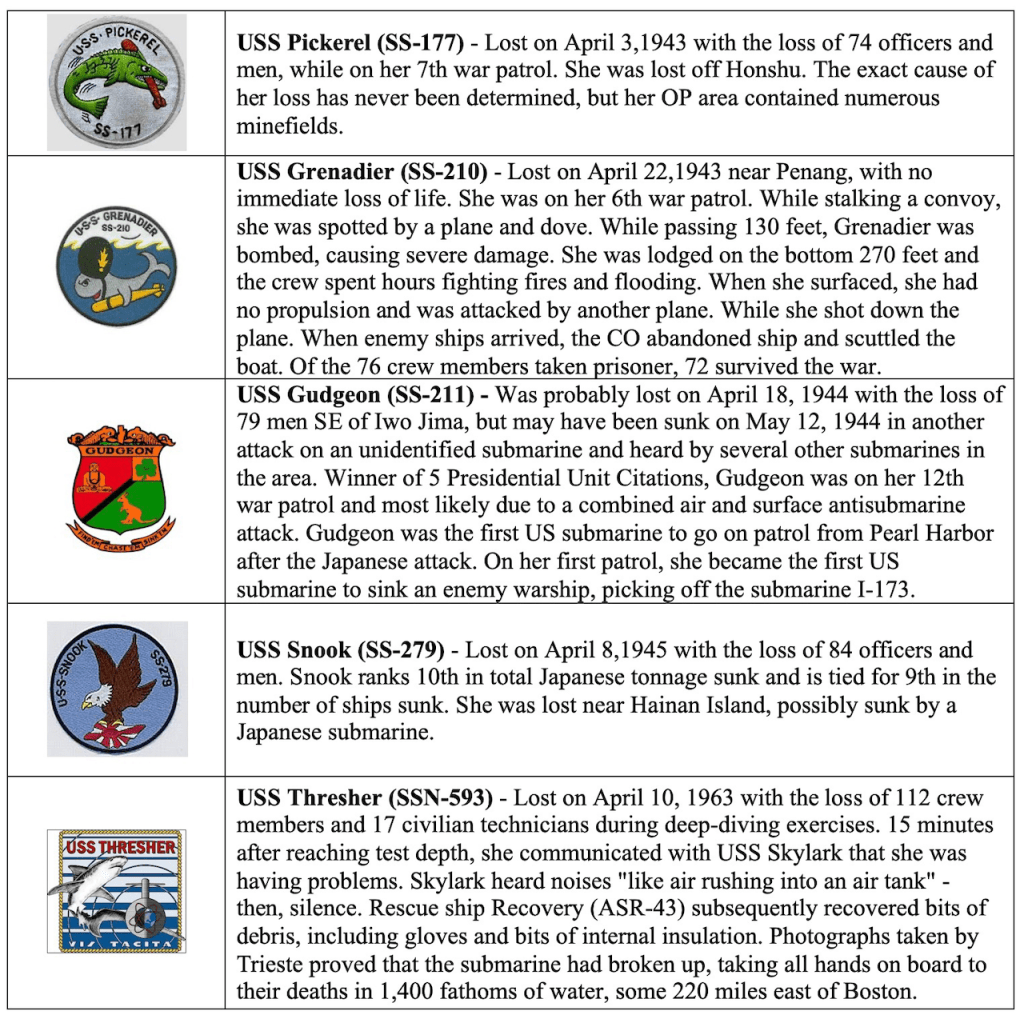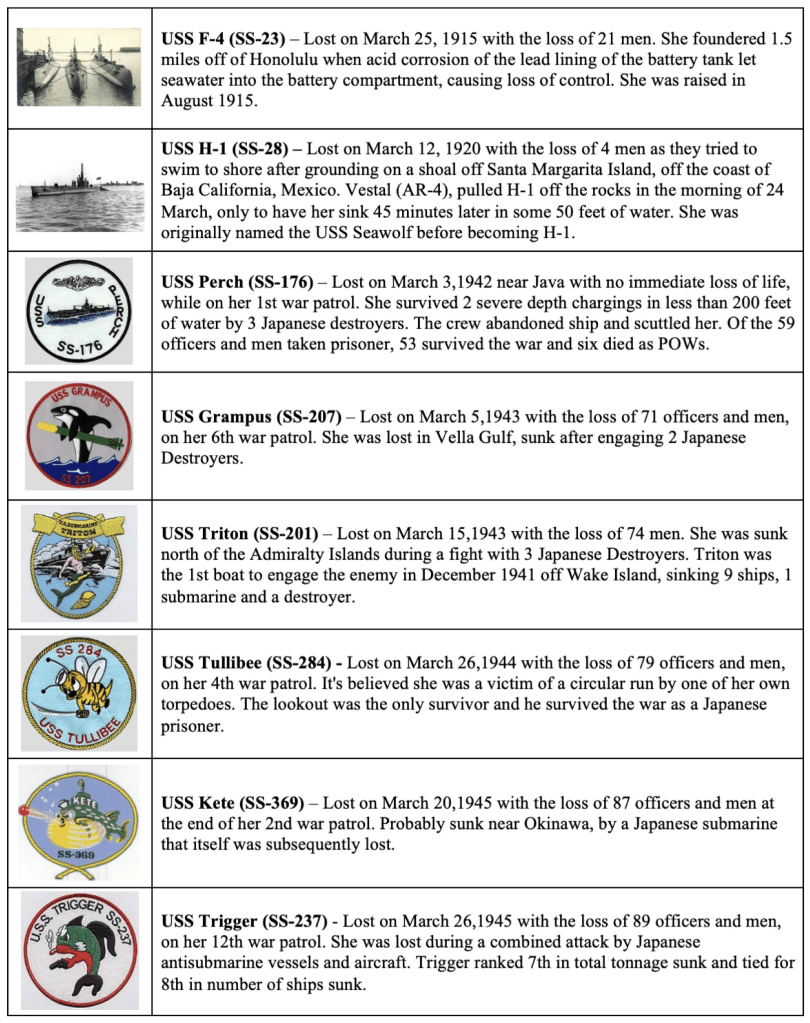
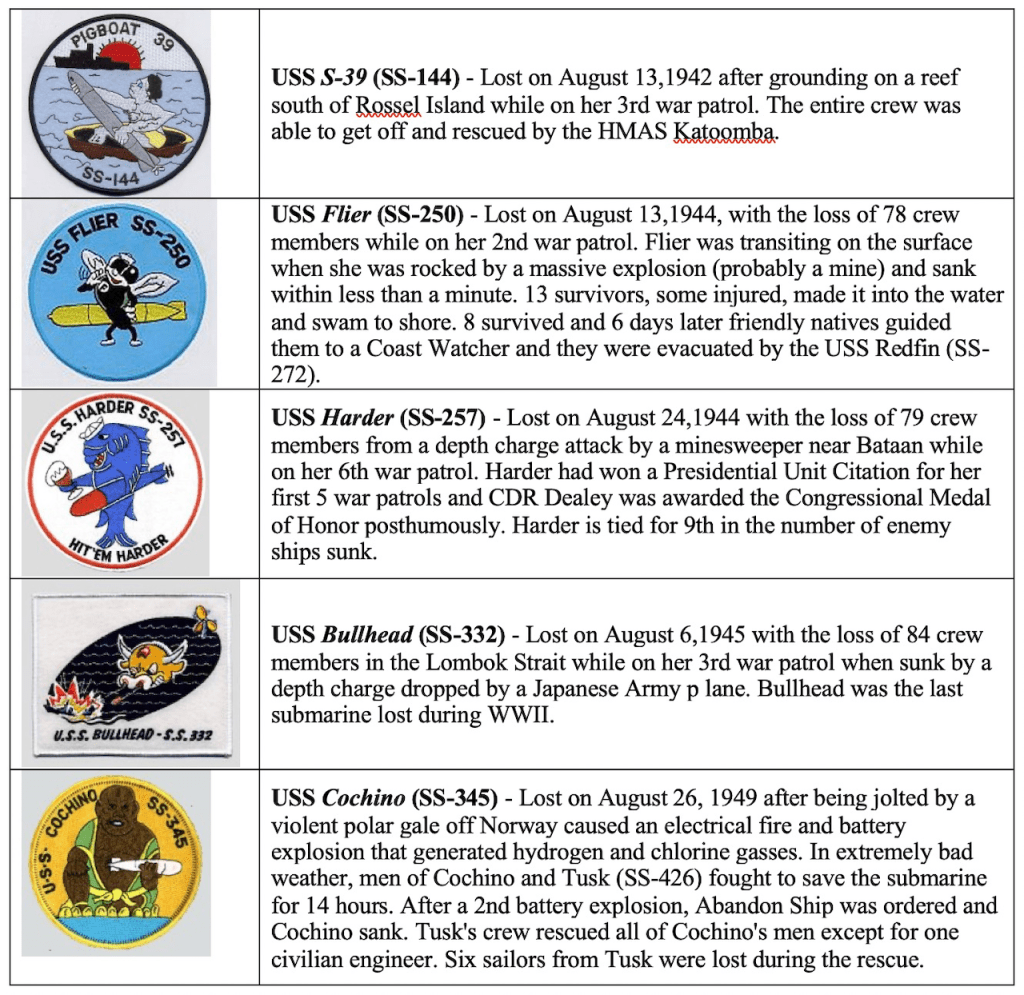
Tolling of the Boats Lost in August

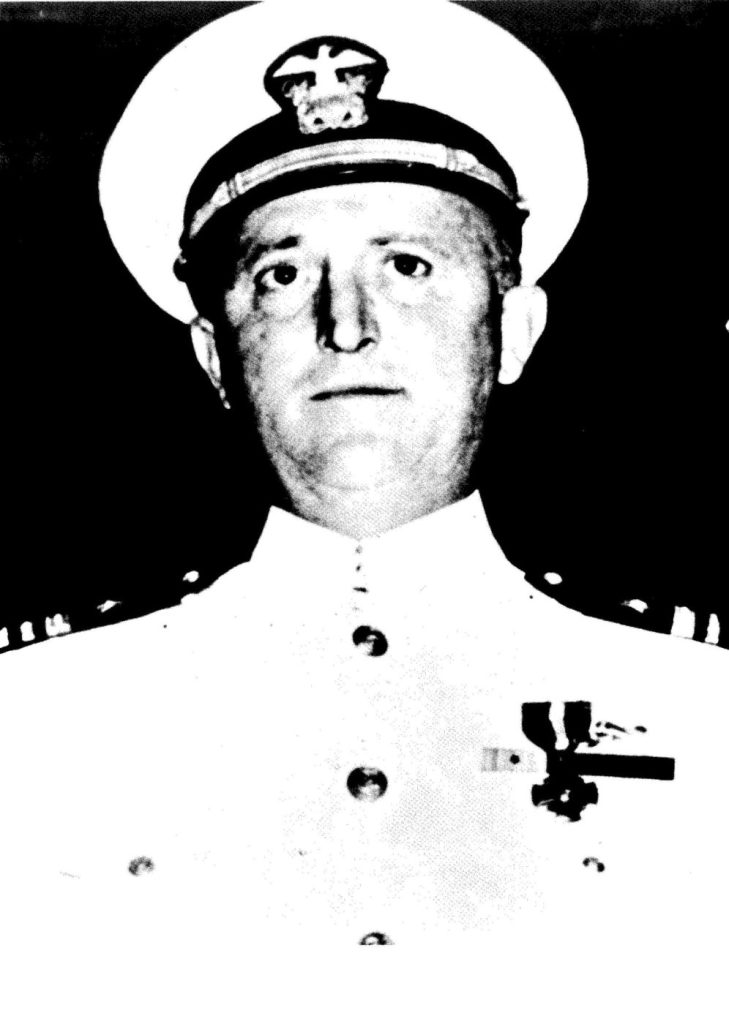
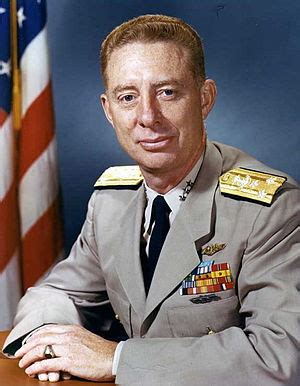
Commander Samuel Dealey

Commander Dealey was born on September 13, 1906 in Dallas, Texas, where he attended Oak Cliff High School. He graduated from the Naval Academy in June 1930. Dealey had duty on the battleship USS NEVADA (BB-36) before training as a submarine sailor.

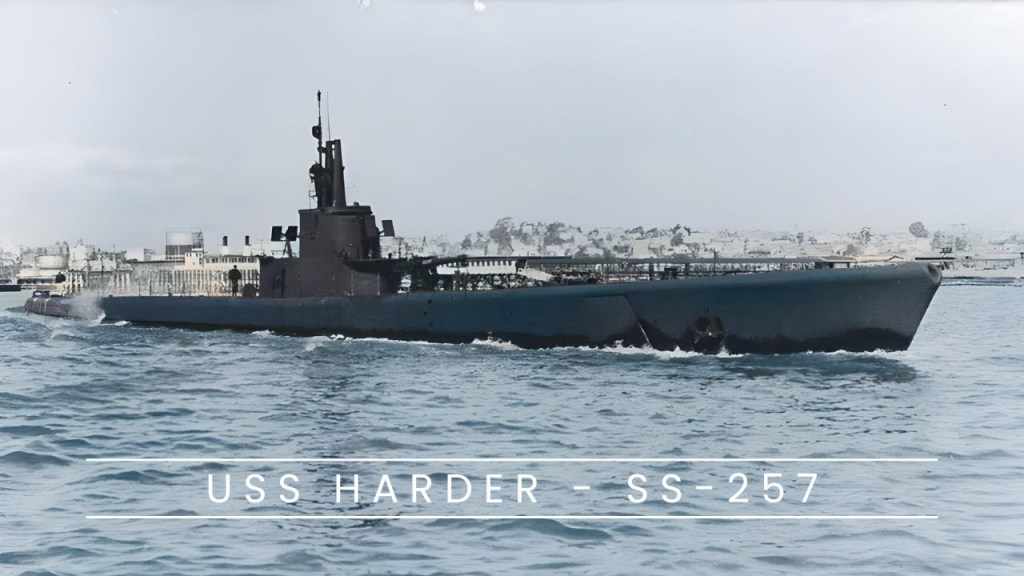
He assumed command of USS HARDER (SS-257) upon her commissioning on December 2, 1942. Commander Dealey guided his submarine deep into enemy waters, wreaking destruction on Japanese shipping.

On HARDER’S fifth war patrol, Commander Dealey pressed home a series of bold and daring attacks, both surfaced and submerged, which sank three enemy destroyers and damaged two others. For his exceptional gallantry in these actions, Commander Dealey received the Medal of Honor.

The CITATION reads:

“For conspicuous gallantry and intrepidity at the risk of his life above and beyond the call of duty as Commanding Officer of the USS HARDER during her 5th War Patrol in Japanese-controlled waters. Floodlighted by a bright moon and disclosed to an enemy destroyer escort which bore down with intent to attack, CDR Dealey quickly dove to periscope depth and waited for the pursuer to close range, then opened fire, sending the target and all aboard down in flames with his third torpedo. Plunging deep to avoid fierce depth charges, he again surfaced and, within 9 minutes after sighting another destroyer, had sent the enemy down tail first with a hit directly amid ship. Evading detection, he penetrated the confined waters off Tawi Tawi with the Japanese Fleet base 6 miles away and scored death blows on 2 patrolling destroyers in quick succession. With his ship heeled over by concussion from the first exploding target and the second vessel nose-diving in a blinding detonation, he cleared the area at high speed. Sighted by a large hostile fleet force on the following day, he swung his bow toward the lead destroyer for another “down-the-throat” shot, fired 3 bow tubes and promptly crash-dived to be terrifically rocked seconds later by the exploding ship as the HARDER passed beneath. This remarkable record of 5 vital Japanese destroyers sunk in 5 short-range torpedo attacks attests the valiant fighting spirit of CDR Dealey and his indomitable command.”

He was lost with his submarine during its sixth war patrol, when HARDER was sunk August 24, 1944 by a depth charge attack off Luzon, Philippines.

After nearly 80 years, the wreck of the USS Harder has been found in May 2024

Tolling of the Boats Lost in June

Smallwood Hall

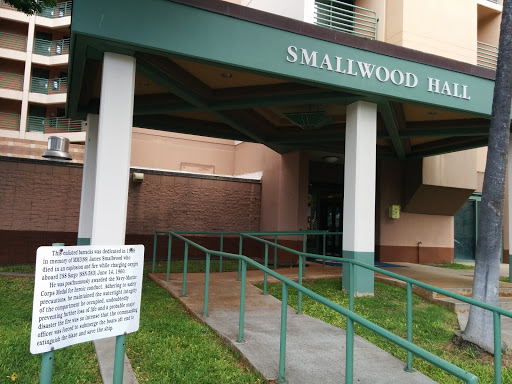
On 15 April 1987, Submarine Base Pearl Harbor reopened a newly renovated 17-story Bachelor Enlisted Quarters capable of housing 516 personnel. This building was dedicated on 26 February 1988 in the memory of MM3 (SS) James E. Smallwood for the sacrifice of his life while performing his duties in the service of his country.

MM3(SS) James Smallwood was the duty auxiliaryman on USS Sargo in 1960 and was taking aboard oxygen from a pierside truck/trailer.

The connection was in the stern room with the manifold behind the watertight door in the forward port corner of the room. Although the exact circumstances will not be known, a high pressure high flow leak occurred.

Smallwood, realizing the danger to himself and the ship, woke the only other man in the room and told him to get out. (The stern room had some berthing). He then attempted to isolate the leak. Just as the man he awakened cleared the hatch, the room erupted in an oxygen rich explosion/fire fed by any flammable material and the high pressure oxygen. Smallwood died instantly in the room. The crew attempted to fight the fire and eventually, unable to enter the room and with the temperature of the aft bulkhead of the engine room high enough to blister and smoke the paint in the engine room even with hoses playing water on it, the decision was made to breast out from the wharf (S1B) and submerge the stern. This was done, the fire went out.

MM3 (SS) James E. Smallwood was posthumously awarded the Navy-Marine Corps Medal for heroic conduct.

The CITATION reads:

“For heroic conduct on June 14, 1960 while serving on board U.S.S. SARGO (SSN-583) moored at the Submarine Base, Pearl Harbor, Hawaii. While supervising the operation of charging high pressure oxygen into the SARGO’s storage tanks, SMALLWOOD firmly and meticulously carried out the ship’s safety precautions requiring isolation of the charging compartment from the remainder of the vessel. Aware of the potential danger involved, he denied entry of several of his shipmates to the Stern Room and kept the watertight door and bulkhead flappers shut. SMALLWOOD lost his life in a raging fire which broke out during the oxygen charge. Through his steadfast adherence to safety precautions, he undoubtedly prevented further loss of life and a probable major disaster. His courage and outstanding devotion to duty were in keeping with the highest traditions of the United States Naval Service.”

Tolling of the Boats Lost in February

Take her down!

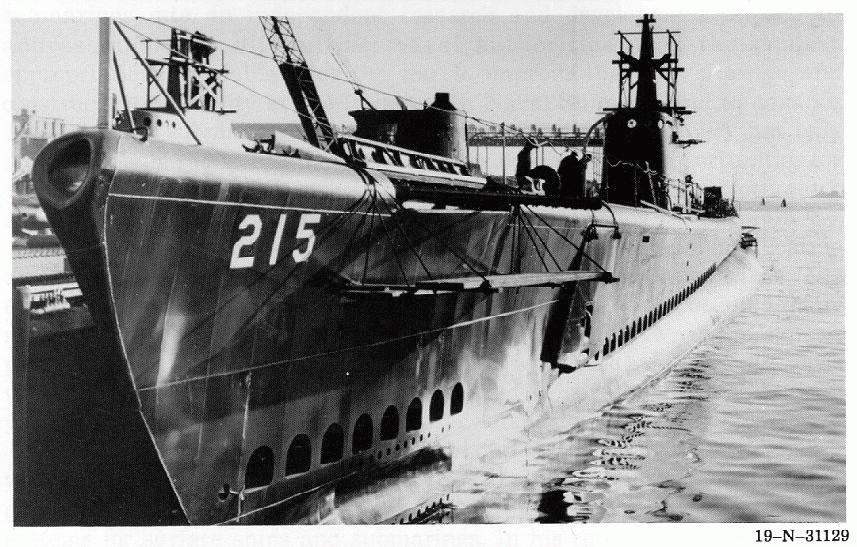
CDR Gilmore was the first U.S. submariner to receive the Medal of Honor in World War II. He was awarded this medal for his actions while serving as Commanding Officer of USS Growler (SS 215).

CDR Gilmore was the first U.S. submariner to receive the Medal of Honor in World War II. He was awarded this medal for his actions while serving as Commanding Officer of USS Growler.

On February 7 Growler sighted a ship in the murky darkness. CDR Gilmore readied torpedoes and closed for an attack. At a range of approximately 2000 yards, the target, the 2,500 ton patrol boat Hayasaki, spotted Growler. The swift ship reversed course and charged the submarine. Gunfire and the groans of the twisted hulls roared in the night. CDR Gilmore, the last man on the bridge, shouted through the open conning tower hatch, “Take her down!” He had chosen to sacrifice himself rather than further jeopardize his boat.

CDR Howard W. Gilmore lost his life in a selfless act of heroism that has become one of the most inspiring legends of the Submarine Force.

“For conspicuous gallantry and valor above and beyond the call of duty as commanding officer of the USS GROWLER during her fourth war patrol in the southwest Pacific from 10 January to 7 February 1943. Boldly striking at the enemy in spite of continuous hostile air and anti-submarine patrols, CDR Gilmore sank one Japanese freighter and damaged another by torpedo fire, successfully evading severe depth charges following each attack. In the darkness of night on 7 February, an enemy gunboat closed range and prepared to ram the GROWLER.

CDR Gilmore daringly maneuvered to avoid the crash and rammed the attacker instead, ripping into her port side and bursting wide her plates. In the terrific fire of the sinking gunboat’s heavy machineguns, CDR Gilmore calmly gave the order to clear the bridge, and refusing safety for himself, remained on deck while his men preceded him below. Struck down by a fusillade of bullets and having done his utmost against the enemy, in his final living moments, CDR Gilmore gave his last order to the officer of the deck, “Take her down”. The GROWLER dove; seriously damaged but under control. She was brought safely to port by her well trained crew inspired by the courageous fighting spirit of their dead Captain.”

Tolling of the Boats Lost in January

Providence of a Donation

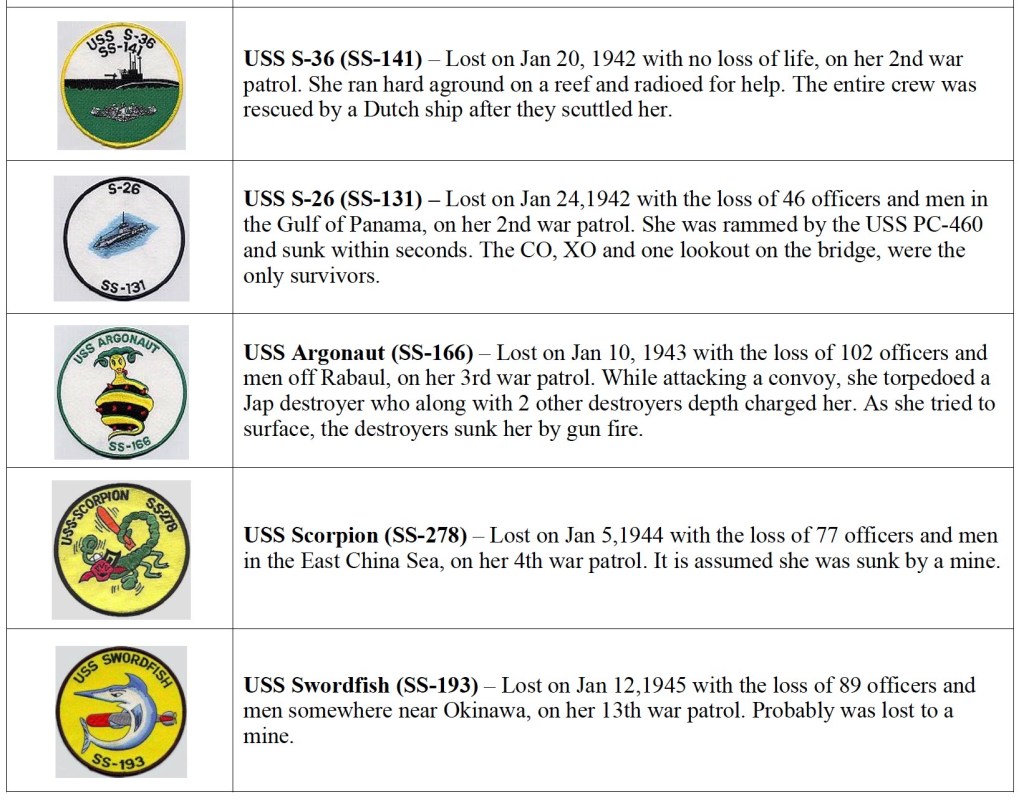
On January 10, 1943 the entire crew of 102 was lost as the USS Argonaut (SS-166) was sunk by Japanese destroyers.

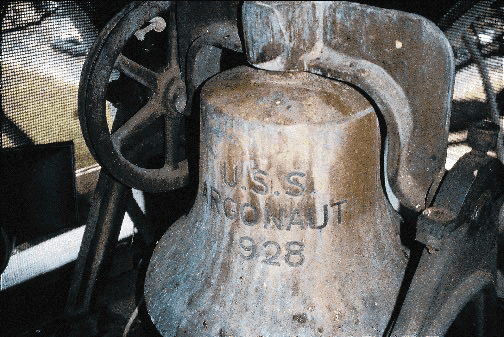
By providence the crew donated the ship’s bell to the under construction Submarine Memorial Chapel, just before the submarine put to sea for her last patrol.

The bell still hangs and rings in the steeple today, and each time the Argonaut’s bell tolls, it is in remembrance of all Sailors and lost crews at a time of war or peace.

“I am the voice of the USS ARGONAUT (SS 166). I was later classified APS 1 (submarine transport), and I was the largest of the U.S. submarines to participate in World War II. I was over 380 feet long and had a beam of over 33 feet. I was originally built as a minelayer, and I had two mine laying chutes and special tubes built into a large stern room. In 1942, I was converted to a cargo carrying and troop transport submarine, my mine laying gear was removed, and my stern room was fitted for troop berthing. I transported Marines for the Makin Island raid. In January 1943 I was on patrol near Rabaul when I was attacked by two Japanese destroyers who were avenging the torpedoing of a third destroyer in a convoy. The two destroyers hammered the water with depth charges; and my bow thrust above the surface and remained there for sometime as destroyers repeatedly fit it with gunfire. Finally I slid with my crew of 105 102 men into the depths of the Pacific.”

Tolling of the Boats Lost in September

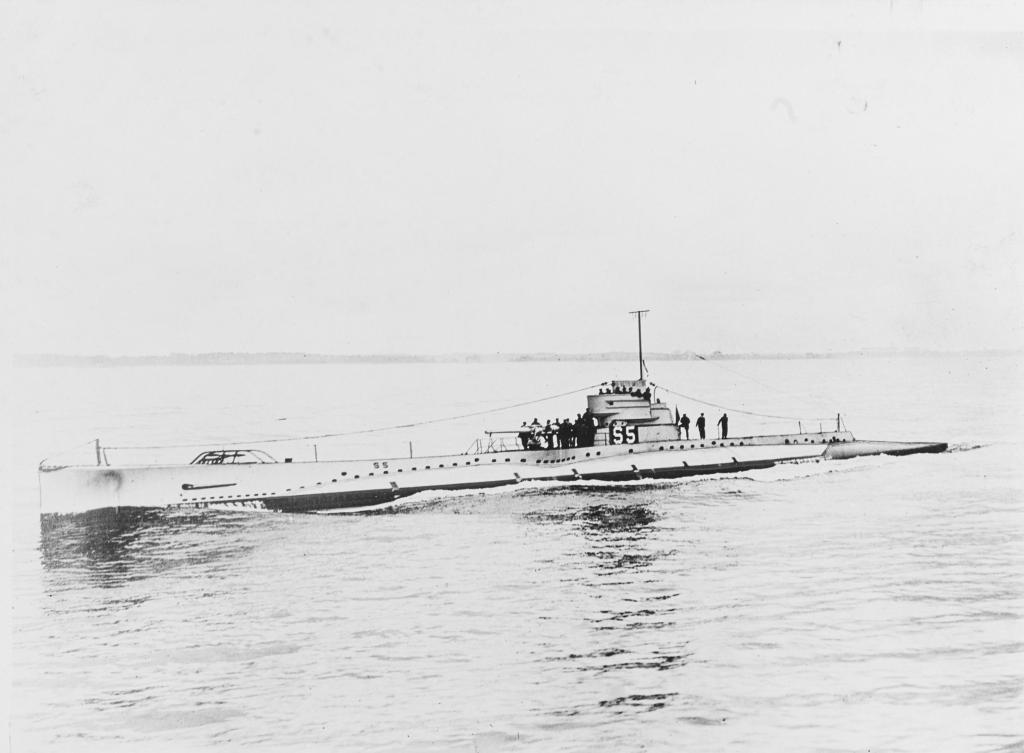
The S-5 rescue was a miraculous story of great determination and resourcefulness by the crew.

S-5 sank when the forward torpedo room was accidentally flooded preventing a successful surfacing. In a desperate move all main ballast tanks were blown to bring the stern out of the water. The result was more than 60 degree down angle with the nose stuck in the mud; 17 feet of the stern extended out of the water. 

The crew was literally walking on the bulkheads; the decks had become bulkheads. There were 34 men on board, crowded into the aft compartments. All kinds of problems were overcome, but they were still trapped with no electricity other than flashlights. The commanding officer, LCDR “Savvy” Cooke, crawled into the tiller room with two chiefs. After eight hours of exhausting effort, using a breast hand drill, they drilled a ¾ inch hole through the pressure hull.

Several more holes were drilled and connected with handsaws and chisels. The effort produced a hole of 1 ½ inches by 4 inches. It was large enough to push a stick with the captain’s shirt on it out of the hole. By then the main problem was putrid air and lack of fresh water. After a painful wait, SS Alanthus’s Captain Johnson was attracted by the odd sight. The ship’s captain approached this small Tower of Pisa in a rowboat. 

Using the small opening the following conversation took place:

Johnson: “What ship is this?”

Cooke: “S-5. U.S. Navy”

Johnson: “Who is speaking?”

Cook: “LCDR Charles Cook, commanding.”

Johnson: “Where is your destination?”

Cook: “To Hell by Compass!”

Whereupon both laughed.

This plate was cut from the stern of the USS S-5 to provide egress for the crew from the damaged submarine. The plate reads:

“Removed from the United States Submarine S-5 to allow the crew of that vessel to escape after being imprisoned for 37 hours, the S-5 while engaged in diving exercises flooded a forward compartment and sank at 2:00 pm September 1, 1920 in 165ft of water. After repeated efforts, the crew managed to bring the stern of the vessel to the surface. The vessel was lying at an angle of 60 degrees with the bow resting on the bottom. The crew managed to cut a small hole in the hull and by an improvised signal attracted the attention of the passing steamer ALANTHUS. Later the Pan-American steamer GEORGE W. GOETHALS arrived on the scene. The chief engineer of that that vessel, assisted by the chief engineer of the ALANTHUS, worked with a ratchet drill and chisel, removed this plate at 3:00am September 3, 1920 and the crew of S-5 numbering 34 men were rescued.“

Tolling of the Boats Lost in July

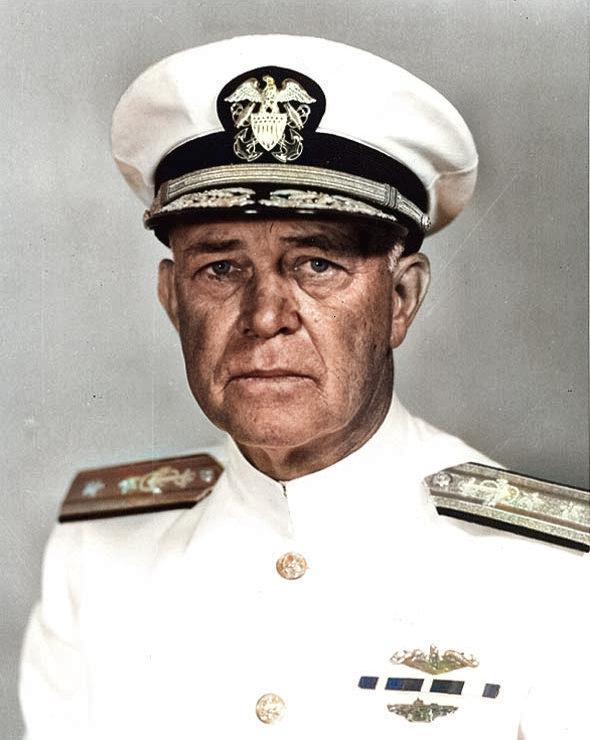
Admiral Lawson P. Ramage

Lawson Paterson Ramage was born on January 14, 1909 in Monroe Bridge, Massachusetts. He graduated from the U.S. Naval Academy in 1931 and was subsequently commissioned as an Ensign in the U.S. Navy. From 1931 to 1935, he served onboard several ships, including the USS S-29 (S-134).

During World War II, Admiral Ramage was highly decorated for his actions in combat — being awarded the Silver Star, two Navy Crosses, and the Medal of Honor. Admiral Ramage was stationed at Pearl Harbor on the staff of the Commander, Submarines Pacific during the Japanese attack in December 1941. In early 1942, he served on his first patrol of the war as the Navigator of the USS GRENADIER. He was awarded the Silver Star as a member of the GRENADIER’S crew for “conspicuous gallantry and intrepidity” while patrolling enemy waters. In June 1942, he assumed his first command — the USS TROUT. Under his command TROUT sank three ships during his four war patrols. He was awarded the Navy Cross for valor for actions while in command of the TROUT at Midway, Truk, the Solomons, and the South China Sea. In May 1943, he assumed command of the new BALAO-class submarine, the USS PARCHE (SS-384). On July 31, 1944, CDR Ramage commanded the PARCHE in a daring dawn assault on a heavily-escorted Japanese convoy, during which the PARCHE sunk two ships and badly damaged three others. For this he was awarded the Medal of Honor which was personally presented to him by President Franklin D. Roosevelt on January 10, 1945.

The CITATION reads:

“For conspicuous gallantry and intrepidity at the risk of his life above and beyond the call of duty as commanding officer of the U.S.S. PARCHE in a predawn attack on a Japanese convoy, 31 July 1944. Boldly penetrating the screen of a heavily escorted convoy, CDR. Ramage launched a perilous surface attack by delivering a crippling stern shot into a freighter and quickly following up with a series of bow and stern torpedoes to sink the leading tanker and damage the second one. Exposed by the light of bursting flares and bravely defiant of terrific shellfire passing close overhead, he struck again, sinking a transport by two forward reloads. In the mounting fury of fire from the damaged and sinking tanker, he calmly ordered his men below, remaining on the bridge to fight it out with an enemy now disorganized and confused. Swift to act as a fast transport closed in to ram, CDR. Ramage daringly swung the stern of the speeding PARCHE as she crossed the bow of the onrushing ship, clearing by less than 50 feet but placing his submarine in a deadly crossfire from escorts on all sides and with the transport dead ahead.

Undaunted, he sent 3 smashing “down the throat” bow shots to stop the target, then scored a killing hit as a climax to 46 minutes of violent action with the PARCHE and her valiant fighting company retiring victorious and unscathed.”

The Parche Memorial stands as a lasting tribute to CDR Ramage and the decisive fighting spirit that won the war.

Tolling of the Boats Lost in May

The Momsen Lung

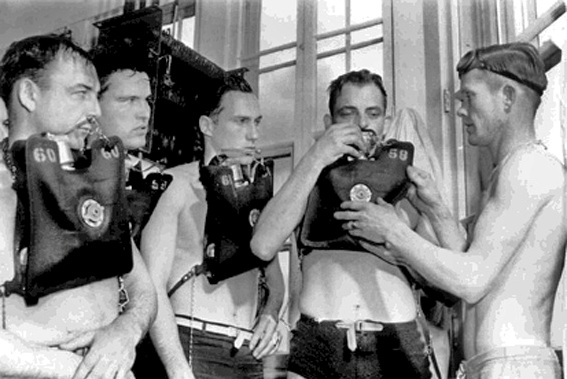
The Momsen lung was a early underwater rebreather used prior to and during World War II by American submariners as emergency escape gear.

While serving with the Submarine Safety Test Unit, Charles Momsen began working on a device to help sailors surface. It was officially called the Submarine Escape Lung, it consisted of an oblong rubber bag that recycled exhaled air. The press enthusiastically received the device and dubbed it the Momsen Lung, a name that stuck.

The Lung contained a canister of soda lime, which removed poisonous carbon dioxide from exhaled air and then replenished the air with oxygen. Two tubes led from the bag to a mouthpiece: one to inhale oxygen and the other to exhale carbon dioxide. The device hung around the neck and strapped around the waist. Besides providing oxygen for the ascent, it also allowed a submariner to rise slowly to the surface, thus avoiding decompression sickness (“the bends”).

Between June 1929 and September 1932, then-Lt. Momsen developed the lung with Chief Gunner’s Mate Clarence L. Tibbals and Frank M. Hobson, a civilian employee of the Bureau of Ships. In 1929, Momsen received the Distinguished Service Medal for personally testing the device at a depth of 200 feet (61 m). The Lung saved its first lives in October 1944, when eight submariners used it to reach the surface after Tang (SS-306) sank in 180 feet (55 m) of water in the East China Sea. The Lung was eventually supplemented by the Steinke hood and free-ascent techniques.

Tolling of the Boats Lost in April

USS Thresher (SSN 593)

On 10 April 1963, while engaged in a deep test dive, the nuclear submarine USS THRESHER (SSN 593) was lost at sea with all persons aboard. Based on the findings of a Court of Inquiry and the subsequent Joint Congressional Committee on Atomic Energy hearings into the loss of the THRESHER, it was concluded that a flooding casualty in the engine room, resulting from a piping failure in one of the salt water systems, was the most probable cause for the loss.

A THRESHER Design Appraisal Board determined that, although the basic design of this submarine class was sound, measures should be taken to improve the level of confidence in the material condition of the hull integrity boundary and in the ability of submarines to control and recover from flooding casualties. Thus the genesis of the Level I/SUBSAFE Program. The program establishes control for procurement, inspection, certification, test, identification, documentation, record control, storage, issue, turn-in, recall and disposal. Level I/SUBSAFE Stock Program materials are intensively managed and controlled. They require certification with traceable objective quality evidence. Items include submarine hull pressure boundary fittings, high pressure air and gas components, high pressure/temperature steam system components and selected safety related equipment on surface ships and submarines.

Tolling of the Boats Lost in March

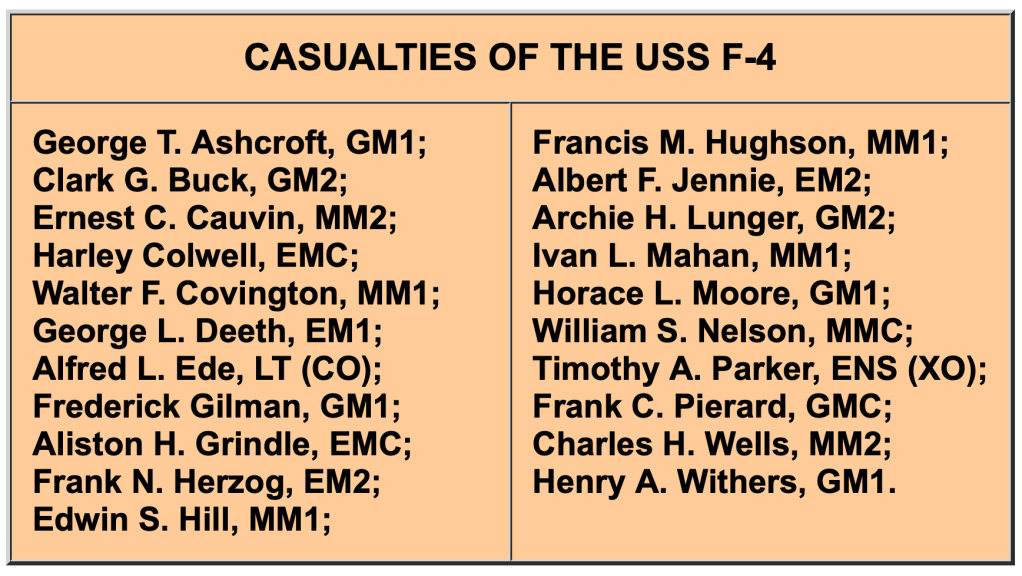
Loss of F-4 Leads to Creation of Submarine School

The USS F-4 was an “F” class submarine, and was built in Seattle, Washington. Originally named Skate, her name was changed to F-4 in November 1911, while she was under construction. The new submarine was commissioned in May 1913 and operated along the U.S. west coast until mid-1914, when she was transferred to Hawaii. On 25 March 1915, during a routine dive a few miles off Honolulu, F-4 sank in 51 fathoms of water, with the loss of her 21 crew members.
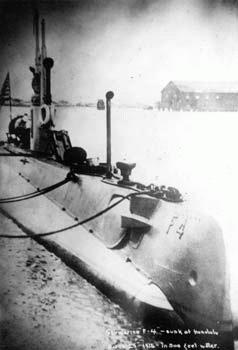
The USS F-4, seen here before it went down 85 years ago, was the United States’ first tragic submarine sinking.

The ensuing rescue attempts and successful recovery of the sunken submarine were major events in the history of Navy diving and salvage. Raising F-4 was done under the technical direction of Naval Constructor Julius A. Furer in April-August 1915. Initially, cables were dragged under her hull and she was lifted and towed into shallower water during May. While taking part in the extremely deep diving activities involved in this phase of the operation, Navy Diver Frank W. Crilley performed an act of heroism for which he received the Medal of Honor.

As F-4‘s weakened hull could not withstand further measures of the type used in the initial lifting, the final part of the recovery effort had to await construction of special salvage pontoons. On 29 August 1915, after the pontoons had been brought to Hawaii from the west coast, and following extensive additional diving work, the submarine was raised from the bottom and taken into Honolulu Harbor for dry-docking. Examination of the wreck revealed design defects that were corrected in existing and future Navy submarines, greatly enhancing the safety of the undersea service. F-4 was not repaired. Her remains were buried near the Pearl Harbor Submarine Base in 1940.
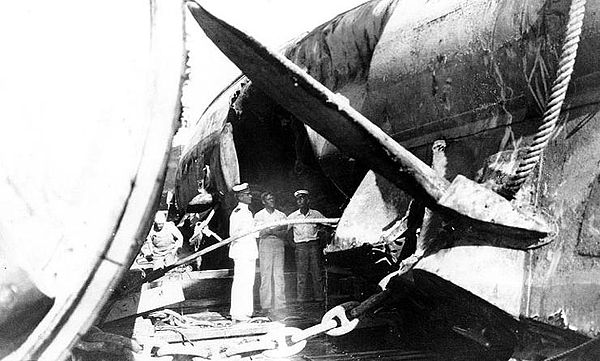
U.S. Navy inspection personnel examining the large implosion hole in F-4‘s port side in drydock at Honolulu, Territory of Hawaii, ca. late August or early September 1915. F-4 had been raised from 306 ft (93 m) of water and towed into port. This view was taken from off the port bow, showing F-4‘s port-side diving plane in the center. She is upside down, rolled to starboard approximately 120° from the vertical.

On another historical note, this great tragedy in the Submarine Force resulted in the creation of a school dedicated to teaching the art of submarine warfare. The sinking of the submarine F-4 off the coast of Hawaii with the loss of all hands in 1915 caused the Secretary of the Navy to direct the establishment of a formal school to instruct submariners in the operation and maintenance of these specialized boats. The commanding officer of the Submarine Base in New London, Connecticut, was directed to establish the Naval Submarine School, which began operation on 1 July 1916. After six months of training, the first officer class graduated on 23 December 1916. The first enlisted class graduated one year later.
Tolling of the Boats Lost in December

A day that will live in infamy

The attack on Pearl Harbor (called the Hawaii Operation or Operation Z by the Japanese Imperial General Headquarters, and the Battle of Pearl Harbor by some Americans) was a surprise military strike conducted by the Imperial Japanese Navy against the United States Naval Base at Pearl Harbor, Hawaii on the morning of December 7, 1941. The next day the United States declared war on Japan resulting in their entry into World War II. The attack was intended as a preventive action in order to keep the U.S. Pacific Fleet from influencing the war that the Empire of Japan was planning in Southeast Asia, against Britain and the Netherlands, as well as the U.S. in the Philippines. The base was attacked by Japanese aircraft (a total of 353 planes, in two waves) launched from six aircraft carriers.