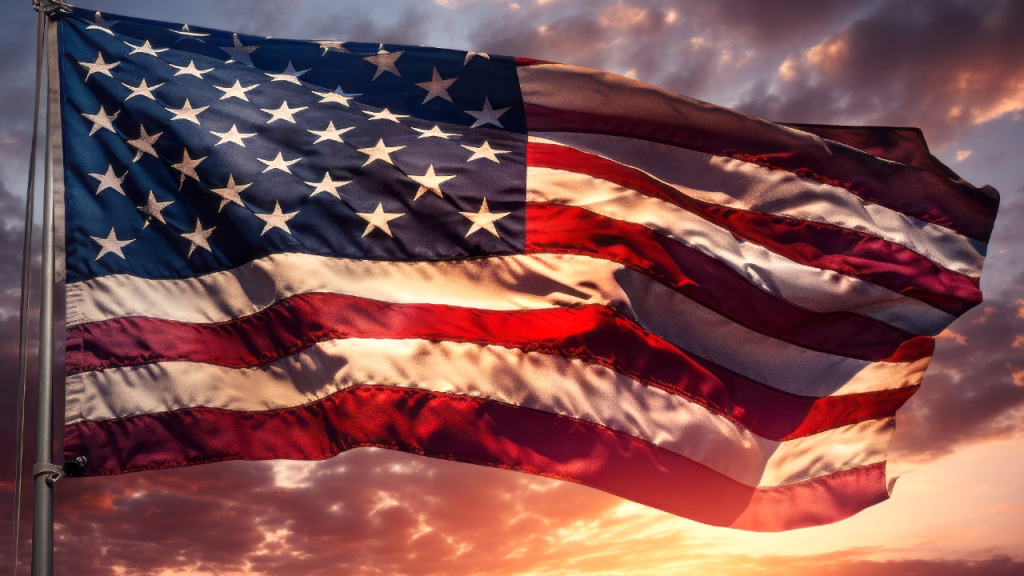
On May 30, 1916, President Woodrow Wilson issued a presidential proclamation establishing a national Flag Day on June 14. Many Americans celebrate Flag Day by displaying the Red, White and Blue in front of homes and businesses. The day commemorates the adoption of the Stars and Stripes as the official flag of the United States.
My Name is Old Glory
I am the Flag of the United States of America – My name is Old Glory! I fly atop the world’s tallest buildings. I stand watch in America’s halls of justice. I fly majestically over great institutions of learning. I stand guard with the greatest military power in the world. Look up and see me! I stand for Peace, Honor, Truth, and Justice – I stand for Freedom. I am confident, I am arrogant, I am proud! When I am flown with my fellow banners, my head is a little higher, my colors a little truer. I bow to no one – I am recognized all over the world. I am Worshipped, I am Loved, and I am feared! I have fought in every battle of every war for more than two hundred years Gettysburg, Shiloh, Appomattox, San Juan Hill, the trenches of France, the Argon Forest, Anzio, Rome, Pearl Harbor, the beaches of Normandy, Guam, Okinawa, Japan, Korea, Viet Nam, the Persian Gulf, and a score of other places long forgotten by all but those who were there with me. I was there. I led my Soldiers, Sailors, Airmen and Marines, I followed them, and watched over them. They love me! I was on a small hill on Iwo Jima. I was dirty, battle worn, and tired, but my Soldiers cheered me, and I was PROUD! I have been soiled, burned, torn, and trampled in the streets of countries that I have helped set free. It does not hurt, for I am invincible. I have been a silent witness to all of America’s finest hours. My finest hour comes, when I am torn into strips to be used as a bandage for my wounded comrades on the field of battle, when I fly at half mast to honor my Soldiers, Sailors, Airmen, and Marines, when I lie in the trembling arms of a grieving mother at the graveside of her fallen son or daughter. I am proud – My name is Old Glory! Long may I wave, dear God. Long may I wave.
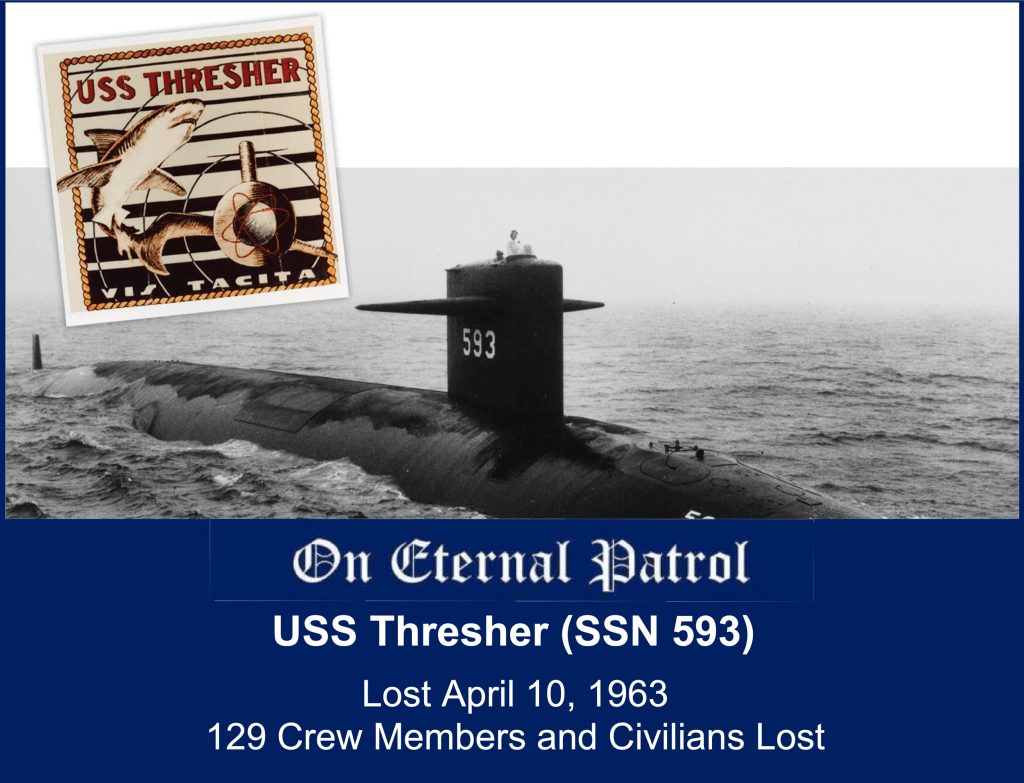
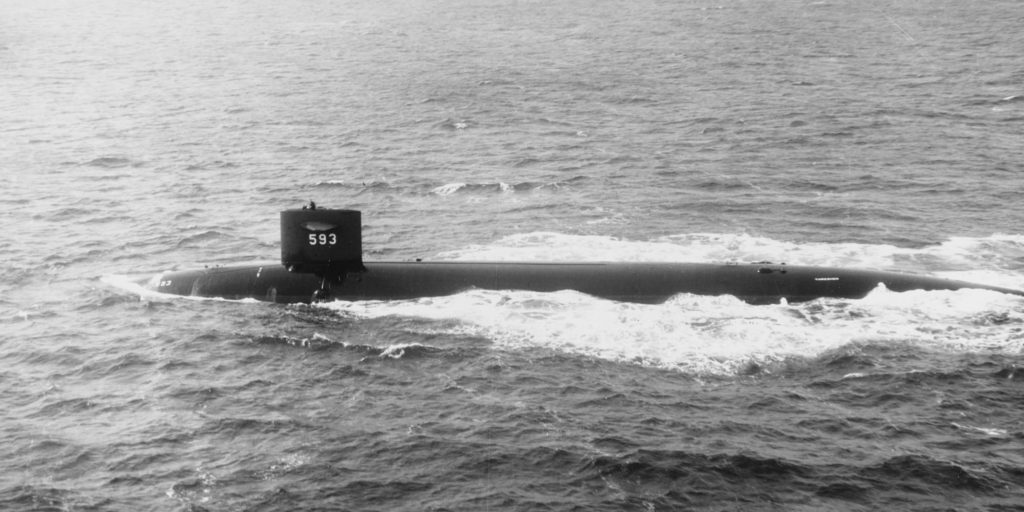
USS Thresher (SSN 593) was laid down on 28 May 1958 by the Portsmouth (N.H.) Naval Shipyard; launched on 9 July 1960; sponsored by Mrs. Frederick B. Warder; and commissioned on 3 August 1961, Commander Dean W. Axene in command.
Following trials the nuclear attack submarine took part in Nuclear submarine Exercise (NUSUBEX) 3-61 off the northeastern coast of the United States from 18 to 24 September.
On 18 October; the submarine headed south along the east coast. After calling at San Juan, Puerto Rico, she conducted further trials and test-fired her torpedo system before returning to Portsmouth on 29 November. The ship remained in port through the end of the year and spent the first two months of 1962 evaluating her sonar system and her Submarine Rocket (SUBROC) system. In March, the submarine participated in NUSUBEX 2-62, an exercise designed to improve the tactical capabilities of nuclear submarines, and in anti-submarine warfare training with Task Group ALPHA.
Off Charleston, the ship undertook operations observed by the Naval Antisubmarine Warfare Council, before she returned briefly to New England waters from whence she proceeded to Florida for SUBROC tests. However, while mooring at Port Canaveral, the submarine was accidentally struck by a tug which damaged one of her ballast tanks. After repairs at Groton, CT, by the Electric Boat Company, the ship returned south for more tests and trials off Key West. Thresher then returned northward and remained in dockyard hands through the early spring of 1963.
In company with SKYLARK (ASR 20), Thresher put to sea on 10 April 1963 for deep-diving exercises. In addition to her 16 officers and 96 enlisted men, the submarine carried 17 civilian technicians to observe her performance during the deep-diving tests.
Fifteen minutes after reaching her assigned test depth, the submarine communicated with SKYLARK by underwater telephone, apprising the submarine rescue ship of difficulties. Garbled transmissions indicated that – far below the surface – things were going wrong. Suddenly, listeners in SKYLARK heard a noise “like air rushing into an air tank” – then, silence.
Efforts to reestablish contact with Thresher failed, and a search group was formed in an attempt to locate the submarine. Rescue ship RECOVERY (ARS 43) subsequently recovered bits of debris, including gloves and bits of internal insulation. Photographs taken by bathyseaph TRIESTE proved that the submarine had broken up, taking all hands on board to their deaths in 1,400 fathoms of water, some 220 miles east of Boston.
THRESHER was officially declared lost in April 1963.
Submarine Safety (SUBSAFE) – After the Thresher incident, a court of inquiry and the Joint Congressional Committee on Atomic Energy hearings concluded that a flooding casualty in the engine room, resulting from a piping failure in one of the sea-water systems, was the most probable cause. On 3 June 1963, the SUBSAFE program was established within the Bureau of Ships to develop the Submarine Safety Certification Criterion, outlining the minimum actions required to provide a satisfactory level of confidence in the integrity of submarine systems and the adequacy of certain depth-control capabilities. The first effort to apply additional rigor in design, manufacturing, operation, and maintenance to a subset of critical systems within the nuclear submarine, the program’s goal was to provide maximum reasonable assurance of hull integrity to preclude flooding, and the operability and integrity of critical systems and components to control and recover from a flooding casualty, should one occur. The Bureau of Ships issued a certification criterion addressing design, material, fabrication, testing, and record keeping on 20 December 1963.
Since the inception of the SUBSAFE Program in 1963, only one submarine has been lost. USS Scorpion (SSN 589) was lost in May 1968 with 99 officers and men aboard. She was not a SUBSAFE certified submarine and the evidence indicates that she was lost for reasons that would not have been mitigated by the SUBSAFE Program. We have never lost a SUBSAFE certified submarine.
The Spanish-American War paved the way to Hawai’i. Within a decade, the U.S. not only annexed Hawai’i in 1898, but also the Philippine Islands and Guam. Thus, American isolationism died and ushered in a new era in U.S. naval history.
The acquisition of Hawai’i not only advanced Admiral Alfred Thayer Mahan’s program for American control of the Pacific but promoted trade and commerce. Mahan had urged acquisition of Hawai’i back in 1893. He was a naval strategist whose historical studies convinced him of the supreme importance of naval power and of the imperative necessity for the U.S. to strengthen its position in a highly competitive world.
Mahan advocated a big peacetime Navy. The acquisition of bases was a requisite of sea power. Mahan’s theories captivated young Assistant Secretary of the Navy, Theodore Roosevelt. So when Roosevelt became president in 1901, he stressed the importance of bolstering up America’s naval power. However, in 1903 there was not a single American naval base in Asiatic waters; ships of the Asiatic Squadron were dependent on dockyards at Nagasaki and Hong Kong. With the construction of Roosevelt’s large fleet, dockyards and coaling stations became vital.
These stations were part of the base facilities necessary to make naval activities in the Pacific self-sufficient in an emergency. At the time, only two ships in the Navy were capable of steaming from San Francisco to Manila without refueling. Development of Hawai’i was imperative. However, a base was desirable in the Philippines to support America’s policy toward China. U.S. defense officials could not agree on the best location for the establishment of a base in the Philippines. The Navy’s choice in January 1901 was Subic Bay. The Army preferred Cavite in Manila Bay for the naval base. Funds were appropriated for a base at Olongapo in Subic Bay In 1904. But funds for the development of a base at Pearl Harbor were suppressed.
In 1906, a board, headed by Secretary of War Taft, investigated the development of naval bases. The board found Pearl Harbor to be a port of secondary strategic importance. They found Puget Sound, San Francisco Bay, and Subic Bay to be strategically our most Important ports in the Pacific. However, pressure mounted for recognition of Hawai’i. The Navy Department sought development at Pearl Harbor.
In 1907, the U.S. Navy stationed the first submarines overseas in the Pacific. Two A-class boats, the A-6 and A-7, were disassembled for transportation to the Philippine Islands on board the USS Caesar (AC-14), a collier. Finally, on 13 May 1908, Congress appropriated funding to commence “immediate” development of Pearl Harbor. This decision to build a major base at Pearl Harbor was sound in that it clinched the American position in the central and eastern Pacific.
In 1913, five C-class submarines made a historic 700-mile voyage from Guantanamo Bay, Cuba, to Cristobal, Panama Canal Zone. These little submarines, with a displacement of only 238 tons and powered by small gasoline engines, completed the cruise without any difficulty. Up to that time this was the longest cruise ever undertaken by any U.S. submarines. The overall success of this venture elevated the submarine out of the role as a purely defense weapon. Prior to this, the submarine’s principal role had been for coastal and harbor defense.
The trans-Caribbean undertaking offered a new perspective for submarines. The Navy Department was taking another look at the possibilities of the submarine. The feat encouraged Secretary of the Navy, Josephus Daniels, to consider expanding submarine activities to Hawai’i.
Several months later, with the installation of German-type diesel engines in the new E-class, submarines were afforded an improved status in safety, speed, and radius of action. Even though Hawai’i did not possess adequate facilities to maintain submarines, the positioning of submarines in Hawai’i was not thwarted.
Prior to the outbreak of World War I, little consideration was given to the care and maintenance of submarines, except at primary navy yards and stations. No definite plans were laid down for the establishment of bases for the maintenance of submarine detachments outside the established navy yards.
SUBMARINES IN HAWAI’I
Four F-class submarines were selected for duty in Hawai’i. The submarines were transferred from the First Submarine Division in San Pedro, California to Mare Island Navy Yard for preparation. Incapable of making the 2400-mile trip on their own, the four boats would be towed to Hawai’i by two armored cruisers, the USS South Dakota (CA-9) and USS West Virginia (CA-6).
At Mare Island, the submarines underwent a general overhaul, obtained special fittings and preliminary training of the crew for the special transoceanic crossing. Finally the eventful day arrived. The two cruisers upped anchor shortly before dawn on 16 July 1914 and stood down the bay from Mare Island. Steaming through the Golden Gate, the two ships rendezvoused off-shore near the Farallon Islands with two of the F-boats. Two separate crossings would be required.
Once in position, the cruisers passed towlines to the USS F-1 (SS-20) and USS F-3 (SS-22). The tedious crossing was completed on 1 August. Upon refueling, the two cruisers returned to California for the two remaining submarines. On 15 August, the USS F-2 (SS-21) and USS F-4 (SS-23) were taken in tow and by nightfall of 24 August had safely reached Hawai’i.
Another component that would make up the balance of the First Submarine Flotilla in Hawai’i was the support vessel USS Alert (AS-4), an old 1874 Iron gunboat. In 1911, the Alert was converted into a submarine tender and in 1914 chugged across the Pacific to a new homeport in Hawai’i.
The four submarines and Alert moored at Pier 5 (the old Flat Iron Pier) across Ala Moana Road from the Old Naval Station in downtown Honolulu. Bachelor officers from the submarine flotilla were quartered on board Alert and the rest of the crew housed in nearby barracks. All hands messed on board Alert.
In those pioneer days, submarines remained tied close to their tenders. Training operations were limited and generally conducted out of Honolulu Harbor seldom exceeding ten miles, the distance an F-boat could travel on the surface in an hour.
On 25 March 1915, tragedy struck! The F-4, under the command of Lieutenant Alfred L. Ede sank off Honolulu Harbor in 305 feet of water during a training dive. All hands perished!Extensive salvage efforts were undertaken and by August the F-4 was finally raised to determine the cause of the loss.
Upon completion of the Board of Inquiry’s investigation, the hulk was towed from Honolulu to Pearl Harbor and sunk in the loch between Quarry Point and Kuahua Island. In 1940, when new piers were to be erected in this vicinity, a dredge dug a deep ditch alongside the wreck and the F-4 rolled into it — where it remains to this day. The remaining F-boats continued operating on a limited basis and would eventually be towed back to the mainland.
THE NEED FOR A SUBMARINE BASE
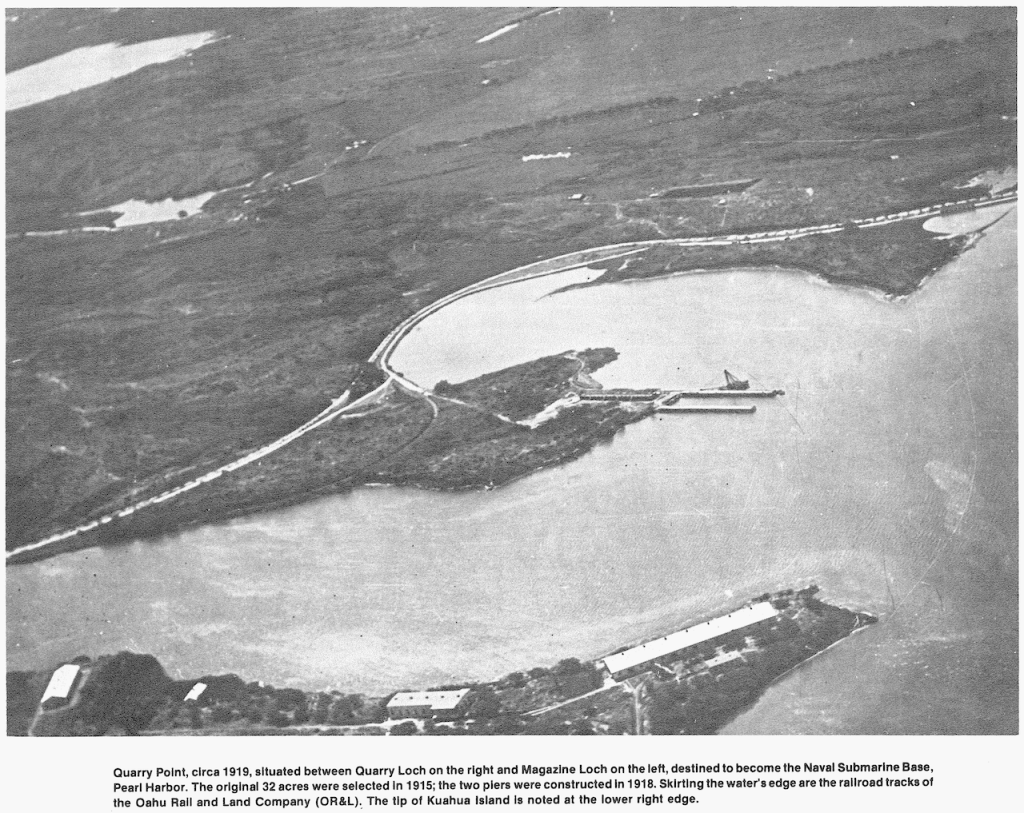
Studies were being conducted by the Bureau of Yards and Docks with a view toward the development of a typical submarine base. The plan detailed specific types of shop buildings, barracks, and piers required for a submarine base of the time. Secretary of the Navy Daniels submitted a letter to the Navy’s General Board concerning submarine shore bases. The letter stipulated the Intentions of the Secretary to “submit to the coming Congress estimates for the construction of submarine shore bases.” The plans for a typical submarine base were approved in September 1915. Hawai’i was a part of this plan on 14 October 1915, Admiral George Dewey, President of the Navy’s General Board, signed an endorsement concurring with the recommendation that “Quarry Point is the best location for the proposed submarine base at Pearl Harbor.”
FIRST SUBMARINES IN PEARL HARBOR
In October 1915, units comprising Submarine Flotilla Three departed San Francisco for duty in Hawai’i. This flotilla was composed of four K-class submarines, the K-3, K-4, K-7 and K-8. The flotilla operated briefly from Honolulu Harbor and in November shifted operations to Pearl Harbor. The facilities at the Old Naval Station in Honolulu were inadequate for submarine operations. A temporary base was established at Pearl Harbor on Kuahua Island, which was later commissioned as the Naval Ammunition Depot and called Magazine Island. Today this is the site of the Naval Supply Center.
Again the submarine tender Alert provided support. The K-boats conducted torpedo and diving tests, and participated in operations developing tactics in submarine warfare. But when America’s Involvement in World War I called for increased naval activity, the K-boats were reassigned. On 31 October 1917, the K-boats departed Hawai’i for Key West, Florida. Hawai’i was without submarines.
DEVELOPMENT OF SUBMARINE BASE, PEARL HARBOR
In March 1917, funds were allocated for the construction of two creosoted-timber piers at Quarry Point. This marked the beginning of submarine development at Pearl Harbor.
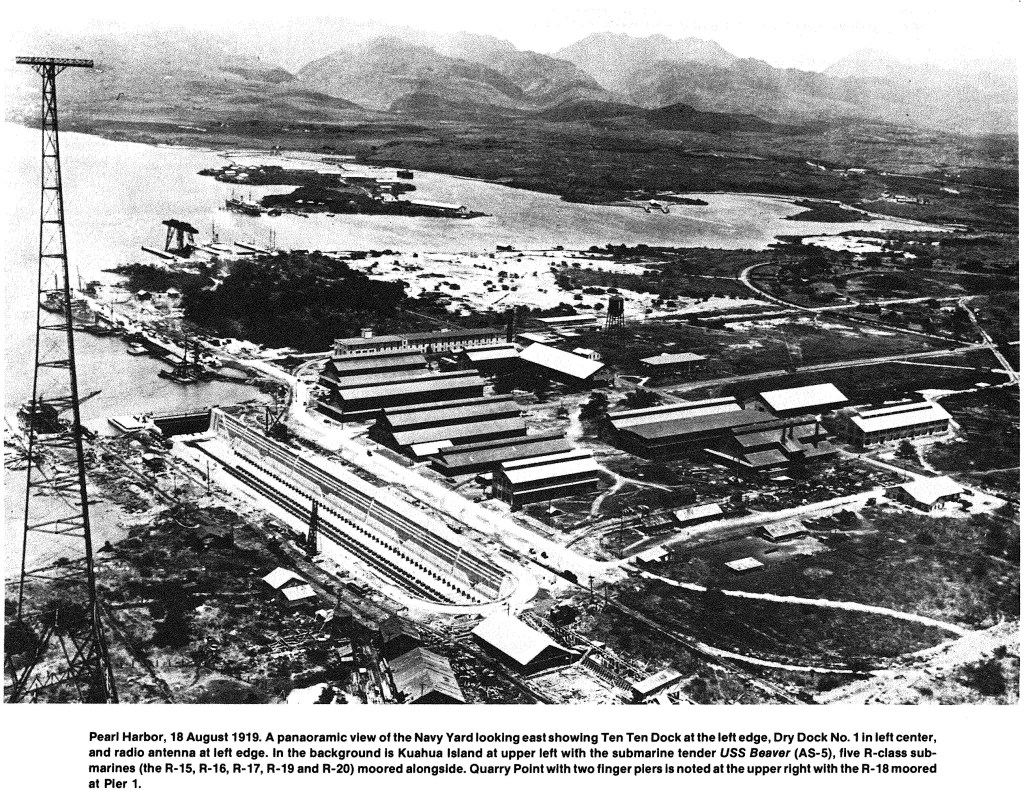
Shortly after the Armistice was signed in 1918, six R-class submarines were assigned to the Hawaiian area to establish the submarine base at Pearl Harbor. On 17 June 1919, the submarine tender USS Beaver (AS-5), a converted merchantman, and the six R-boats (R-15 through R-20), departed San Francisco for Hawai’i. This contingent comprised Submarine Division Fourteen under the command of Lieutenant Commander Felix X. Gygax, a pioneer submariner and first Officer in Charge of the Submarine School In New London, Connecticut.
The Honolulu Star-Bulletin of 25 June, described the arrival of the submarine division in Hawai’i. “The first unit of the new naval defense for these islands, consisting of the mother ship Beaver and six submarines of the R type, will make Oahu this afternoon, and will be berthed near the drydock at Pearl Harbor. The six subs form the advance guard of boats of this type to come here for permanent duty.”
Upon entering Pearl Harbor, all the submarine division found were two finger piers constructed at the site of today’s submarine base at Quarry Point. The R-18 moored at Pier 1 of the submarine base to charge air and batteries, thus becoming the first submarine to moor at the base. The Beaver and remaining fl-boats anchored nearby but would eventually moor at Kuahua Island.
Sometime after arrival of the squadron, land at Quarry Point began to be cleared of cactus, rocks and algaroba trees by the enlisted forces for the erection of temporary buildings. No funds had been appropriated for any construction, so the base force lived ashore in tents provided by the Beaver.
In August 1919, the battleship New York arrived with Secretary of the Navy Daniels and other dignitaries comprising a Special Board of Inspection of Naval Bases on the Pacific Coast. The Board recommended on 20 October, that a first class naval base, capable of taking care of the entire U.S. Fleet in time of war, be developed immediately in Pearl Harbor. Among the Board’s recommendations included an appropriation of over a million dollars for a complete submarine base which included dredging around the piers.
In October 1919, a building constructed from wartime wooden huts removed from Base No. 1 at Queenstown, Ireland, was commissioned as a sick bay at the submarine base. This complex included a second wooden building that served as a store and issuing facility. These structures served as the base dispensary until completion of a permanent building (Bldg. 665) in 1936. Hospital corpsmen were quartered in tents at Quarry Point.
The first Ship’s Service Department in the Fourteenth Naval District was established at the base in 1919. A Ship’s Service at the Naval Station did not commence operation -until a few years later. The volume of business in those early stores was certainly meager compared to the volume of business in today’s Navy Exchange facilities. Yet the services provided in the early stores were quite varied and included practically everything necessary or convenient for naval personnel. In many instances, credit provisions were so inclusive that naval personnel could have all charge accounts with commercial stores, including utility bills and house rent paid by the Ship’s Service Department, which, in turn would submit an invoice for the entire household expense at the end of the month.
On 18 November 1919, the Navy promulgated General Order No. 510 and was signed by Secretary of the Navy Josephus Daniels. This order (The Status of Shore-Based Submarine Organization), defined the status and directed the methods to be employed In administering and operating the shore-based submarine organizations. The intention was that all matters of personnel and material, within the submarine bases, should parallel as closely as possible that of mobile submarine tenders. This directive stipulated that “Commissioned and enlisted personnel of the bases not included in the crews of the vessels based thereon will be attached to the small tenders or other surface vessels assigned for exercise purposes. Officers commanding bases will command the vessels to which such personnel are attached. For instance, the officer in command at New London will command USS Fulton (assigned at present), and all personnel not attached to commissioned vessels of the organizations based thereon will be attached to Fulton.” As a result, Gygax assumed command of the resident tender, the USS Beaver.
General Order No. 510 defined the status of the submarine base at the time. The directive stated “Pearl Harbor (the Submarine Base) is within the naval station. Immediate senior is commandant of the fourteenth naval district.” The submarine base had not been officially established or commissioned.
On 19 December 1919, the protected cruiser USS Chicago (CL-14), arrived and anchored temporarily off-shore near the base. The old cruiser had once been commanded by the illustrious Alfred T. Mahan and was now relieving the Beaver as the resident tender. Chicago would eventually moor at the base to provide berthing accommodations for officer personnel.
In February 1920 the temporary facilities at Kuahua Island closed down and operations shifted to Quarry Point.
A veil of secrecy has always surrounded submarine development and, to some extent, the development of the submarine base. There is a definite lack of historical documentation reflecting the development of our submarine bases. This book attempts to partially alleviate this situation and to preserve vital elements of our submarine history. This then, is the story of one of our submarine bases, the Naval Submarine Base, Pearl Harbor, Hawaii.
It is impossible to describe every particular event in detail or to cover all the individuals who merited recognition for their contributions to the successful accomplishment of the base’s task. This history has been kept as impersonal as possible, and has been made a record of the teamwork achieved under the aspiring leader- ship of numerous individuals.
This publication provides a short history of the base; however, research continues in an attempt to uncover the actual establishment date of the base. Why has this date been difficult to ascertain? There are several reasons why an establishment date is hard to determine.
For many years it was believed the base was established on 2 February 1920 and Commander Chester W. Nimitz was the first commanding officer. Research has proven this to be incorrect. Nimitz was still serving on board the battleship USS South Carolina (BB-26) in Norfolk, Virginia at the time.
Normally when a base is established the Navy Department will promulgate a General Order, signed by the Secretary of the Navy. Research has failed to uncover such a document for this base.
The base was attempting to develop during the era of disarmament. The World War I experience with the submarine left disturbing residual effects on naval doctrine and policy. It was very clear that this rapidly developing weapon had profoundly altered the conduct of war upon the sea. The submarine had undergone “enormous development” during World War I. It had remarkable qualities of “concealment and surprise.” The submarine had forced changes in capital ship design, in fleet organization, and in tactics. And, Great Britain could not forget their narrow escape from certain disaster inflicted by German U-boats. With this memory vividly in mind, Great Britain came to the Paris Peace Conference in 1919 armed with a proposal to abolish the submarine.
This proposal had the support of American statesmen and their naval advisers. A Navy Department memorandum prepared just before the armistice favored the total suppression of submarines. And this posi- tion was elaborated in a further memorandum prepared for President Wilson in Paris. In this document the American naval staff recommended that “all submarines in the world should be destroyed, and their future possession by any power forbidden. They serve no useful purpose in times of peace. They are inferior to surface craft in time of war except in ability to treacherously attack merchant ships. Civilization demands that naval war be placed on a higher plane and confined to combatant vessels. So long as the submarine exists it will be used in the stress of war to attack neutral trade.”
This radical proposal does not appear to have been considered very seriously in Paris. The French opposed it. Thus, the question was lost during the prolonged hassle of whether the Allies should destroy or distribute the ships of the defeated German Navy.
The outlook for abolishing the submarine dimmed following the Paris Peace Conference. However, when President Harding entered the White House in 1921, he pledged to take steps toward the limitation of armaments. He summoned an international conference to be held in Washington.
During the Washington Conference on Limitation of Armament in 1921-22, the future of the submarine was again one of the major problem areas. Once more, Great Britain proposed abolishment of the submarine. However, the attitudes toward the submarine had changed. The admiralties of Japan and Italy found in the submarine promising solutions for certain of their strategic problems. French naval authorities discovered in the submarine a possible solution to their centuries old quest for an inexpensive counterpoise to England’s overwhelming command of the sea. And, naval opinion in the U.S. veered away from the radical proposal supported at Paris. The U.S. had no intentions of giving up the submarine.
So when the Washington Conference assembled in November 1921, all the principal naval powers, except Great Britain, had plans to further strengthen their submarine forces. The Conference would drag on for weeks and weeks. The Conference halted the armaments race and achieved much in limiting capital ships and aircraft carriers, but it failed to agree to limit submarines in any way.
Another side note of this Conference, Japan proposed the U.S. “agree not to increase the fortifications or naval bases at Guam, the Philippine Islands, and Hawaii.”
Treaties initiated at the Washington Conference were due to expire in 1936 and, in 1930, the main naval powers met in London to try to reach agreement on what was to follow it. Since the Washington Conference the British had never ceased to advocate the total abolition of the submarine and this was still their vow when the delegates assembled in London. But once again, Great Britain failed to secure the abolition of the submarine at the London Naval Conference.
The aforementioned events should provide the reader with a better insight into the political environment which existed during the postwar years of World War I. Precisely what impact those tumultuous years of dis- armament talks cast upon the early development of the base is not known. Certainly the overall effect could have delayed the promulgation of a Navy Department General Order to establish the base.
Relatively little information was available locally in the early years of the base. The Naval Historical Center and National Archives remain one of our finest assets. Also, it is very possible valuable information was inadvertently lost or destroyed during the disestablishment of the Fourteenth Naval District during the late 1970s. However, despite the adversities, the search continues and the mystery of when the base was established prevails.
The publication of this history could not have been accomplished without the support and assistance of numerous individuals. I am extremely indebted to Dr. Dean C. Allard, Head of Operational Archives Branch, Naval Historical Center, Washington, D.C., and Ms. Elaine C. Everly, Assistant Chief of Navy and Old Army Branch, National Archives, Washington, D.C., for their support of our endeavors and in providing needed materials. Also, to Mrs. Dorothy Fuller, Head Librarian of the Naval Base, Pearl Harbor, for her invaluable assistance in offering material. The Naval Submarine Base Photo Lab provided indispensable support and service. Their expertise supplied an in depth profile of photos from the past and present.
Lastly, my appreciation to Captain George R. Stubbs, Commanding Officer, Naval Submarine Base, Pearl Harbor, for his desire to publish this history. Without his support and encouragement, this project could not have been accomplished.
“A day which will live in infamy and will never be forgotten!”
Remembrance Events
December 6
@3:30PM – Blackened Canteen Ceremony on the USS Arizona Memorial
The annual “Blackened Canteen” ceremony centers on a single artifact — a canteen recovered after a June 1945 mid-air collision of two American bombers over Shizuoka, Japan — and the actions of a Japanese farmer who sought to promote peace and reconciliation after the bombing raid that killed 2,000 people in his city.
The Blackened Canteen ceremony began 71 years ago, now joins two nations with the hope of a world that will join together to seek peace on Earth.
@5:00PM – USS Utah Ceremony at the USS Utah Memorial on Ford Island Livestream link. Open to the Public (Military Base access required).
December 7
@7:30AM – 81st Pearl Harbor CommemorationLivestream link Open to the Public at the Pearl Harbor National Memorial.
@1:00PM – USS Oklahoma Ceremony at the USS Oklahoma Memorial on Ford Island. Open to the Public (Military Base access required).
@4:30PM – The National Pearl Harbor Memorial Parade 2022 commemorating the 81st Anniversary of World War II beginning at 4:30 PM.
The Parade Route – begins at Fort DeRussy, proceeds down Kalakaua Avenue for 1 mile, then takes Monsarrat Avenue to the Waikiki Shell where an evening concert for participants will be held.
Preliminary Event Schedule – 1630 Opening Ceremony – Fort DeRussy Park – 1800 Parade Begins on Kalakaua Avenue in Waikiki. I’m trying to get a car for our Sterling Cale to ride and I’d like to have Legionnaires march beside him! – 1930 Closing Ceremony





 Bowfin Pearl Harbor Base