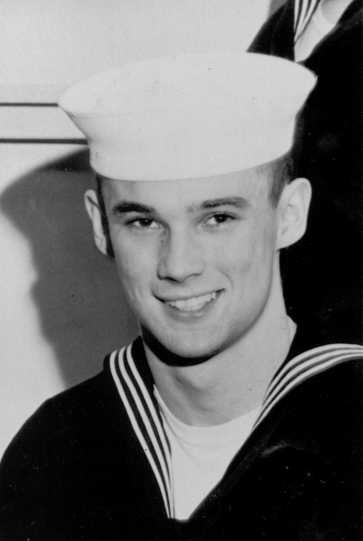
On April 15, 1987, Submarine Base Pearl Harbor reopened a newly renovated 17-story Bachelor Enlisted Quarters capable of housing 516 personnel. This building was dedicated on February 26, 1988 in the memory of MM3 (SS) James E. Smallwood for the sacrifice of his life while performing his duties in the service of his country.
He was posthumously awarded the Navy-Marine Corps Medal for heroic conduct. The citation reads:
“For heroic conduct on June 14, 1960 while serving on board USS SARGO (SSN-583) moored at the Submarine Base, Pearl Harbor, Hawaii. While supervising the operation of charging high pressure oxygen into the SARGO’s storage tanks, SMALLWOOD firmly and meticulously carried out the ship’s safety precautions requiring isolation of the charging compartment from the remainder of the vessel. Aware of the potential danger involved, he denied entry of several of his shipmates to the Stern Room and kept the watertight door and bulkhead flappers shut. SMALLWOOD lost his life in a raging fire which broke out during the oxygen charge. Through his steadfast adherence to safety precautions, he undoubtedly prevented further loss of life and a probable major disaster. His courage and outstanding devotion to duty were in keeping with the highest traditions of the United States Naval Service.”
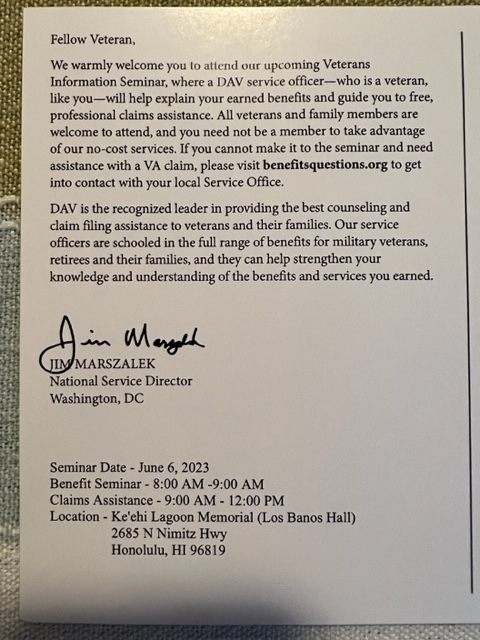
The Disabled American Veterans (DAV) is sponsoring a veterans benefits seminar & offering claims assistance on June 6th at the Ke’ehi Lagoon Memorial from 8am – 12pm.
Benefits Seminar – 8 to 9am Claims Assistance – 9am to 12pm
The Momsen lung was a early underwater rebreather used prior to and during World War II by American submariners as emergency escape gear.
While serving with the Submarine Safety Test Unit, Charles Momsen began working on a device to help sailors surface. It was officially called the Submarine Escape Lung, it consisted of an oblong rubber bag that recycled exhaled air. The press enthusiastically received the device and dubbed it the Momsen Lung, a name that stuck.
The Lung contained a canister of soda lime, which removed poisonous carbon dioxide from exhaled air and then replenished the air with oxygen. Two tubes led from the bag to a mouthpiece: one to inhale oxygen and the other to exhale carbon dioxide. The device hung around the neck and strapped around the waist. Besides providing oxygen for the ascent, it also allowed a submariner to rise slowly to the surface, thus avoiding decompression sickness (“the bends”).
Between June 1929 and September 1932, then-Lt. Momsen developed the lung with Chief Gunner’s Mate Clarence L. Tibbals and Frank M. Hobson, a civilian employee of the Bureau of Ships. In 1929, Momsen received the Distinguished Service Medal for personally testing the device at a depth of 200 feet (61 m). The Lung saved its first lives in October 1944, when eight submariners used it to reach the surface after Tang (SS-306) sank in 180 feet (55 m) of water in the East China Sea. The Lung was eventually supplemented by the Steinke hood and free-ascent techniques.
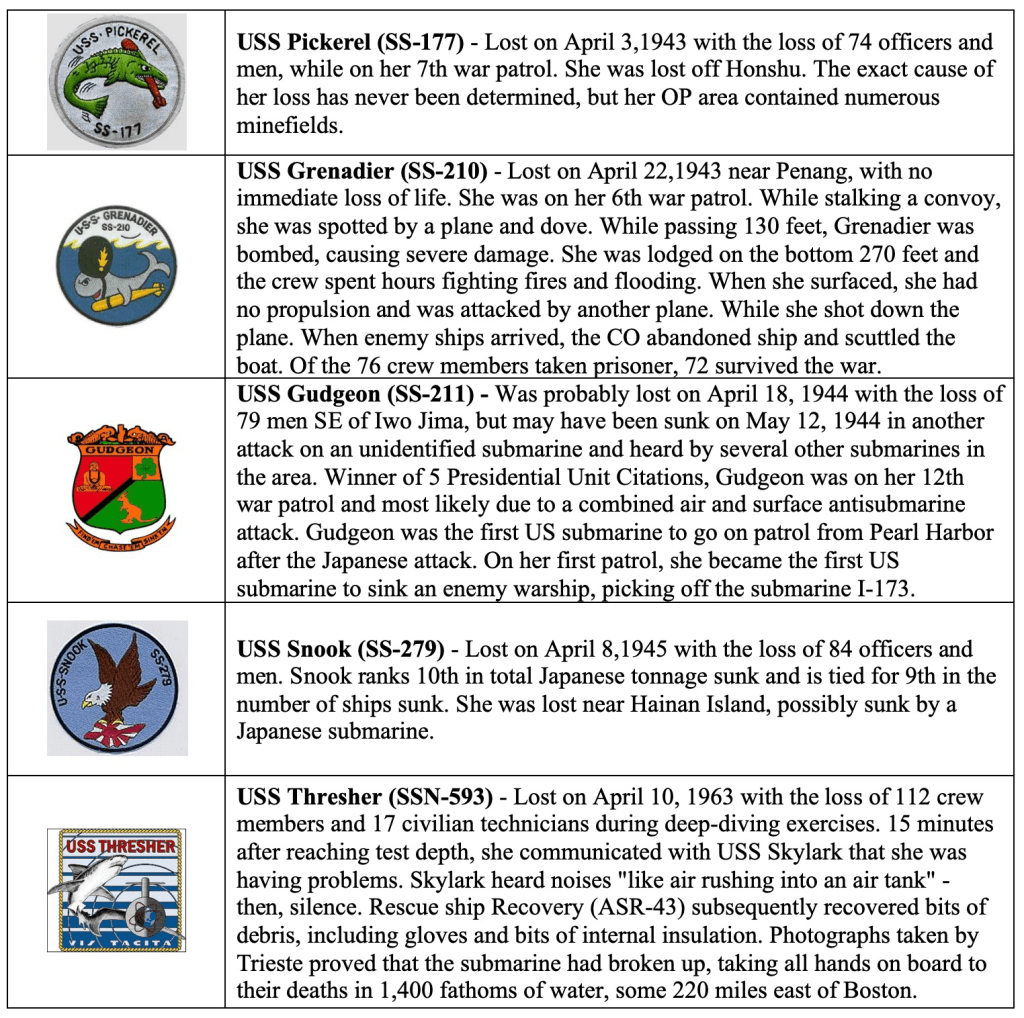
Thresher and the genesis of Level 1/SUBSAFE Program
On 10 April 1963, while engaged in a deep test dive, the nuclear submarine USS Thresher (SSN 593) was lost at sea with all persons aboard. Based on the findings of a Court of Inquiry and the subsequent Joint Congressional Committee on Atomic Energy hearings into the loss of the Thresher, it was concluded that a flooding casualty in the engine room, resulting from a piping failure in one of the salt water systems, was the most probable cause for the loss.
A Thresher Design Appraisal Board determined that, although the basic design of this submarine class was sound, measures should be taken to improve the level of confidence in the material condition of the hull integrity boundary and in the ability of submarines to control and recover from flooding casualties. Thus the genesis of the Level I/SUBSAFE Program. The program establishes control for procurement, inspection, certification, test, identification, documentation, record control, storage, issue, turn-in, recall and disposal. Level I/SUBSAFE Stock Program materials are intensively managed and controlled. They require certification with traceable objective quality evidence. Items include submarine hull pressure boundary fittings, high pressure air and gas components, high pressure/temperature steam system components and selected safety related equipment on surface ships and submarines.
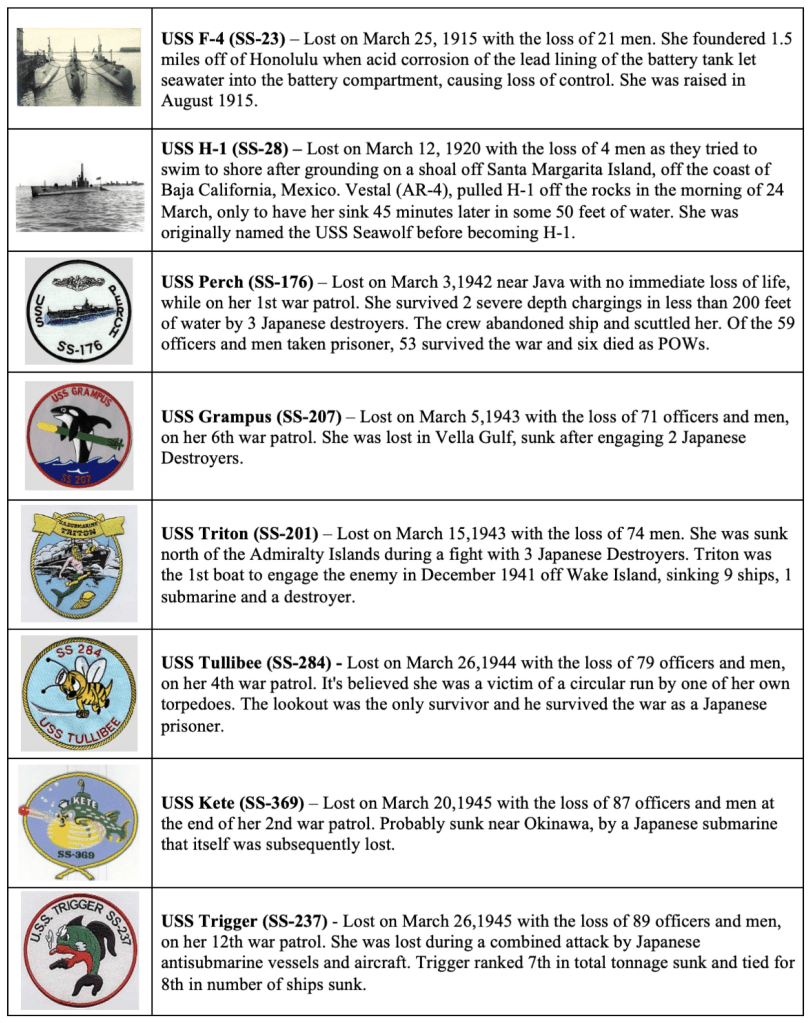
The sinking of the submarine F-4 off the coast of Hawai’i with the loss of all hands in 1915 caused the Secretary of the Navy to direct the establishment of a formal school to instruct submariners in the operation and maintenance of these specialized boats. The commanding officer of the Submarine Base in New London, Connecticut, was directed to establish the Naval Submarine School, which began operation on 1 July 1916. After six months of training, the first officer class graduated on 23 December 1916. The first enlisted class graduated one year later.
Shipmates, Registration is now open for the USSVI Western Region Roundup, which is scheduled for April 27-29, 2023 at the DoubleTree Hotel in Sacramento. We are still working on the Plan of the Day but have already locked in the popular Submarine Movie Night for Friday night.
Our online Registration, hotel Booking and Payment system makes short work of the process Register Online Today www.wrroundup.com! As always, the goal of the Roundup is to provide a way for all Submariners to gather for their mutual benefit and enjoyment. We look forward to seeing you there.
CDR Gilmore was the first U.S. submariner to receive the Medal of Honor in World War II. He was awarded this medal for his actions while serving as Commanding Officer of USS GROWLER.
On February 7 GROWLER sighted a ship in the murky darkness. CDR Gilmore readied torpedoes and closed for an attack. At a range of approximately 2000 yards, the target, the 2,500 ton patrol boat HAYASAKI, spotted GROWLER. The swift ship reversed course and charged the submarine. Gunfire and the groans of the twisted hulls roared in the night. CDR Gilmore, the last man on the bridge, shouted through the open conning tower hatch, “Take her down!” He had chosen to sacrifice himself rather than further jeopardize his boat. CDR Howard W. Gilmore lost his life in a selfless act of heroism that has become one of the most inspiring legends of the Submarine Force.
CDR Gilmore’s Medal of Honor Citation reads:
“For conspicuous gallantry and valor above and beyond the call of duty as commanding officer of the USS GROWLER during her fourth war patrol in the southwest Pacific from 10 January to 7 February 1943. Boldly striking at the enemy in spite of continuous hostile air and anti-submarine patrols, CDR Gilmore sank one Japanese freighter and damaged another by torpedo fire, successfully evading severe depth charges following each attack. In the darkness of night on 7 February, an enemy gunboat closed range and prepared to ram the GROWLER.
CDR Gilmore daringly maneuvered to avoid the crash and rammed the attacker instead, ripping into her port side and bursting wide her plates. In the terrific fire of the sinking gunboat’s heavy machineguns, CDR Gilmore calmly gave the order to clear the bridge, and refusing safety for himself, remained on deck while his men preceded him below. Struck down by a fusillade of bullets and having done his utmost against the enemy, in his final living moments, CDR Gilmore gave his last order to the officer of the deck, “Take her down”. The GROWLER dove; seriously damaged but under control. She was brought safely to port by her well trained crew inspired by the courageous fighting spirit of their dead Captain”
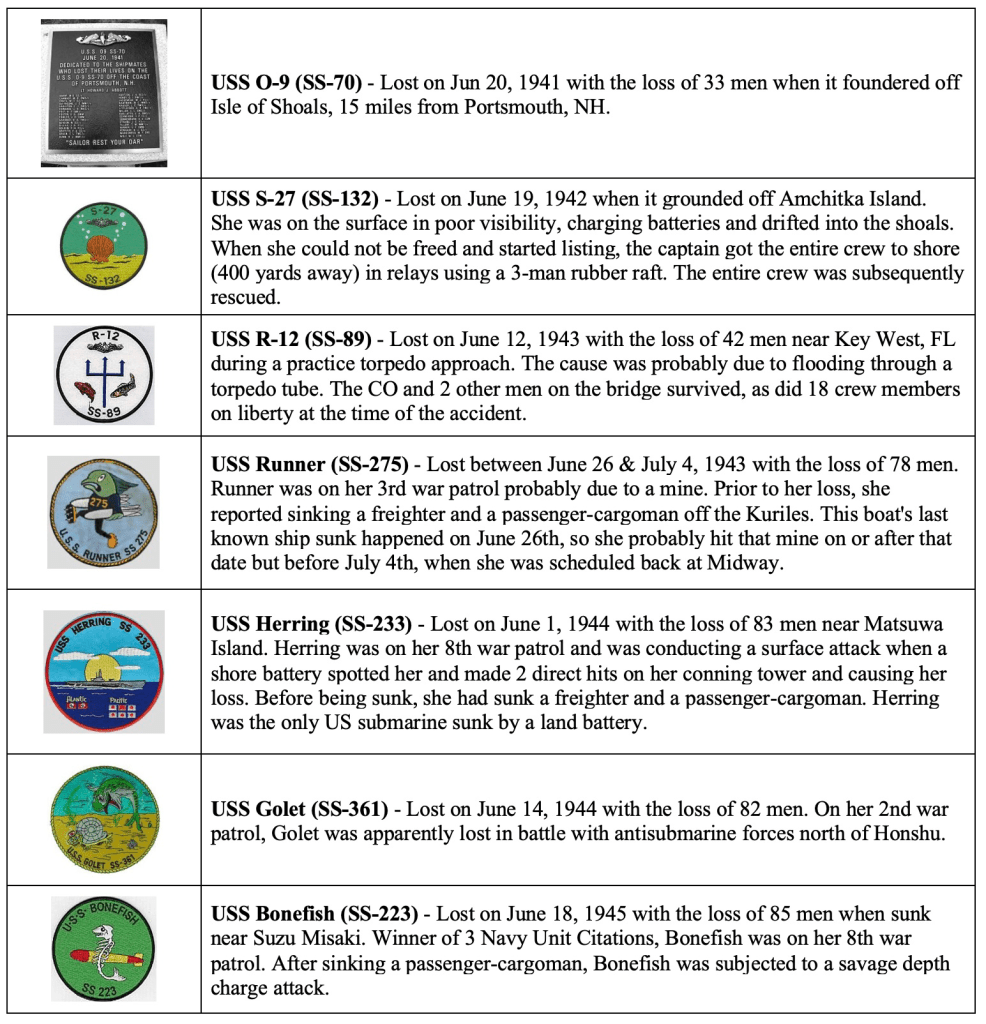
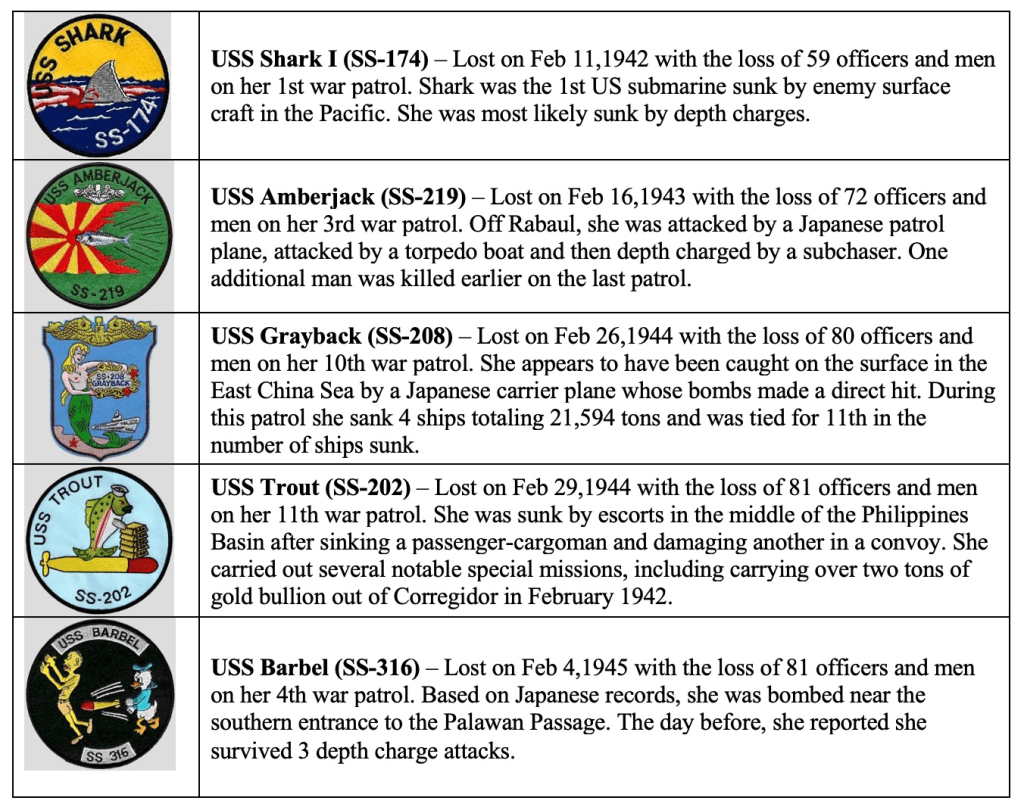
Six “S” class boats were lost during WWII, three of them from grounding. The first of these three was USS S-36. Charts of vast areas of the Pacific war zone were sketchy. Not a few were labeled “from a survey by Capt. James Cook.” Built to a WWI design and commissioned in the early 1920s, these boats were old and obsolete by the outbreak of war with Japan. They lacked the air-conditioning and radar of the later Fleet Boats of the SARGO, PERCH, GATO and BALAO classes of submarines. Yet brave men sailed these “smoke” boats into harm’s way.
The bell that hangs in the steeple of the Submarine Memorial Chapel was donated from the crew of USS Argonaut right before her last patrol, one she never returned from. On January 10, 1943 the entire crew of 102 was lost as the boat was sunk by Japanese destroyers.
“I am the voice of the USS Argonaut (SS 166). I was later classified APS 1 (submarine transport), and I was the largest of the U.S. submarines to participate in World War II. I was over 380 feet long and had a beam of over 33 feet. I was originally built as a minelayer, and I had two mine laying chutes and special tubes built into a large stern room. In 1942, I was converted to a cargo carrying and troop transport submarine, my mine laying gear was removed, and my stern room was fitted for troop berthing. I transported Marines for the Makin Island raid. In January 1943, I was on patrol near Rabaul when I was attacked by two Japanese destroyers who were avenging the torpedoing of a third destroyer in a convoy. The two destroyers hammered the water with depth charges; and my bow thrust above the surface and remained there for sometime as destroyers repeatedly fit it with gunfire. Finally I slid with my crew of 102 men into the depths of the Pacific.”
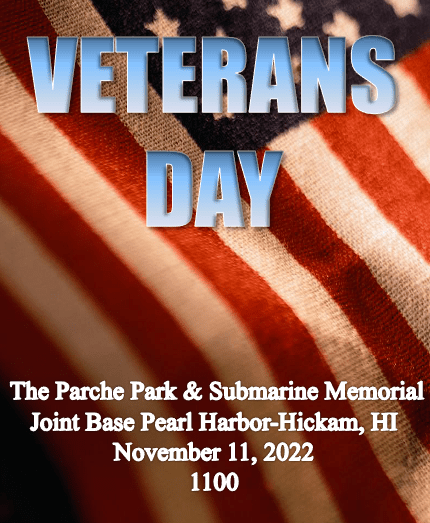
On November 11, 2022 at 11:00am Bowfin Pearl Harbor Base SUBVETS conducted our annual Veterans Day Commemoration ceremony at the JBPHH Submarine Memorial.
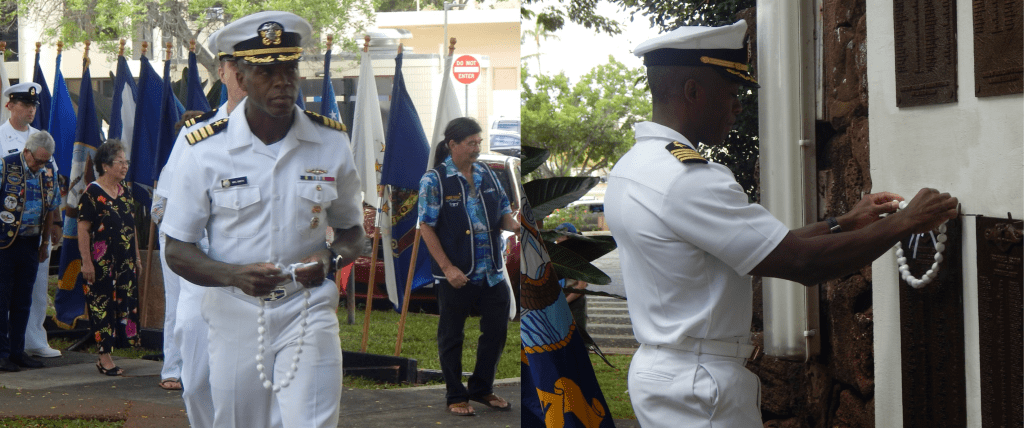
Similar to the first commemoration ceremony in 1960 conducted by the Submarine Veterans of WWII, members of Bowfin SUBVETS placed leis on the 47 bronze plaques mounted on the wall.
Base Commander Paul Jurcsak opened the commemoration. Followed by the Parading of All 50 State Flags by the Radford High School JROTC and Boy Scout Troop 97, and the posting of colors by National Sojourners Inc. members Roy Ota and Dennis Egge. The National Anthem was performed Pacific Fleet Band, Harbor Brass Quintet led by MU2(SW) Michael Bookman Jr. Submarine Readiness Squadron 33 (formally, NSSC) Chaplain LT Jordan Dill, CHC, USN performed the invocation.
Base Commander Paul Jurcsak led the tolling of the bell for Submarines lost in WWII, while Rob Roberts, LT, USN (Ret) rank the bell. Led by Captain Mel R. Smith our keynote speaker.
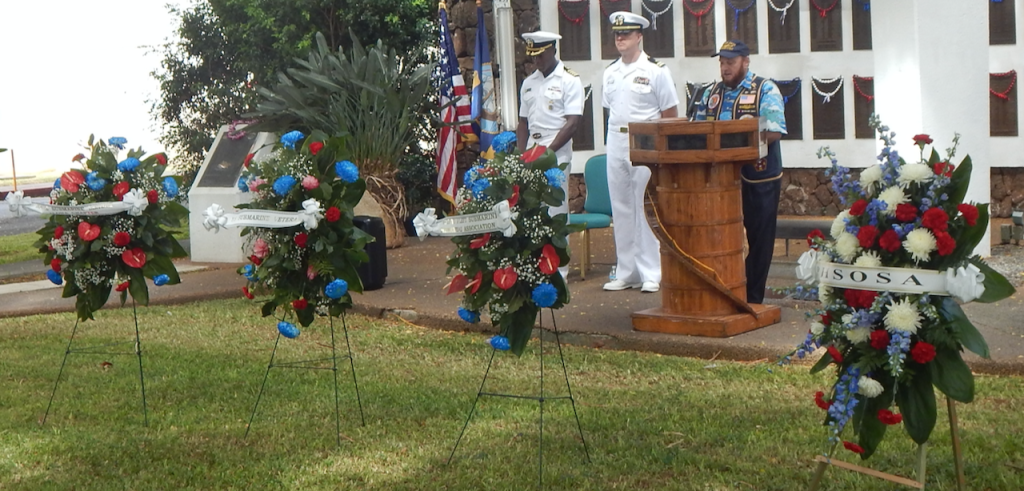
This was followed by Special Lei Presentation by Dolores Brown for the USS Growler (SS 215) the “State Submarine of Hawaii,” and Wreath presentations by Bowfin Base, U.S. Submarine Veterans, Inc., Pacific Fleet Submarine Memorial Association, U.S. Submarine League, Aloha Chapter and Pearl Harbor Submarine Officers’ Spouses Association.
Our distinguished guest Captain Mel R. Smith, Executive Assistant Commander USINDOPACOM, provided the keynote address.
We closed with the benediction by Chaplain Dill followed by a Three Gun Volley by the JBPHH Navy Honor Guard Detachment led by CTN2 Zachary Scarbro and the playing of Taps by MU2(SW) Michael Bookman Jr.
Following the ceremony Bowfin SUBVETS and invited guests moved to the Lockwood Lanai for a Texas BBQ lunch.
Originally known as Armistice Day. In 1918, on the 11th hour of the 11th day of the 11th month, an armistice, or temporary cessation of hostilities, was declared between the Allied nations and Germany in World War I, then known as “the Great War.” Commemorated in many countries as Armistice Day the following year, November 11th became a federal holiday in the United States in 1938. In the aftermath of World War II and the Korean War, Armistice Day became legally known as Veterans Day dedicated to American veterans of all wars. There are an estimated 20 million living Veterans today, with approximately 100K in Hawaii.
Veterans Day is a time to honor not just those who have fought for us in battle, but all of the outstanding men and women who served in our nation’s armed forces since our founding 241 years ago.
Not all veterans have seen war, but a common bond that they all share is the oath, to defend the Constitution of the United States against all enemies, foreign and domestic, an oath that expressed their willingness to die defending this great nation. An oath that everyone of them will keep even after exciting active service.
Perhaps, most significant in preserving our way of life and defending freedom, are the battles that America does not have to fight.
I believe President Ronald Reagan said it best…“We remember those who were called upon to give all a person can give, and we remember those who were prepared to make that sacrifice if it were demanded of them in the line of duty, though it never was. Most of all, we remember the devotion and gallantry with which all of them ennobled their nation as they became champions of a noble cause.”
We salute all our veterans who have made this great country possible.
God bless you, God bless Hawaii, and God bless America!
Nominations for Bowfin Pearl Harbor Base Officers is now open, and will close on August 5, 2022. Voting will be open from August 6 to 31, 2022. Results will be announced and newly elected officers will be sworn in at the September meeting. Officers to be elected are Base Commander, Vice Commander, Secretary and Treasurer.
Bowfin Pearl Harbor Base Bylaws of January 3, 2022 – ARTICLE X – OFFICERS
Section 1 – Base Officers
A. Elected Base Officers shall include the following: Base Commander, Base Vice Commander, Base Secretary, and Base Treasurer. B. The prerequisite for Base Office is that the Nominee must be a Regular or Life Member in good standing a minimum of twelve consecutive months. C. The term of office for Base Officers, will be two (2) years or until a successor has been elected. D. Appointed Officers shall consist of: Chief of the Boat, Chaplain and Committee Chairmanships appointed by the Base Commander and confirmed by the Executive Board.
Section 3 – BASE COMMANDER A. Act as the Chief Executive Officer. B. Cause to call all regular and special meetings of the Base. C. Preside over all regular and special meetings of the Base. D. Enforce the National and Base Constitution and Bylaws. E. Direct and supervise the operation of the Base. F. Prepare and present an annual report to the membership. G. Submit, in writing to all officers for confirmation, all appointed officers and committee chairmanships. H. Be responsible for the promulgation of all pertinent information to the membership of the Base. I. Other duties as necessary in the support of Article III – Purpose. J. Serve as a member of the Executive Board. K. Work up, keep current and pass on, immediately to his relief a “Turn Over” folder, including all official correspondence, records and official materials assigned to his care.
Section 4 – VICE COMMANDER A. In the absence of the Base Commander, shall preside at all meetings. B. Perform such duties as assigned by the Base Commander or as necessary in the support of Article III – Purpose. C. Serve as a member of the Executive Board. D. Work up, keep current and pass on, immediately to his relief a “Turn Over” folder, including all official correspondence, records and official materials assigned to his care.
Section 5 – SECRETARY A. Shall keep minutes of all meetings and maintain files for reference. Copies are to go to the Base Commander. B. Shall read the meeting minutes, if required, at the Business Meetings and place copies on file with the Base Commander. C. Shall keep a file of all outgoing and incoming correspondence, and maintain the contact information of all members. D. Serve as a member of the Executive Board. E. Work up, keep current and pass on, immediately to his relief a “Turn Over” folder, including all official correspondence, records, and official materials assigned to his care. F. Perform such duties as assigned by the Base Commander or as necessary in the support of Article III – Purpose.
Section 6 – TREASURER A. Shall be responsible for all funds and securities of the USSVI Bowfin Pearl Harbor Base and deposit such in the name of the Base. B. Shall read the monthly financial reports, if required, at the Business and Executive Board Meetings and place copies on file with the Base Commander and Secretary. C. Serve as a member of the Executive Board. D. The books shall be audited annually, prior to being relieved, by an auditing committee. This committee will consist of three active members appointed by the Executive Board. The Executive Board may require an additional audit as deemed necessary. E. Shall collect dues and forward to National that portion of the dues required by them in accordance with existing National Bylaws. F. All monies in the Base functions shall pass through the Treasury. G. Work up, keep current and pass on, immediately to his relief a “Turn over” folder, including all official correspondence, records, and official materials assigned to his care. H. Perform such duties as assigned by the Base Commander or as necessary in the support of Article III – Purpose.