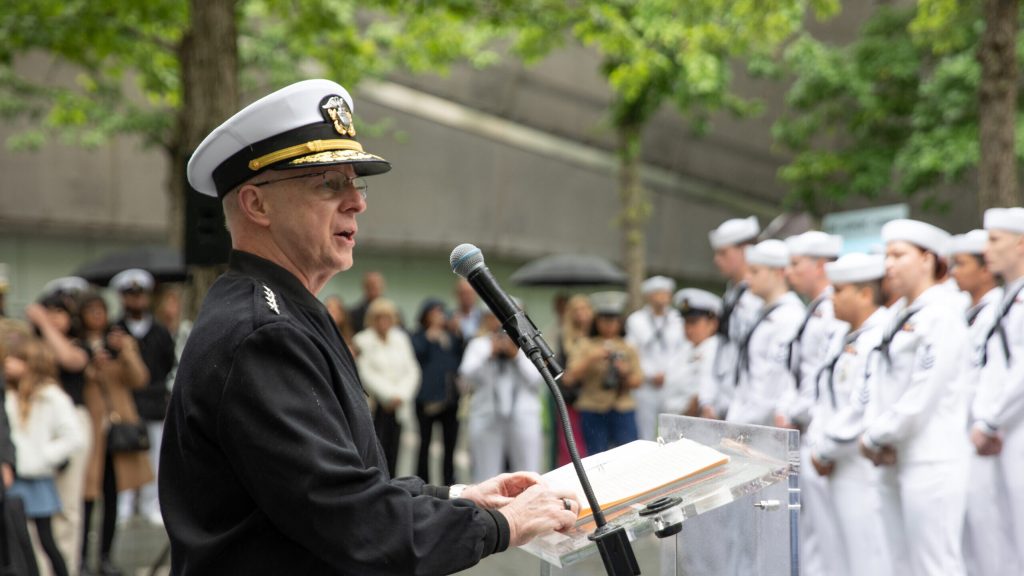
Adm. Daryl Caudle, Commander, U.S. Fleet Forces Command, delivers remarks during a reenlistment and promotion ceremony at the 9/11 Memorial, May 23, during Fleet Week New York 2025.
WASHINGTON — Adm. Daryl Caudle, the White House’s nominee to become the 34th chief of naval operations, said today he would consider pulling the plug on the Los Angeles-class attack submarine USS Boise (SSN-764), the US Navy submarine so beset with maintenance problems that it has been sitting dockside for the better part of a decade.
“Working with the Secretary of the Navy, I want to take that on, if I’m confirmed, and look at that hard,” Caudle told Senate lawmakers during his confirmation hearing today. “The decision whether or not to actually walk away from Boise is a big one, and I want to make sure I clearly understand the trajectory and trends, but I hear you loud and clear, senator, on how unacceptable it is, how long she’s been in the yards.” Read full story HERE.
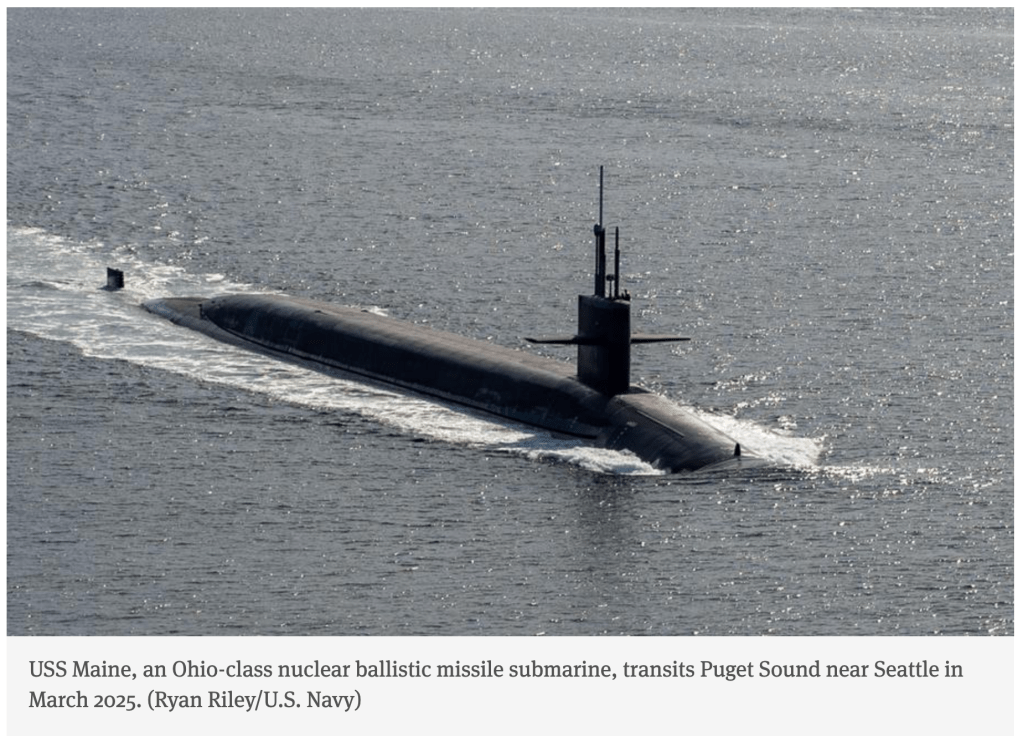
The Navy plans to spend up to $250 million to extend and modernize a pier at Naval Base Kitsap-Bangor to serve new ballistic missile and attack submarines coming into the fleet in the next decade.
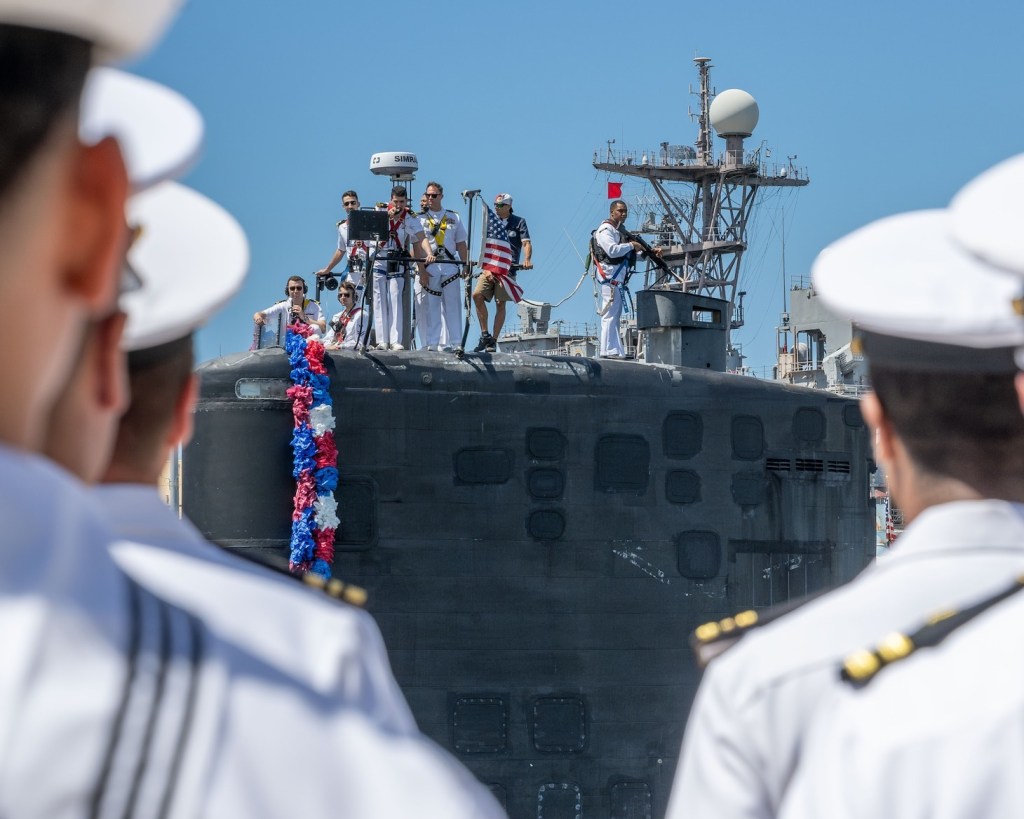
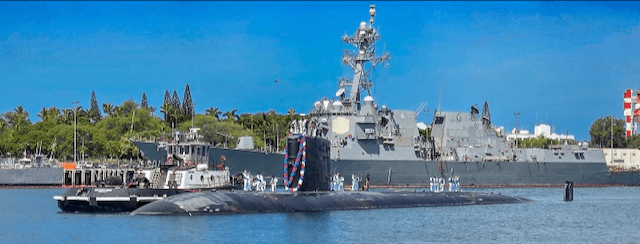
JOINT BASE PEARL HARBOR-HICKAM, Hawaii (July 12, 2025) – Los Angeles-class fast-attack submarine USS Toledo (SSN 769) arrives at Joint Base Pearl Harbor-Hickam during its change of homeport, July 12, 2025. (U.S. Navy photo by Mass Communication Specialist 1st Class Scott Barnes)
The Los Angeles-class fast-attack submarine USS Toledo (SSN 769) arrived at its new homeport of Joint Base Pearl Harbor-Hickam, from its previous homeport of Portsmouth, Virginia, July 12, 2025. The Toledo joined Submarine Squadron 7 as their fourth Los Angeles-class fast-attack submarine.
“Our crew is excited to finally arrive in Pearl Harbor after completing an important maintenance period in Hampton Roads,” said Cmdr. Dustin Kraemer, commanding officer of the Toledo. “Our crew looks forward to the new chapter for Toledo and the opportunities while operating throughout the Indo-Pacific.”
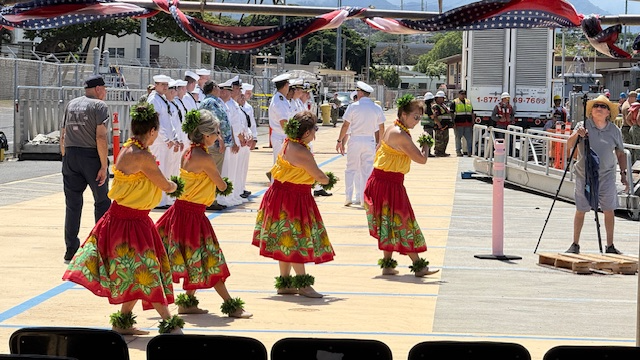
Capt. Corey Poorman, commander, Submarine Squadron 7, met the Toledo pierside upon arrival to welcome the crew to the island. “The Squadron 7 Ohana enthusiastically welcomes the crew and families of the Toledo with Hawaii’s enriched culture and spirit of aloha,” said Poorman. “Our team looks forward to continuing the training and certification of Toledo’s crew in defense of our nation and its allies and partners.”
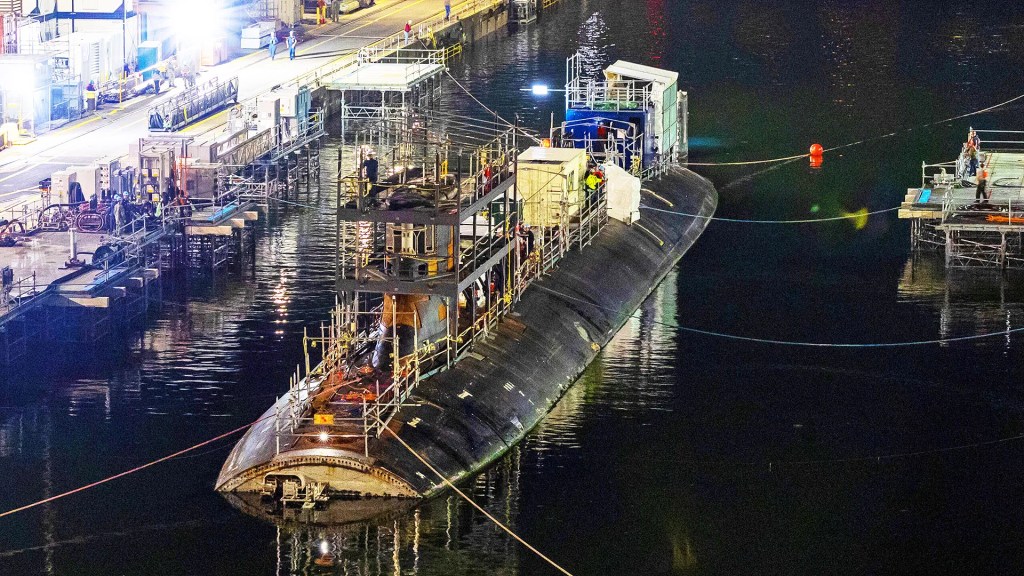
USS Connecticut (SSN 22) is docked for its Extended Docking Selected Restricted Availability July 12 at Puget Sound Naval Shipyard & Intermediate Maintenance Facility. Wendy Hallmark/USN
The USS Connecticut, one of the U.S. Navy’s prized Seawolf class nuclear attack submarines, is set to finally return to service late next year. The Navy previously indicated it could rejoin the fleet this fall. Connecticut is currently at the Puget Sound Naval Shipyard in Washington State for repairs and other work after suffering major damage, particularly to its bow, from a collision with an underwater seamount in the South China Sea in 2021.
To perpetuate the memory of our shipmates who gave their lives while voluntarily serving in submarine warfare in the pursuit of their duties while serving their country. That their dedication, deeds and supreme sacrifice be a constant source of motivation toward greater accomplishments. To further promote and keep alive the spirit and unity that existed among submarine crewmen during World War II. To promote sociability general welfare and good fellowship among our members. To pledge loyalty and patriotism to the United States of America and it’s constitution.
1. Bowfin Pearl Harbor Base
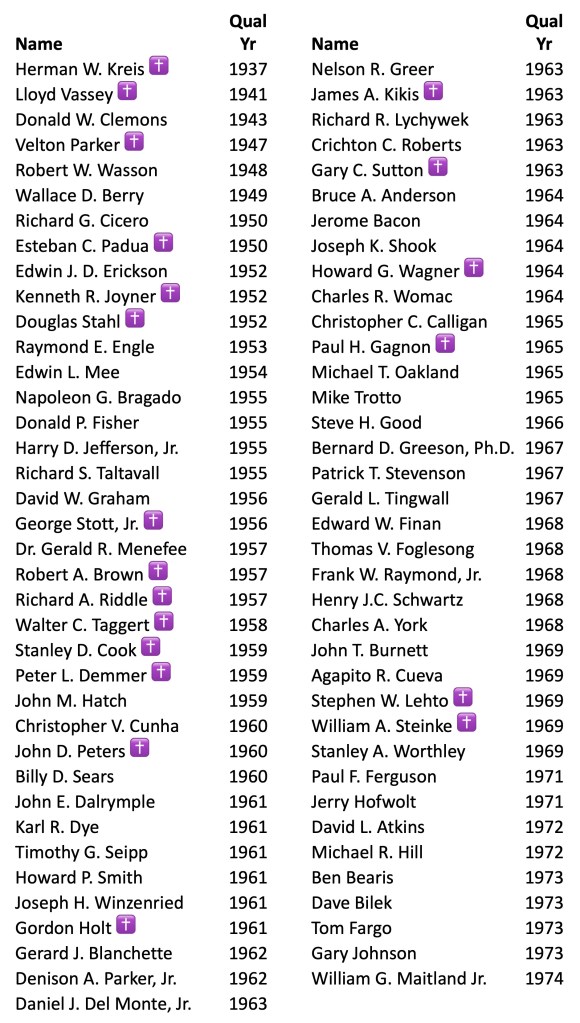
Bowfin Meeting – We conducted our June meeting at Clean Sweep Bar, Lockwood Hall. The following members attended – Base Commander Paul Jurcsak, Secretary Brett Kulbis, Treasurer Pat Suenaga, COB Gary Johnson, and members Dave Atkins, George Barlett, Jim Bazemore, David Bilek, Rodney Boucher, Allen Clemons, Dan Del Monte, Karl Dye, Ben McGowan, Crichton Roberts, Thom Sousa, Wade Thode, and Ken Voorhees.
Welcomed Guests – Mi-ye Bilek, Judy McGowan and Wesley Thode.
Binnacle List – Please keep the all our members and their families in your good thoughts and prayers, especially Chris Cunha, Paul Ferguson, John Hatch, and Charley Womack.
Hauʻoli Lā Hānau! Bowfin Birthdays for the month ofJuly. Additionally, newest member Dave Bazemore.
The Los Angeles-class Flight III 688i (Improved) attack submarine USS Toledo (SSN 769) made a significant entrance into its new homeport at Pearl Harbor, Hawaii, today. This marks a new chapter for the storied vessel, which recently completed an extensive engineered overhaul and modernization, ensuring its continued operational relevance in the U.S. Navy’s submarine fleet.
The 688i brings quieter operation, advanced sonar, and the ability to operate under ice, making it one of the most versatile submarines in the U.S. Navy. These upgrades ensure the Toledo can conduct a wide range of missions, from intelligence gathering and special operations to direct engagement and support of carrier strike groups.
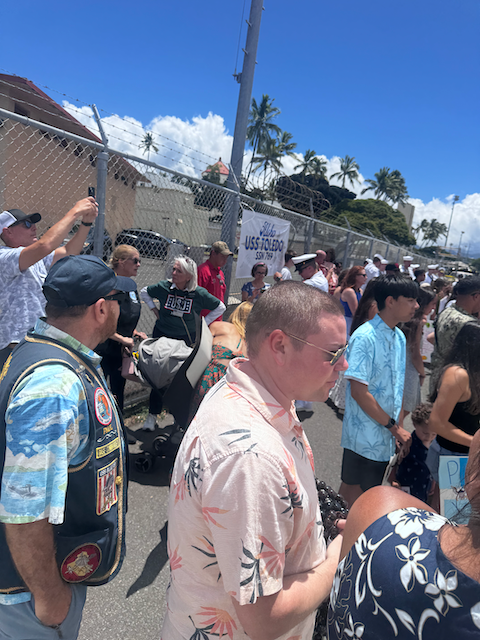
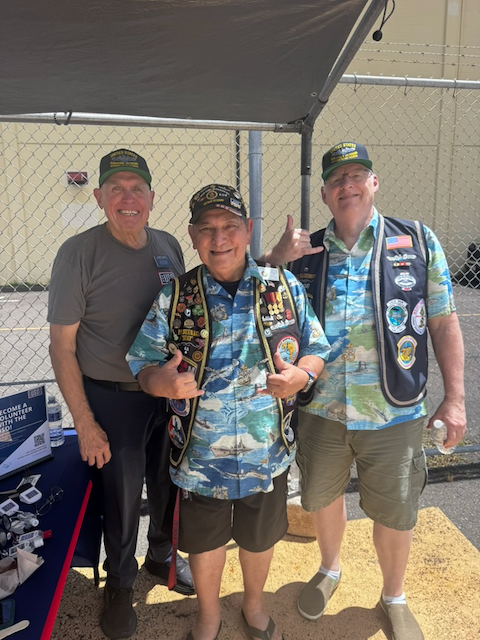
Upon her arrival, the USS Toledo was greeted by the Bowfin Pearl Harbor Base Submarine Veterans (Subvets), a group with deep ties to the legacy of undersea warfare. The Bowfin subvets, named after the historic WWII submarine USS Bowfin (“Pearl Harbor Avenger”), are known for their dedication to preserving submarine history and supporting active-duty submarine crews in Pearl Harbor.
With her arrival at Pearl Harbor, the USS Toledo embarks on a new era of service, ready to meet the demands of the Pacific theater. She strengthens the U.S. Navy’s undersea capabilities in the Indo-Pacific region. As strategic challenges evolve, the presence of a modernized, battle-ready 688i submarine enhances deterrence and supports the Navy’s commitment to regional security.
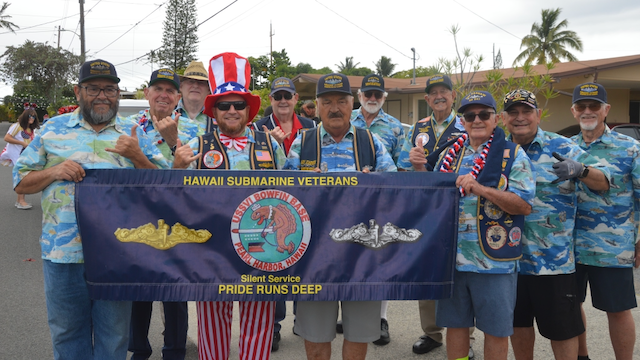
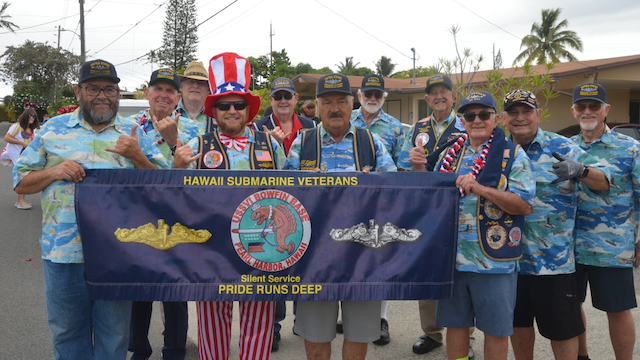
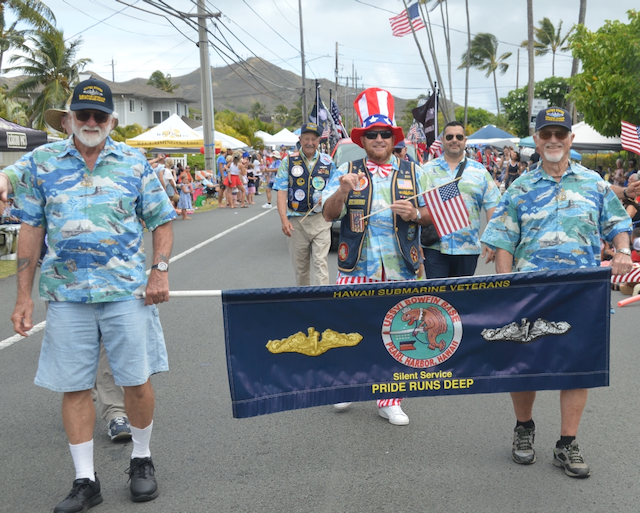
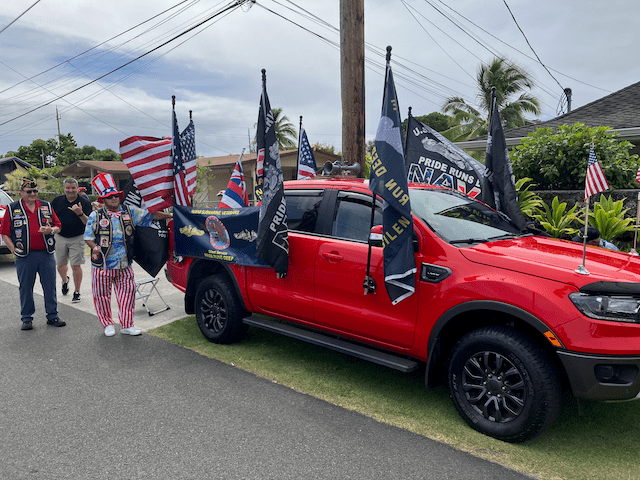
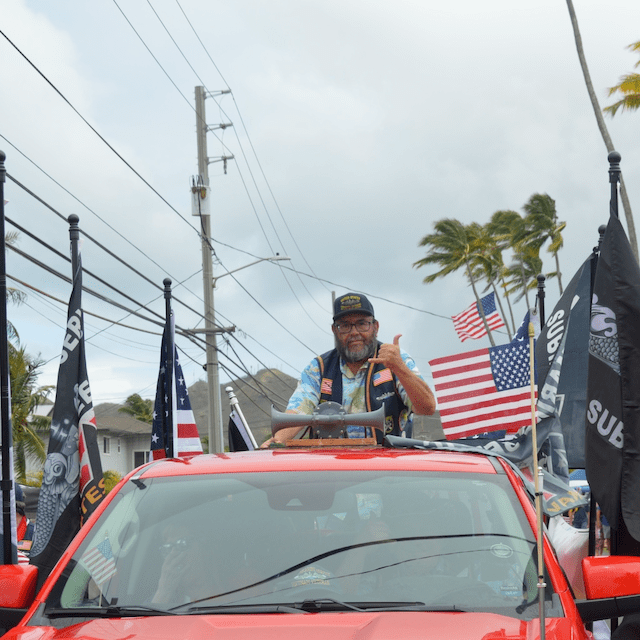
On Friday, July 4, 2025, members of the Bowfin Pearl Harbor Base proudly joined the 76th Annual Kailua Independence Day Parade, upholding a beloved tradition that continues to unite generations along Kainalu Drive. For over seven decades, the Kailua Independence Day Parade has been a vibrant celebration of unity, patriotism, and community spirit. Since 1970, Bowfin Pearl Harbor Base submarine veterans have been honored participants, symbolizing dedication, service, and the enduring relationship between the military and the local community.
This year’s theme, “Waves of Aloha,” beautifully embodies the ever-present spirit of kindness, unity, and welcome that defines Kailua. Just as ocean waves continuously shape the shoreline, the aloha spirit shapes the community—embracing everyone with warmth, respect, and compassion.
“Waves of Aloha” Highlights:
Enduring Bonds – Celebrating the connections between generations, neighbors, and friends, strengthened through shared traditions and support.
Community Spirit – Uplifting Kailua through acts of generosity, inclusion, and collective energy.
Heritage and Progress – Honoring the past while looking forward, much like the waves that are both timeless and ever-changing.
Military and Civilian Unity – Recognizing the contributions of Bowfin Pearl Harbor Base submarine veterans and all who serve, fostering gratitude and pride.
The Bowfin Pearl Harbor Base submarine veterans are honored to continue their participation in this cherished parade. As we ride the “Waves of Aloha” together, we celebrate not only our nation’s independence but also the enduring spirit of Kailua—a community where aloha flows as freely as the ocean breeze.
The Periscope is a monthly publication of the Los Angeles-Pasadena Base of USSVI.
What’s Inside General Meeting Minutes Tolling the Boats New Chinese Sub USS Iowa Commissioned Fishermen Cath Drones “For Those Who Dived” Dex Armstrong Chapter News Calendar Events E-Board Meeting Minutes New Gen.Dyn./EB Contract Breaking News: Brick Project Red October in Seal Beach
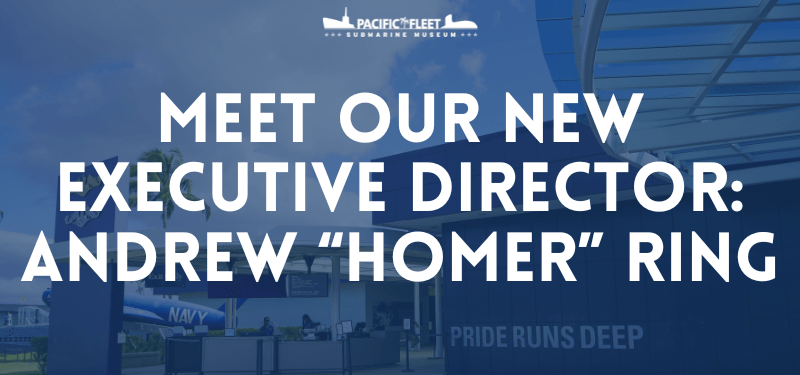
Starting last month as the new executive director of the Pacific Fleet Submarine Museum, Andrew “Homer” Ring acknowledges the legacy of the USS Bowfin submarine and the brave men and women that she honors. Read full story HERE.
Flag Day traces its roots to June 14, 1777, when the Continental Congress adopted the resolution that “the flag of the thirteen United States be thirteen stripes, alternate red and white; that the union be thirteen stars, white in a blue field, representing a new constellation”. However, the formal observance of Flag Day as a national holiday took more than a century to develop.
The modern Flag Day celebration began with the dedicated efforts of Bernard J. Cigrand, a 19-year-old schoolteacher in Waubeka, Wisconsin. On June 14, 1885, Cigrand placed a small American flag in an inkwell on his desk and asked his students to write essays about what the flag meant to them, referring to that day as the flag’s birthday. This simple classroom exercise would spark Cigrand’s lifelong campaign to establish a national Flag Day observance.
Cigrand’s advocacy efforts gained momentum throughout the late 1800s and early 1900s. He moved to Chicago to attend dental school and in 1886 published an article titled “The Fourteenth of June” in the Chicago Argus newspaper, publicly proposing an annual observance of the flag’s birth. His persistence paid off when President Woodrow Wilson issued a proclamation on May 30, 1916, establishing June 14 as Flag Day.
Wilson’s proclamation was particularly significant, as it called for Flag Day to be observed “with special patriotic exercises, at which means shall be taken to give significant expression to our thoughtful love of America, our comprehension of the great mission of liberty and justice to which we have devoted ourselves as a people”. The proclamation emphasized Flag Day as “a day of renewal and reminder” for American ideals and principles.
The U.S. Submarine Force Flag Day Connection
USS Nautilus (SSN 571) Christening January 1954
The most significant connection between Flag Day and the submarine force occurred on June 14, 1952, when President Harry S. Truman laid the keel of the USS Nautilus (SSN-571), the world’s first nuclear-powered submarine. This ceremony at the Electric Boat shipyard in Groton, Connecticut, was deliberately scheduled for Flag Day, marking what Truman called “one of the most significant developments of our time”.
In his Flag Day address at the keel-laying ceremony, Truman reflected on the dual significance of the occasion. He noted that June 14, 1777, marked the 175th anniversary of the flag’s adoption, while also celebrating the dawn of the nuclear age in naval warfare. Truman emphasized that the ceremony represented “not because we are starting a new ship for war, but because we are making a great advance in use of atomic energy for peace”.
The symbolism was profound: on the same date that commemorated America’s national banner, the nation was launching into a new era of maritime power that would fundamentally alter the strategic balance of the Cold War. Truman declared, “Today, we stand on the threshold of a new age of power”.
The Nautilus went on to make history, becoming the first vessel to reach the geographic North Pole on August 3, 1958, and establishing numerous speed and distance records during its 25-year career. The submarine’s achievements validated the revolutionary technology that was born on Flag Day 1952.
In Summary
Submarine operations, by their very nature, often occur far from public view, making the symbolic connection to the flag even more important. The submarine force’s motto of operating “Unseen and On Scene”emphasizes how submarines serve as silent guardians of American interests while carrying the flag into the world’s most remote and dangerous waters.
The intertwined history of Flag Day and the U.S. Submarine Force represents more than mere coincidence, it reflects the deep connection between American naval tradition and national identity. From the Revolutionary War submarine Turtle to the nuclear-powered vessels of today, submarines have served as extensions of American sovereignty and power projection capabilities.
The Flag Day keel-laying of the USS Nautilus in 1952 created a lasting bond between the national holiday and the submarine force, symbolizing how American technological innovation and naval tradition combine to protect and advance national interests. This connection continues to resonate in contemporary submarine force traditions, ceremonies, and observances that honor both the flag and those who have served beneath it in the silent service.
As the submarine force continues to evolve and modernize, the Flag Day connection serves as a reminder of the enduring values and principles that guide American naval service. The flag that was adopted on June 14, 1777, continues to fly over submarines that patrol the world’s oceans, carrying forward the legacy of those who came before and maintaining the proud traditions of the silent service.







 Bowfin Pearl Harbor Base