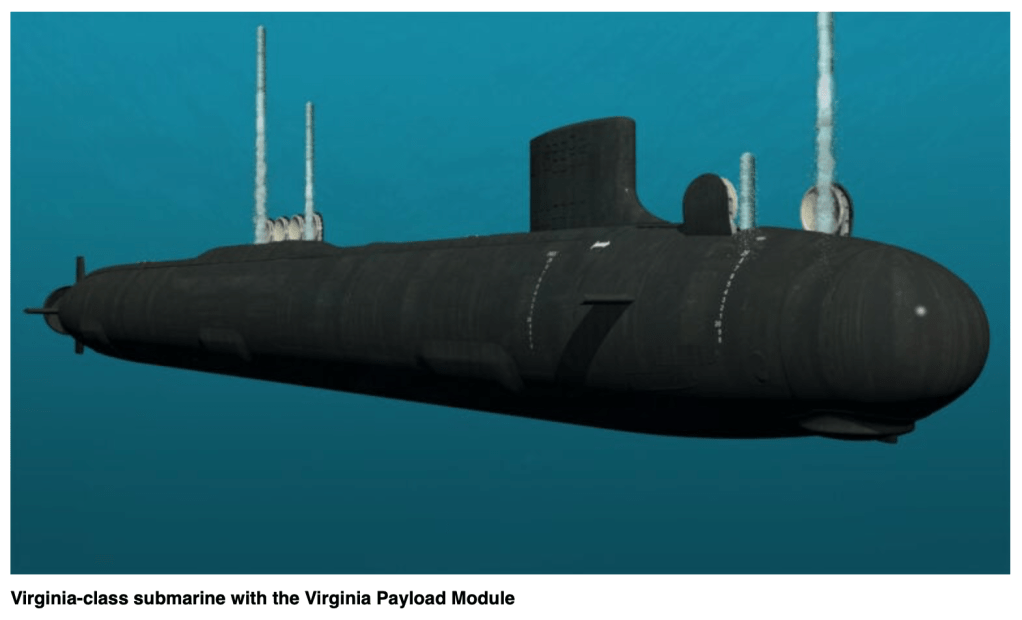
The Navy’s Fiscal Year 2025 budget will ask Congress to fund one Virginia-class attack boat, a break from a steady two-per-year demand signal from the service and a sign that industry is still catching up to the current demand, three sources familiar with the proposed budget submission confirmed to USNI News.
The decision, initially contemplated last year, is a tacit recognition from the Navy and the Pentagon that the two shipyards building the attack boats and the industrial base can’t keep up with the two-per-year pace that the service says it needs to keep the fleet healthy, the sources all confirmed to USNI News.
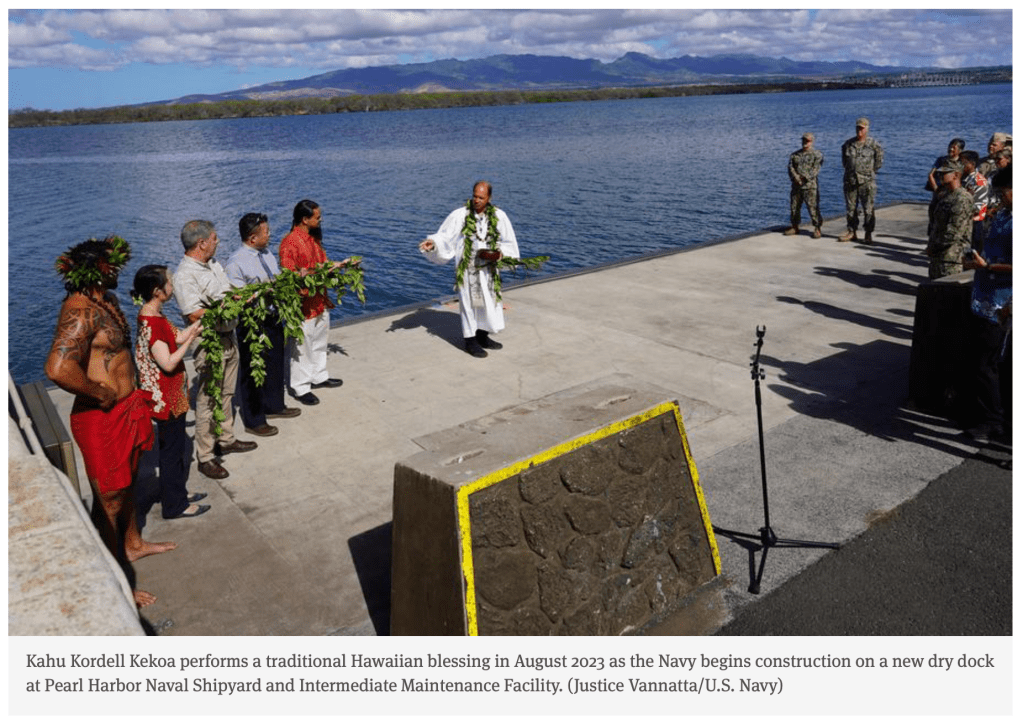
The Navy has begun the most expensive building project in its history with construction of a $3.4 billion submarine-repair dry dock in Pearl Harbor, Hawaii. The initial work of installing foundational piles into the harbor waters began this month, with project completion expected by early 2028.
The initial work of installing foundational piles into the harbor waters began this month, with project completion expected by early 2028.
Celebrating 124 Years Defending Freedom from Under the Sea!
Commodores, Commanding Officers, CSP N-Heads, Command Master Chiefs, and friends of the Submarine Community,
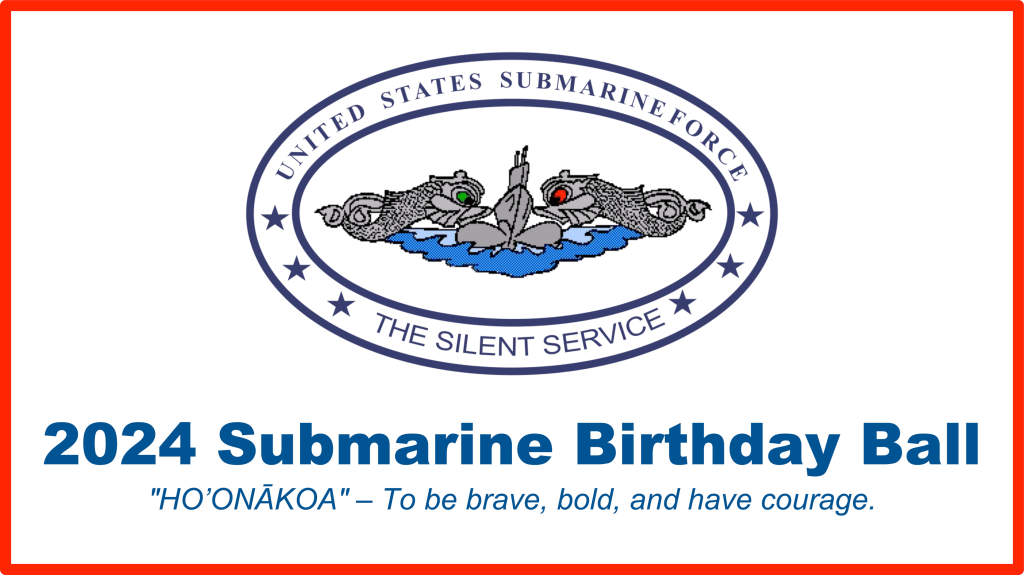
Aloha, the 2024 Submarine Birthday Ball message is out and provided below. This year’s theme celebrates and honors the warrior spirit and is “HO’ONĀKOA” – to be brave, bold, and have courage.
The hotel registration link is active and there are 50 rooms for each night at $202/night + $40 hotel fee. Current cheapest room through direct booking with Hilton is $305/night + various fees and taxes.
For the Wardroom, the EventZilla link is live and active, tickets can now be purchased. We are experiencing some difficulties with EventZilla redirecting to the Hilton hotel reservation link, so if you receive an error message, please try copy/pasting the link directly into a new window and it should work as intended.
LT Adam L. Davis Flag Secretary & Staff Executive Officer Commander Submarine Force, U.S. Pacific Fleet
—–OFFICIAL INFORMATION DISPATCH FOLLOWS—– RAAUZYUW RUOIAAA9005 0440019-UUUU–RUOIAAA. ZNR UUUUU R 130015Z FEB 24 MID60010090253574S FM COMSUBPAC PEARL HARBOR HI TO RUOIAAA/COMSUBRON ONE RUOIAAA/COMSUBRON SEVEN RUOIAAA/NAVSUBTRACENPAC PEARL HARBOR HI RUOIAAA/NAVSHIPYD AND IMF PEARL HARBOR HI RUOIAAA/SUBREADRON THREE THREE INFO ZEN/HQ USPACOM HONOLULU HI RUOIAAA/COMPACFLT PEARL HARBOR HI RUOIAAA/JB PEARL HARBOR-HICKAM HI RUOIAAA/NAVSUP FLT LOG CTR PEARL HARBOR HI ZEN/SDV TEAM ONE ZEN/NAVSPECWARGRU EIGHT LOGSUPPU PEARL HARBOR HI RUOIAAA/NAVIOCOM HAWAII RUOIAAA/COMSUBPAC PEARL HARBOR HI BT UNCLAS MSGID/GENADMIN/COMSUBPAC// SUB/124TH PEARL HARBOR SUBMARINE BIRTHDAY BALL// POC/DAVIS, ADAM/LT/COMSUBPAC/-/TEL:808-473-2458/ EMAIL:ADAM.L.DAVIS26.MIL(AT)US.NAVY.MIL// POC/BREY,CHRIS/CMDCM/COMSUBPAC/-/TEL:808-473-1378/ EMAIL: CHRISTOPHER.L.BREY.MIL(AT)US.NAVY.MIL// RMKS/1. 2024 MARKS THE 124TH ANNIVERSARY OF SUBMARINE SERVICE IN PEARL HARBOR. TO HONOR OUR PAST AND CELEBRATE OUR FUTURE, SUBMARINE ENLISTED AND OFFICER BIRTHDAY BALLS, RESPECTIVELY, WILL BE HELD ON FRIDAY AND SATURDAY, 12 AND 13 APRIL 2024 AT THE HILTON HAWAIIAN VILLAGE. THIS YEAR’S THEME WILL BE “HO’ONAKOA” OR TO BE BRAVE, BOLD, AND HAVE COURAGE. 2. ALL SUBMARINERS – ENLISTED, OFFICERS, ACTIVE, RESERVE, RETIRED, AND ALL FRIENDS OF THE SUBMARINE FORCE, CIVILIAN AND MILITARY, ARE INVITED TO ATTEND THE PEARL HARBOR SUBMARINE BIRTHDAY BALLS. THIS MESSAGE PROVIDES THE LATEST INFORMATION FOR PURCHASING SUBMARINE BIRTHDAY BALL TICKETS AND RESERVING HOTEL ROOMS. 3. LOGISTICS. A. PEARL HARBOR ENLISTED SUBMARINE BIRTHDAY BALL WILL BE HELD FRIDAY, 12 APRIL 2024 IN THE HILTON HAWAIIAN VILLAGE CORAL LOUNGE AND BALLROOM, COMMENCING WITH SOCIAL HOUR (CASH BAR) AT 1700 AND PROGRAM BEGINNING AT 1800. (1) TICKETS ARE AVAILABLE FOR PURCHASE VIA COMMAND SUBMARINE BALL REPRESENTATIVES FOR $100 EACH. (2) UNIFORM. – FULL DRESS WHITES OR DINNER DRESS WHITE JACKET. – CIVILIAN – BLACK TIE OR FORMAL BUSINESS ATTIRE. – COVERS ARE NOT REQUIRED. B. PEARL HARBOR OFFICER SUBMARINE BIRTHDAY BALL WILL BE HELD SATURDAY, 13 APRIL 2023 IN THE HILTON HAWAIIAN VILLAGE CORAL LOUNGE AND BALLROOM, COMMENCING WITH SOCIAL HOUR (CASH BAR) AT 1700 AND PROGRAM BEGINNING AT 1800. (1) TICKETS ARE AVAILABLE FOR PURCHASE VIA EVENTZILLA, https://events.eventzilla.net/e/124th-pearl-harbor-submarine-birthday-ball-officer-2138606437 SELECT THE EVENT, 2024 PEARL HARBOR OFFICERS SUBMARINE BIRTHDAY BALL, OR SEARCH EVENTS BY LOCATION, HONOLULU, HI. – SELECT THE NUMBER OF TICKETS, DINNER PREFERENCE AND COMMAND, RETIREE, OR CIVILIAN. TICKETS ARE $110 EACH FOR O3 AND BELOW OR $130 EACH FOR O4 AND ABOVE AND CAN BE PURCHASED WITH A CREDIT CARD OR BY PAYPAL. – TICKETS MUST BE PURCHASED NO LATER THAN 5 APRIL TO ENSURE GUESTS ARE SEATED WITH THEIR RESPECTIVE COMMANDS. (2) UNIFORM. – O5 & ABOVE: DINNER DRESS WHITE JACKET. – O4 & BELOW: DINNER DRESS WHITE OR OPTIONAL DINNER DRESS WHITE JACKET. – CIVILIAN – BLACK TIE OR FORMAL BUSINESS ATTIRE. – COVERS ARE NOT REQUIRED. (3) INFORMATION FOR ASHORE AND AFLOAT COMMAND RECOGNITION AND CENTERPIECE COMPETITION WILL BE PROMULGATED SEPCOR. 4. HOTEL RESERVATIONS. FOR BOTH THE OFFICER AND ENLISTED SUBMARINE BIRTHDAY BALL, A BLOCK OF ROOMS AT THE HILTON HAWAIIAN VILLAGE AND HILTON DOUBLE TREE ARE AVAILABLE. SPECIAL RATE ONLY APPLIES FOR ROOMS BETWEEN 12-13 APRIL 2023. (1) HILTON HAWAIIAN VILLAGE – 50 ROOMS ARE AVAILABLE PER NIGHT. – NIGHTLY RATE OF $202, $40 PER NIGHT FOR OVERNIGHT PARKING. – EVENT LINK: https://www.hilton.com/en/attend-my-event/usnsubmarinebirthdayball/ 5. ALL WHO READ THIS MESSAGE ARE ENCOURAGED TO TAKE PART IN THIS TIME HONORED TRADITION AS WE CELEBRATE THE 124th ANNIVERSARY OF OUR FORCE AND PROVIDE TRIBUTE TO THOSE WHO HAVE GONE BEFORE US TO DEFEND FREEDOM AND DEMOCRACY FROM UNDER THE SEA.// BT #9005 NNNN
Dolphin Scholarship Foundation | February 13, 2024
Grab your pen and start sketching!
Contest Rules
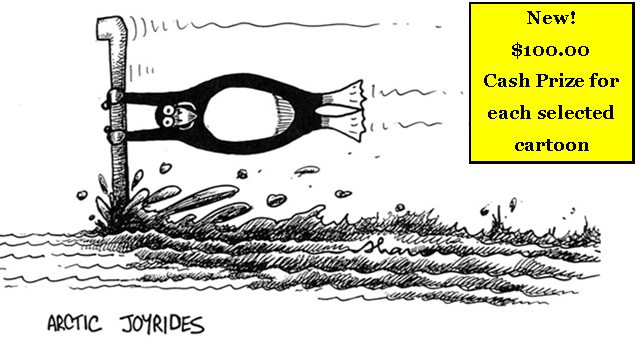
1. Twelve (12) drawings will be selected for the 2025 Dolphin Scholarship Foundation cartoon calendar.
2. Drawings are to be humorous and submarine themed depicting life in the Submarine Service.
3. All cartoons must be: - Original artwork, not copies. - Hand drawn in black ink (not pencil) on white paper OR black & white computer generated. - Landscape orientated on 8 ½ x 11 paper.
4. Please print on a separate piece of paper: - Artist’s Name; - If current or former military member: rank/rate and duty station; - If dependent: sponsor’s name, rank/rate, duty station, and artist’s age if under 18; - Mailing address, e-mail address, & phone number.
5. Please DO NOT fold entry.
6. $100.00 cash prize for each selected cartoon.
7. Entries due by June 15, 2024.
Direct all entries (keep the originals!) or questions to:
Dolphin Scholarship Foundation 4966 Euclid Road, Suite 109 Virginia Beach, VA 23462
***IF SENDING DIGITALLY, PLEASE RETAIN ORIGINAL. WE MAY REQUEST A PAPER COPY IF A HIGHER RESOLUTION IS NEEDED FOR PUBLISHING***
Our Contact Information Dolphin Scholarship Foundation 4966 Euclid Road, Suite 109 Virginia Beach, VA 23462 757-671-3200 http://www.dolphinscholarship.org
To perpetuate the memory of our shipmates who gave their lives while voluntarily serving in submarine warfare in the pursuit of their duties while serving their country. That their dedication, deeds and supreme sacrifice be a constant source of motivation toward greater accomplishments. To further promote and keep alive the spirit and unity that existed among submarine crewmen during World War II. To promote sociability general welfare and good fellowship among our members. To pledge loyalty and patriotism to the United States of America and it’s constitution.
1. Bowfin Pearl Harbor Base
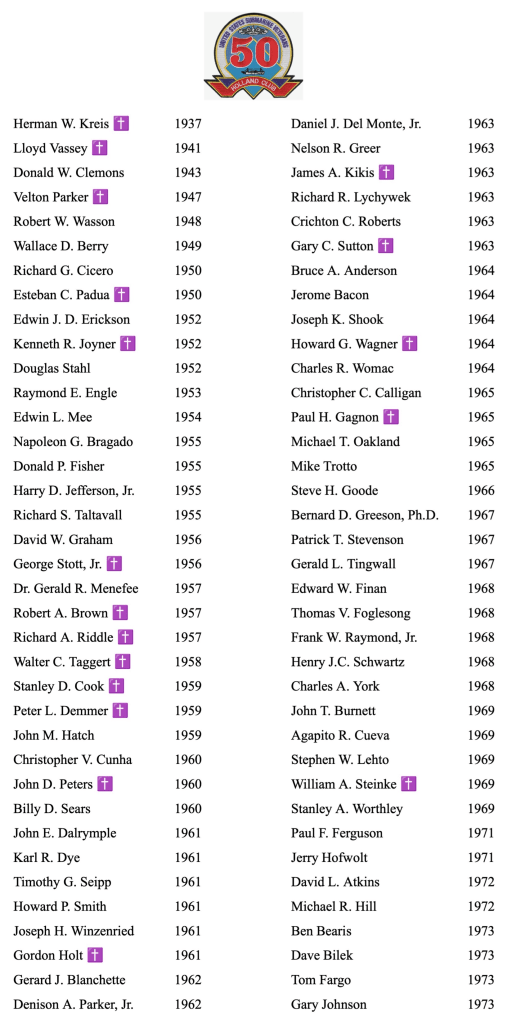
Bowfin Meeting – Bowfin Meeting – We conducted our February meeting at Clean Sweep Bar, Lockwood Hall. The following members attended – COB Gary Johnson, Secretary Brett Kulbis, Treasurer Carl Tatro, George Barlett, Hap Belisle, Rodney Boucher, David Danby, Dan Del Monte, Karl Dye, Paul Ferguson, Nelson Greer, Gary Grisham, Ace Parker, Crichton Roberts, Tim Seipp, Wade Thode, and Joe Winzenried.
Welcomed Guests – Dorothy Brown, Nancy Kreis, Sandra Parker, Johanna Vacerro, Renee Ferguson, William Thode, and Frank Diaz. Mahalo to Gary Grisham for bring Subway sandwiches for the meeting.
Binnacle List – Please keep the following members and their families in your good thoughts and prayers: Paul Jurcsak who fell and shattered his shoulder, Charlie and Linda Womack, and Chris Cunha.
Bowfin Scholarship Fundraiser – On Saturday, February 17, 2024 from 6 p.m.-8 p.m., the Pacific Fleet Submarine Museum and Battleship Missouri Memorial will co-host a one-night only exclusive “sneak peek” at the local nightlife during the wartime years. This will fund the Bowfin Scholarship. General Admission Tickets ($30) can be purchased in advance at: https://tickets.pearlharborhistoricsites.org/webstore/shop/viewitems.aspx?cg=eventsbo&c=bosl.
We voted to donate $1,000 to the Bowfin Scholarship Fund.
Eagle Scout Project – The project to repair the picnic tables and benches at the USS Parche Memorial Park by Boy Scout Vincent Warr has been approved by NAVFAC. Repairs are scheduled to be conducted the weekend of 17-18 February. In additional support Bowfin Pearl Harbor Base will be providing lunch.
Pearl Harbor Submarine Officers’ Spouses’ Association – The PHSOSA Golf Tournament Fundraiser has been cancelled. We voted to allow them to keep our $1,000 (Nautilus Level) donation.
USSVI Award Season Opens – The 2024 awards season opens on 1 February. Dates to remember:
FEBRUARY 1: Award Nomination period opens and all USSVI Members in good standing submit Award nominations to the National Awards Chair.
APRIL 30: All Award nominations must be received by the National Awards Chair at the close of business on this date.
MAY 5: The National Awards Chair submits nominations to the respective Award on Committee Chair for evaluation, voting and selection of recipients.
2011 – Established Stanley K. Nicholls Award – awarded to the Base Member who, by his personal individual efforts and participation during the preceding years contributed the most to the advancement and embodiment of the USSVI Creed and Agenda, and by his dedicated service and support to the Bowfin Base Pearl Harbor and his fellow Submarine Veterans exemplifies the meaning and spirit of the word, “Shipmate.”
2011 – Base begins efforts to produce a plaque for the USS Growler, the Hawaii State Boat, to place at the Arizona Memorial.
1986 – Members encouraged to write Congress in opposition to turning Fort DeRusy land over to the State of Hawaii.
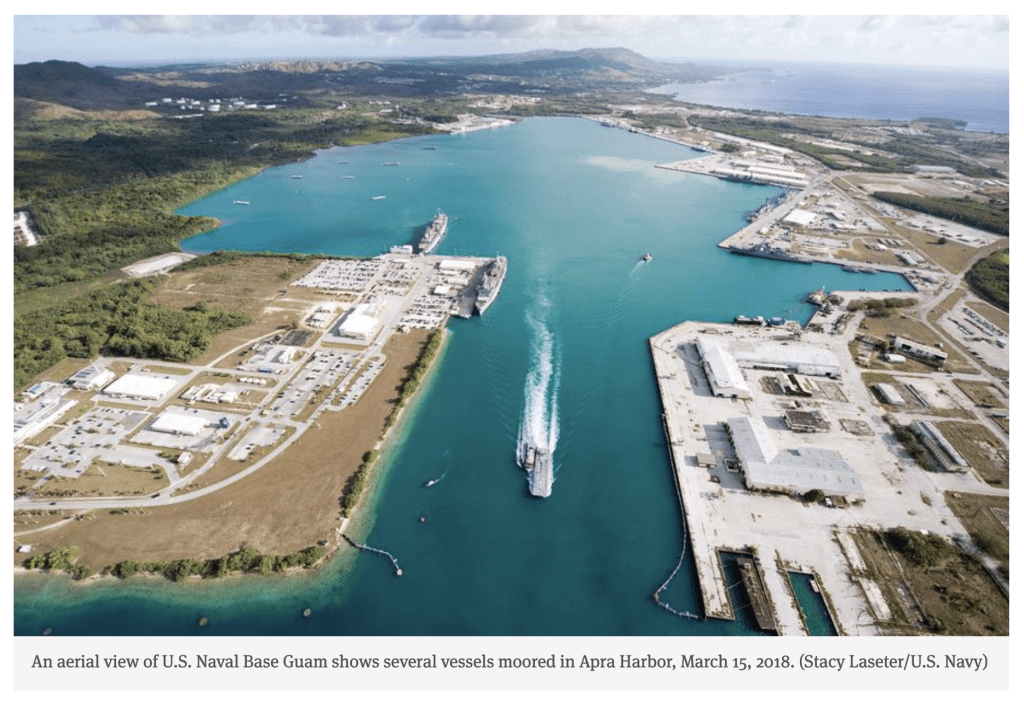
A second, larger contingent of Australian sailors is training alongside U.S. counterparts on Guam as part of an agreement to create a nuclear-powered submarine force for the Australian navy.
Australia sent 37 officers and enlisted personnel to Naval Base Guam to train aboard the submarine tender USS Emory S. Land, according to a Feb. 4 news release from the country’s Department of Defence.
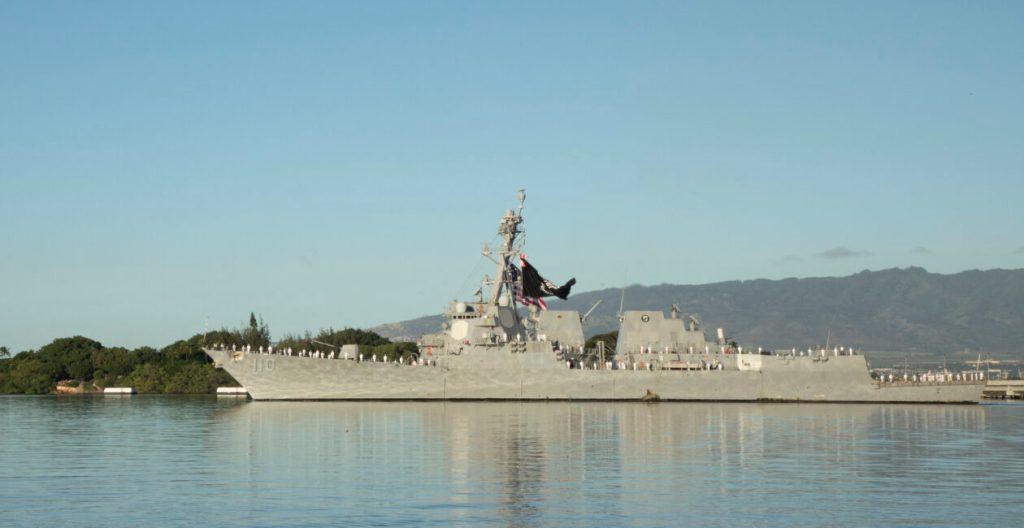
HONOLULU, HI – DECEMBER 07: The Pass-in-Review by the USS William P. Lawrence (DDG 110) as Pearl Harbor Commemorates the 78th Anniversary Of World War II Attacks at the Pearl Harbor National Memorial on December 7, 2019 in Honolulu, Hawaii. On the morning of December 7, 1941 the Japanese mounted a surprise military air strike on the naval base at Pearl Harbor leading to the United States’ formal entry into World War II the next day. 2,335 were killed in the attack and dozens of naval ships were damaged or sunk. (Photo by Kat Wade/Getty Images)
By the time police responded to a call shortly before 10 a.m. regarding a Chinese man and woman conducting surveillance near a security entrance of the historic Joint Base Pearl Harbor Hickam, the two fled in what police identified as a 2021 silver Nissan Altima, with unidentified plates.
The two suspects had been “capturing digital media of the entry control point,” police said. Later that afternoon the pair–a man with a black crew cut and the woman with shoulder-length hair, a pink top, and a white skirt–appeared at another entry point. Police issued a “BOLO,” or “be-on-the-lookout,” notice for the two at all base entrances.
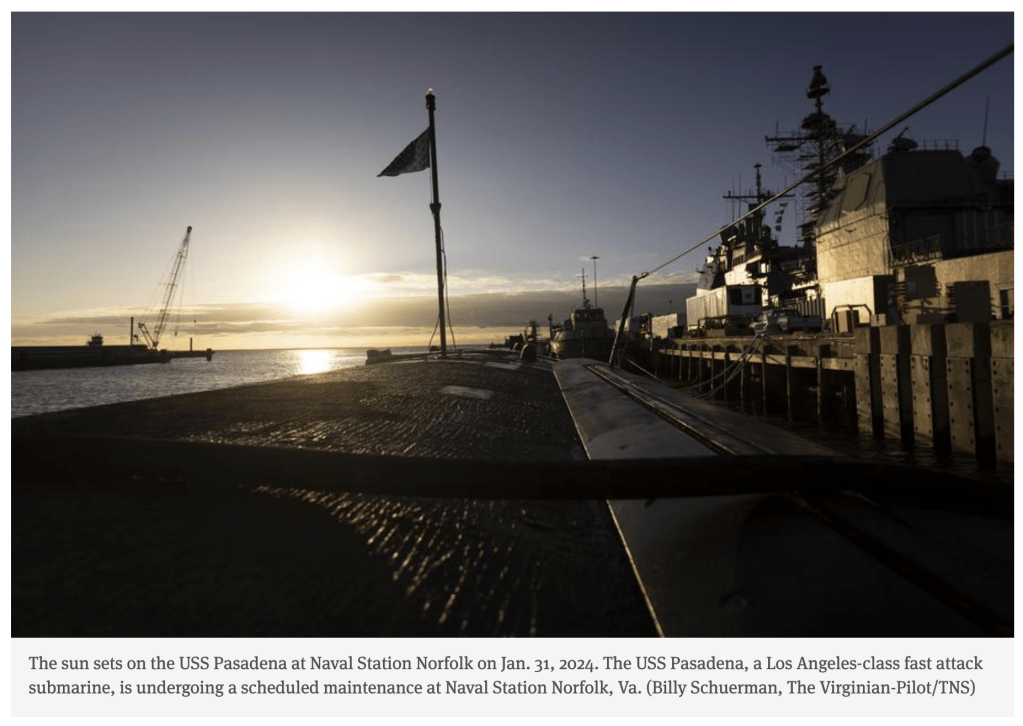
What allows the Pasadena, as well as every submarine in the Navy’s fleet, to live up to the “anytime, anywhere” motto is the ability to be self-sufficient. This includes making its own fresh water and oxygen for the 140 sailors on board.
“Every time we make the decision to surface, we are saying, ‘Here we are,’ ” said Senior Chief Petty Officer Eddie Murray, the master chief of the Pasadena’s engineering department.
The Spanish-American War paved the way to Hawai’i. Within a decade, the U.S. not only annexed Hawai’i in 1898, but also the Philippine Islands and Guam. Thus, American isolationism died and ushered in a new era in U.S. naval history.
The acquisition of Hawai’i not only advanced Admiral Alfred Thayer Mahan’s program for American control of the Pacific but promoted trade and commerce. Mahan had urged acquisition of Hawai’i back in 1893. He was a naval strategist whose historical studies convinced him of the supreme importance of naval power and of the imperative necessity for the U.S. to strengthen its position in a highly competitive world.
Mahan advocated a big peacetime Navy. The acquisition of bases was a requisite of sea power. Mahan’s theories captivated young Assistant Secretary of the Navy, Theodore Roosevelt. So when Roosevelt became president in 1901, he stressed the importance of bolstering up America’s naval power. However, in 1903 there was not a single American naval base in Asiatic waters; ships of the Asiatic Squadron were dependent on dockyards at Nagasaki and Hong Kong. With the construction of Roosevelt’s large fleet, dockyards and coaling stations became vital.
These stations were part of the base facilities necessary to make naval activities in the Pacific self-sufficient in an emergency. At the time, only two ships in the Navy were capable of steaming from San Francisco to Manila without refueling. Development of Hawai’i was imperative. However, a base was desirable in the Philippines to support America’s policy toward China. U.S. defense officials could not agree on the best location for the establishment of a base in the Philippines. The Navy’s choice in January 1901 was Subic Bay. The Army preferred Cavite in Manila Bay for the naval base. Funds were appropriated for a base at Olongapo in Subic Bay In 1904. But funds for the development of a base at Pearl Harbor were suppressed.
In 1906, a board, headed by Secretary of War Taft, investigated the development of naval bases. The board found Pearl Harbor to be a port of secondary strategic importance. They found Puget Sound, San Francisco Bay, and Subic Bay to be strategically our most Important ports in the Pacific. However, pressure mounted for recognition of Hawai’i. The Navy Department sought development at Pearl Harbor.
In 1907, the U.S. Navy stationed the first submarines overseas in the Pacific. Two A-class boats, the A-6 and A-7, were disassembled for transportation to the Philippine Islands on board the USS Caesar (AC-14), a collier. Finally, on 13 May 1908, Congress appropriated funding to commence “immediate” development of Pearl Harbor. This decision to build a major base at Pearl Harbor was sound in that it clinched the American position in the central and eastern Pacific.
In 1913, five C-class submarines made a historic 700-mile voyage from Guantanamo Bay, Cuba, to Cristobal, Panama Canal Zone. These little submarines, with a displacement of only 238 tons and powered by small gasoline engines, completed the cruise without any difficulty. Up to that time this was the longest cruise ever undertaken by any U.S. submarines. The overall success of this venture elevated the submarine out of the role as a purely defense weapon. Prior to this, the submarine’s principal role had been for coastal and harbor defense.
The trans-Caribbean undertaking offered a new perspective for submarines. The Navy Department was taking another look at the possibilities of the submarine. The feat encouraged Secretary of the Navy, Josephus Daniels, to consider expanding submarine activities to Hawai’i.
Several months later, with the installation of German-type diesel engines in the new E-class, submarines were afforded an improved status in safety, speed, and radius of action. Even though Hawai’i did not possess adequate facilities to maintain submarines, the positioning of submarines in Hawai’i was not thwarted.
Prior to the outbreak of World War I, little consideration was given to the care and maintenance of submarines, except at primary navy yards and stations. No definite plans were laid down for the establishment of bases for the maintenance of submarine detachments outside the established navy yards.
SUBMARINES IN HAWAI’I
Four F-class submarines were selected for duty in Hawai’i. The submarines were transferred from the First Submarine Division in San Pedro, California to Mare Island Navy Yard for preparation. Incapable of making the 2400-mile trip on their own, the four boats would be towed to Hawai’i by two armored cruisers, the USS South Dakota (CA-9) and USS West Virginia (CA-6).
At Mare Island, the submarines underwent a general overhaul, obtained special fittings and preliminary training of the crew for the special transoceanic crossing. Finally the eventful day arrived. The two cruisers upped anchor shortly before dawn on 16 July 1914 and stood down the bay from Mare Island. Steaming through the Golden Gate, the two ships rendezvoused off-shore near the Farallon Islands with two of the F-boats. Two separate crossings would be required.
Once in position, the cruisers passed towlines to the USS F-1 (SS-20) and USS F-3 (SS-22). The tedious crossing was completed on 1 August. Upon refueling, the two cruisers returned to California for the two remaining submarines. On 15 August, the USS F-2 (SS-21) and USS F-4 (SS-23) were taken in tow and by nightfall of 24 August had safely reached Hawai’i.
Another component that would make up the balance of the First Submarine Flotilla in Hawai’i was the support vessel USS Alert (AS-4), an old 1874 Iron gunboat. In 1911, the Alert was converted into a submarine tender and in 1914 chugged across the Pacific to a new homeport in Hawai’i.
The four submarines and Alert moored at Pier 5 (the old Flat Iron Pier) across Ala Moana Road from the Old Naval Station in downtown Honolulu. Bachelor officers from the submarine flotilla were quartered on board Alert and the rest of the crew housed in nearby barracks. All hands messed on board Alert.
In those pioneer days, submarines remained tied close to their tenders. Training operations were limited and generally conducted out of Honolulu Harbor seldom exceeding ten miles, the distance an F-boat could travel on the surface in an hour.
On 25 March 1915, tragedy struck! The F-4, under the command of Lieutenant Alfred L. Ede sank off Honolulu Harbor in 305 feet of water during a training dive. All hands perished!Extensive salvage efforts were undertaken and by August the F-4 was finally raised to determine the cause of the loss.
Upon completion of the Board of Inquiry’s investigation, the hulk was towed from Honolulu to Pearl Harbor and sunk in the loch between Quarry Point and Kuahua Island. In 1940, when new piers were to be erected in this vicinity, a dredge dug a deep ditch alongside the wreck and the F-4 rolled into it — where it remains to this day. The remaining F-boats continued operating on a limited basis and would eventually be towed back to the mainland.
THE NEED FOR A SUBMARINE BASE
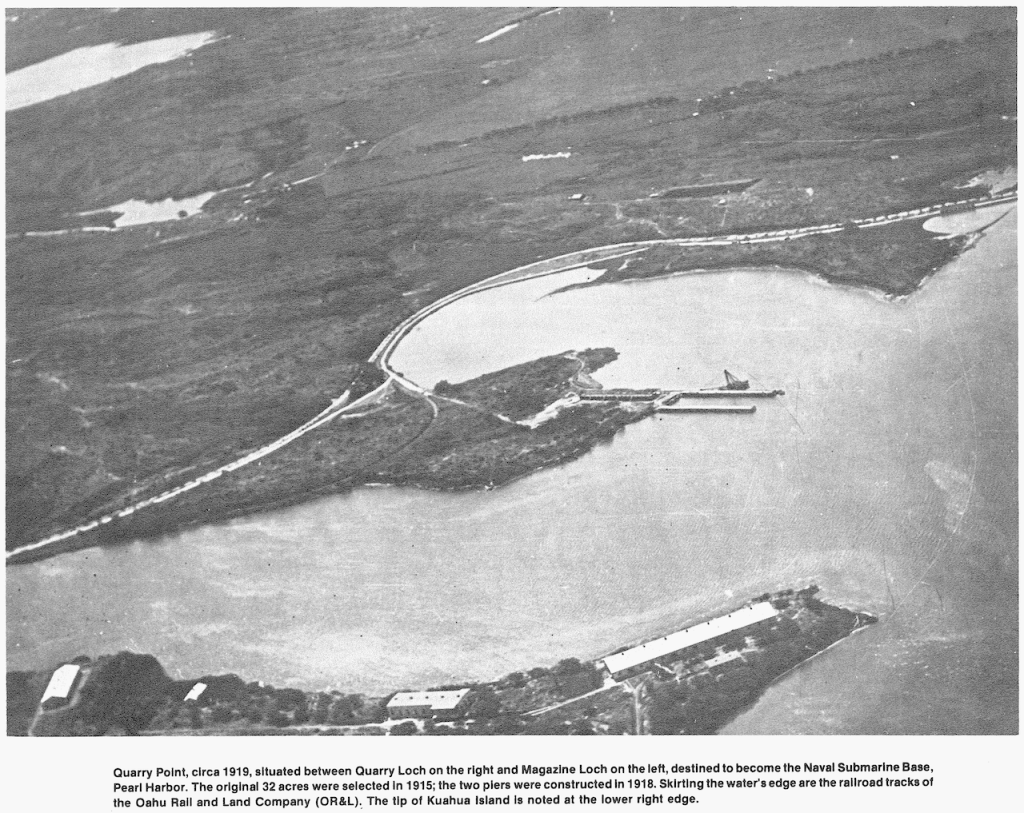
Studies were being conducted by the Bureau of Yards and Docks with a view toward the development of a typical submarine base. The plan detailed specific types of shop buildings, barracks, and piers required for a submarine base of the time. Secretary of the Navy Daniels submitted a letter to the Navy’s General Board concerning submarine shore bases. The letter stipulated the Intentions of the Secretary to “submit to the coming Congress estimates for the construction of submarine shore bases.” The plans for a typical submarine base were approved in September 1915. Hawai’i was a part of this plan on 14 October 1915, Admiral George Dewey, President of the Navy’s General Board, signed an endorsement concurring with the recommendation that “Quarry Point is the best location for the proposed submarine base at Pearl Harbor.”
FIRST SUBMARINES IN PEARL HARBOR
In October 1915, units comprising Submarine Flotilla Three departed San Francisco for duty in Hawai’i. This flotilla was composed of four K-class submarines, the K-3, K-4, K-7 and K-8. The flotilla operated briefly from Honolulu Harbor and in November shifted operations to Pearl Harbor. The facilities at the Old Naval Station in Honolulu were inadequate for submarine operations. A temporary base was established at Pearl Harbor on Kuahua Island, which was later commissioned as the Naval Ammunition Depot and called Magazine Island. Today this is the site of the Naval Supply Center.
Again the submarine tender Alert provided support. The K-boats conducted torpedo and diving tests, and participated in operations developing tactics in submarine warfare. But when America’s Involvement in World War I called for increased naval activity, the K-boats were reassigned. On 31 October 1917, the K-boats departed Hawai’i for Key West, Florida. Hawai’i was without submarines.
DEVELOPMENT OF SUBMARINE BASE, PEARL HARBOR
In March 1917, funds were allocated for the construction of two creosoted-timber piers at Quarry Point. This marked the beginning of submarine development at Pearl Harbor.
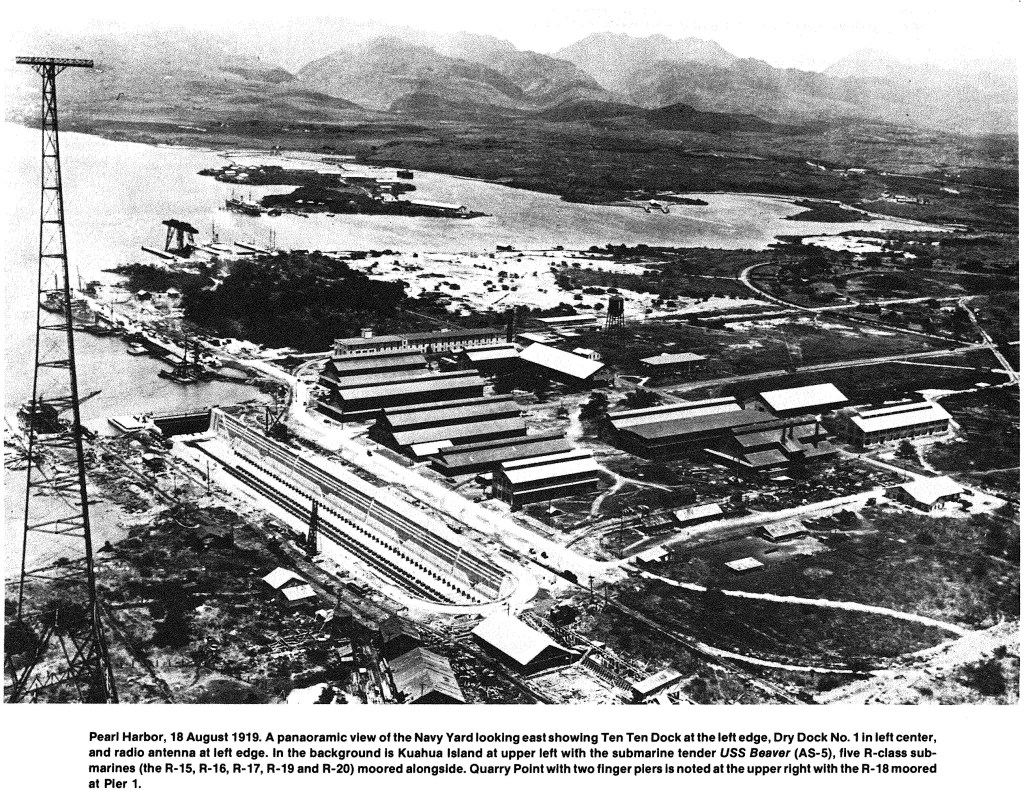
Shortly after the Armistice was signed in 1918, six R-class submarines were assigned to the Hawaiian area to establish the submarine base at Pearl Harbor. On 17 June 1919, the submarine tender USS Beaver (AS-5), a converted merchantman, and the six R-boats (R-15 through R-20), departed San Francisco for Hawai’i. This contingent comprised Submarine Division Fourteen under the command of Lieutenant Commander Felix X. Gygax, a pioneer submariner and first Officer in Charge of the Submarine School In New London, Connecticut.
The Honolulu Star-Bulletin of 25 June, described the arrival of the submarine division in Hawai’i. “The first unit of the new naval defense for these islands, consisting of the mother ship Beaver and six submarines of the R type, will make Oahu this afternoon, and will be berthed near the drydock at Pearl Harbor. The six subs form the advance guard of boats of this type to come here for permanent duty.”
Upon entering Pearl Harbor, all the submarine division found were two finger piers constructed at the site of today’s submarine base at Quarry Point. The R-18 moored at Pier 1 of the submarine base to charge air and batteries, thus becoming the first submarine to moor at the base. The Beaver and remaining fl-boats anchored nearby but would eventually moor at Kuahua Island.
Sometime after arrival of the squadron, land at Quarry Point began to be cleared of cactus, rocks and algaroba trees by the enlisted forces for the erection of temporary buildings. No funds had been appropriated for any construction, so the base force lived ashore in tents provided by the Beaver.
In August 1919, the battleship New York arrived with Secretary of the Navy Daniels and other dignitaries comprising a Special Board of Inspection of Naval Bases on the Pacific Coast. The Board recommended on 20 October, that a first class naval base, capable of taking care of the entire U.S. Fleet in time of war, be developed immediately in Pearl Harbor. Among the Board’s recommendations included an appropriation of over a million dollars for a complete submarine base which included dredging around the piers.
In October 1919, a building constructed from wartime wooden huts removed from Base No. 1 at Queenstown, Ireland, was commissioned as a sick bay at the submarine base. This complex included a second wooden building that served as a store and issuing facility. These structures served as the base dispensary until completion of a permanent building (Bldg. 665) in 1936. Hospital corpsmen were quartered in tents at Quarry Point.
The first Ship’s Service Department in the Fourteenth Naval District was established at the base in 1919. A Ship’s Service at the Naval Station did not commence operation -until a few years later. The volume of business in those early stores was certainly meager compared to the volume of business in today’s Navy Exchange facilities. Yet the services provided in the early stores were quite varied and included practically everything necessary or convenient for naval personnel. In many instances, credit provisions were so inclusive that naval personnel could have all charge accounts with commercial stores, including utility bills and house rent paid by the Ship’s Service Department, which, in turn would submit an invoice for the entire household expense at the end of the month.
On 18 November 1919, the Navy promulgated General Order No. 510 and was signed by Secretary of the Navy Josephus Daniels. This order (The Status of Shore-Based Submarine Organization), defined the status and directed the methods to be employed In administering and operating the shore-based submarine organizations. The intention was that all matters of personnel and material, within the submarine bases, should parallel as closely as possible that of mobile submarine tenders. This directive stipulated that “Commissioned and enlisted personnel of the bases not included in the crews of the vessels based thereon will be attached to the small tenders or other surface vessels assigned for exercise purposes. Officers commanding bases will command the vessels to which such personnel are attached. For instance, the officer in command at New London will command USS Fulton (assigned at present), and all personnel not attached to commissioned vessels of the organizations based thereon will be attached to Fulton.” As a result, Gygax assumed command of the resident tender, the USS Beaver.
General Order No. 510 defined the status of the submarine base at the time. The directive stated “Pearl Harbor (the Submarine Base) is within the naval station. Immediate senior is commandant of the fourteenth naval district.” The submarine base had not been officially established or commissioned.
On 19 December 1919, the protected cruiser USS Chicago (CL-14), arrived and anchored temporarily off-shore near the base. The old cruiser had once been commanded by the illustrious Alfred T. Mahan and was now relieving the Beaver as the resident tender. Chicago would eventually moor at the base to provide berthing accommodations for officer personnel.
In February 1920 the temporary facilities at Kuahua Island closed down and operations shifted to Quarry Point.
A veil of secrecy has always surrounded submarine development and, to some extent, the development of the submarine base. There is a definite lack of historical documentation reflecting the development of our submarine bases. This book attempts to partially alleviate this situation and to preserve vital elements of our submarine history. This then, is the story of one of our submarine bases, the Naval Submarine Base, Pearl Harbor, Hawaii.
It is impossible to describe every particular event in detail or to cover all the individuals who merited recognition for their contributions to the successful accomplishment of the base’s task. This history has been kept as impersonal as possible, and has been made a record of the teamwork achieved under the aspiring leader- ship of numerous individuals.
This publication provides a short history of the base; however, research continues in an attempt to uncover the actual establishment date of the base. Why has this date been difficult to ascertain? There are several reasons why an establishment date is hard to determine.
For many years it was believed the base was established on 2 February 1920 and Commander Chester W. Nimitz was the first commanding officer. Research has proven this to be incorrect. Nimitz was still serving on board the battleship USS South Carolina (BB-26) in Norfolk, Virginia at the time.
Normally when a base is established the Navy Department will promulgate a General Order, signed by the Secretary of the Navy. Research has failed to uncover such a document for this base.
The base was attempting to develop during the era of disarmament. The World War I experience with the submarine left disturbing residual effects on naval doctrine and policy. It was very clear that this rapidly developing weapon had profoundly altered the conduct of war upon the sea. The submarine had undergone “enormous development” during World War I. It had remarkable qualities of “concealment and surprise.” The submarine had forced changes in capital ship design, in fleet organization, and in tactics. And, Great Britain could not forget their narrow escape from certain disaster inflicted by German U-boats. With this memory vividly in mind, Great Britain came to the Paris Peace Conference in 1919 armed with a proposal to abolish the submarine.
This proposal had the support of American statesmen and their naval advisers. A Navy Department memorandum prepared just before the armistice favored the total suppression of submarines. And this posi- tion was elaborated in a further memorandum prepared for President Wilson in Paris. In this document the American naval staff recommended that “all submarines in the world should be destroyed, and their future possession by any power forbidden. They serve no useful purpose in times of peace. They are inferior to surface craft in time of war except in ability to treacherously attack merchant ships. Civilization demands that naval war be placed on a higher plane and confined to combatant vessels. So long as the submarine exists it will be used in the stress of war to attack neutral trade.”
This radical proposal does not appear to have been considered very seriously in Paris. The French opposed it. Thus, the question was lost during the prolonged hassle of whether the Allies should destroy or distribute the ships of the defeated German Navy.
The outlook for abolishing the submarine dimmed following the Paris Peace Conference. However, when President Harding entered the White House in 1921, he pledged to take steps toward the limitation of armaments. He summoned an international conference to be held in Washington.
During the Washington Conference on Limitation of Armament in 1921-22, the future of the submarine was again one of the major problem areas. Once more, Great Britain proposed abolishment of the submarine. However, the attitudes toward the submarine had changed. The admiralties of Japan and Italy found in the submarine promising solutions for certain of their strategic problems. French naval authorities discovered in the submarine a possible solution to their centuries old quest for an inexpensive counterpoise to England’s overwhelming command of the sea. And, naval opinion in the U.S. veered away from the radical proposal supported at Paris. The U.S. had no intentions of giving up the submarine.
So when the Washington Conference assembled in November 1921, all the principal naval powers, except Great Britain, had plans to further strengthen their submarine forces. The Conference would drag on for weeks and weeks. The Conference halted the armaments race and achieved much in limiting capital ships and aircraft carriers, but it failed to agree to limit submarines in any way.
Another side note of this Conference, Japan proposed the U.S. “agree not to increase the fortifications or naval bases at Guam, the Philippine Islands, and Hawaii.”
Treaties initiated at the Washington Conference were due to expire in 1936 and, in 1930, the main naval powers met in London to try to reach agreement on what was to follow it. Since the Washington Conference the British had never ceased to advocate the total abolition of the submarine and this was still their vow when the delegates assembled in London. But once again, Great Britain failed to secure the abolition of the submarine at the London Naval Conference.
The aforementioned events should provide the reader with a better insight into the political environment which existed during the postwar years of World War I. Precisely what impact those tumultuous years of dis- armament talks cast upon the early development of the base is not known. Certainly the overall effect could have delayed the promulgation of a Navy Department General Order to establish the base.
Relatively little information was available locally in the early years of the base. The Naval Historical Center and National Archives remain one of our finest assets. Also, it is very possible valuable information was inadvertently lost or destroyed during the disestablishment of the Fourteenth Naval District during the late 1970s. However, despite the adversities, the search continues and the mystery of when the base was established prevails.
The publication of this history could not have been accomplished without the support and assistance of numerous individuals. I am extremely indebted to Dr. Dean C. Allard, Head of Operational Archives Branch, Naval Historical Center, Washington, D.C., and Ms. Elaine C. Everly, Assistant Chief of Navy and Old Army Branch, National Archives, Washington, D.C., for their support of our endeavors and in providing needed materials. Also, to Mrs. Dorothy Fuller, Head Librarian of the Naval Base, Pearl Harbor, for her invaluable assistance in offering material. The Naval Submarine Base Photo Lab provided indispensable support and service. Their expertise supplied an in depth profile of photos from the past and present.
Lastly, my appreciation to Captain George R. Stubbs, Commanding Officer, Naval Submarine Base, Pearl Harbor, for his desire to publish this history. Without his support and encouragement, this project could not have been accomplished.





 Bowfin Pearl Harbor Base