
By Nelson Greer former EN1(SS)
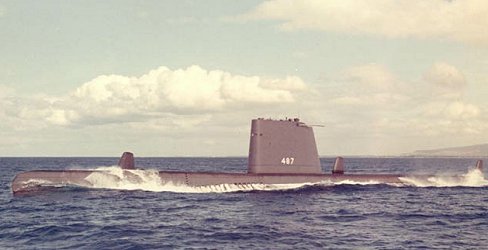
Maybe we were doing an anti-submarine warfare exercise with some ancient black-smoke-belching destroyer on that day in 1963. Or perhaps we were performing precision periscope practice by peering at a panoply of people surfing and sunning on the South Shore of Oahu at Sandy Beach. The men standing watch in the Forward Engine Room of the USS Remora (SS 487) had no periscope to peep through nor sonar to keep an ear on things. No rumbling diesel engines disturbed their peace as the boat was running submerged on the batteries.
It was an easy engine room watch with plenty of time to catch up on swapping sea stories. The only things in operation were a couple of ventilation fans. A wary eye was always kept on the bilges, as an unexplained rise indicates a problem. And this bilge level was rising. An inspection revealed that water was streaming out of our snorkel exhaust drain line, which originated outside the pressure hull. The engine exhaust valves were closed and this section of piping should have been dry. A report was duly made to the powers that be.
The captain surfaced the boat so that the source of the leak could be identified. His fear was that if the snorkel exhaust piping itself was leaking, we would have to abort our beach bunny spy mission and return to Pearl Harbor for repairs. We cobbled together a test rig to put pressure into the drain piping, and all 12 of our Enginemen lay topside to listen for the tell-tale hiss of compressed air escaping.
Fortunately, it was the two-inch-diameter exhaust drain line that proved to be the culprit. Even more fortunately, it was a gasket sandwiched between two pipe flanges that was the source of our problem. This could easily be repaired by us on the spot.
Unfortunately, this pipe joint was located below a maze of other piping in the superstructure underneath our topside deck. The only way to get to it would be to prop open a section of the deck for access, crawl in and belly along the top of the pressure hull to the leaking connection. I was an 18-year-old know-it-all non-qual fireman apprentice Engineman striker, and most importantly, skinny. Our crusty old WWII-era Chief Engineman volunteered me for the task.
This would have been a duck soup job to do in port, and I would have thoroughly enjoyed slithering around like a sea snake. But the Remora was lying dead in the water, rolling in the troughs with a steady southern swell washing through our superstructure every eleven seconds. We were standing topside out of reach of the waves, peering down through the slats of the deck observing the motion of the ocean. We could clearly see our target pipe joint for four seconds. Then it would disappear underwater for seven seconds (and yes, somebody timed it). Just like clockwork. Rising air bubbles removed all doubt that this was the location of our problem. These were not optimal work conditions.
A shipmate handed me two 3/4-inch wrenches and a new gasket and then growled in my ear that a naval operation with 6 submarines, 14 destroyers, 3 aircraft carriers, and a battleship was waiting for me to get my non-qual ass down there and fix that frigging leak. I sloshed and wriggled to my destination and found that I fit very snugly on my belly tightly jammed between the bottom of the snorkel exhaust pipe and the top of the pressure hull. This was a good thing because Mr. Pacific Ocean was trying to wash me away every eleven seconds!
I had been instructed to conserve oxygen by only working when I could breathe, so I would work for four seconds and then hold my breath for seven seconds while I was submerged. That first seven-second span felt like an eternity. I soon became attuned to the rhythm of the sea swallowing and releasing me. It only took the longest half hour of my young life to remove the four nuts and bolts, swap gaskets, and reassemble the joint. I was mighty relieved to be able to slide out backwards and emerge on deck where I could breathe any time I damned well felt like it.
My pack of Pall Malls was on the soggy side of soaked, so the Chief gave me a cigarette and told me to lie below to get some coffee and dry off while they retested the piping and secured the open section of deck. I dropped down the After Battery hatch to the Crew’s Mess and found our Corpsman waiting to check on my condition. I felt indestructible, but had heard through the non-qual grapevine that you could be given medicinal brandy under certain conditions. The only thing I knew about brandy was that it contained alcohol, which my underage self had a hankering for. I saw my opportunity to game the system and asked the Corpsman for brandy. Doc said he needed permission to prescribe that particular potion and quickly ducked through the door into the Control Room. I’m sure he was suppressing a laugh and couldn’t wait to tell our shipmates that this wise-ass, sopping-wet kid the crew had nicknamed ‘Maynard’ was asking for brandy.
Well, he must have asked the Chief of the Boat, the Engineering Officer, Executive Officer, Commanding Officer, DivCom, SubPac, CincPac, CNO, the Pope, possibly President Kennedy, and maybe even the mess cook before he finally returned with a ceramic coffee cup containing an amber liquid he claimed was brandy.
By then I had some hot coffee inside me and my dungarees were halfway dry. I took a sip. This was my first taste of brandy, but even I could tell that the lowest bidder had won the contract to supply the Navy with its stock of this exotic elixir. It was awful. I opted to swallow the foul-tasting liquor rather than swallow my pride.
All was well. The pipe joint passed the pressure test, and we were able to resume our periscope training on whatever tantalizing targets presented themselves. During my ten years in the Navy, I occasionally got wet in weather so cold that I saw icicles hanging from my shipmates’ beards and mustaches, and knew I looked the same. But I never, ever, dared ask for U.S. Navy Brandy again.



Great story Nelson. Is that when you switched over to Pendleton?
LikeLike