Bowfin News | April 2025
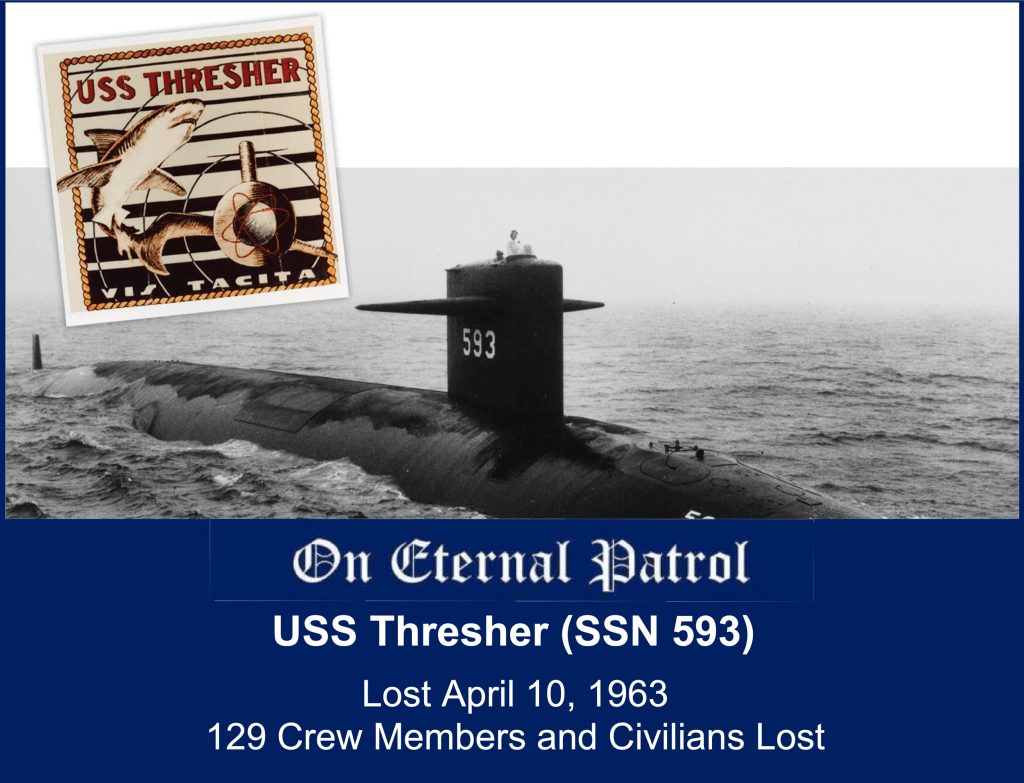
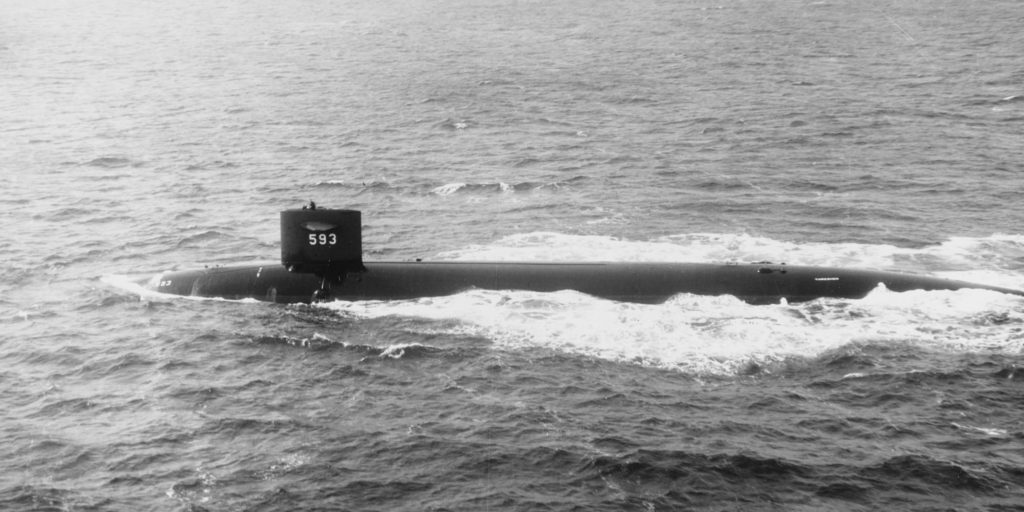
USS Thresher (SSN 593) was laid down on 28 May 1958 by the Portsmouth (N.H.) Naval Shipyard; launched on 9 July 1960; sponsored by Mrs. Frederick B. Warder; and commissioned on 3 August 1961, Commander Dean W. Axene in command.

Following trials the nuclear attack submarine took part in Nuclear submarine Exercise (NUSUBEX) 3-61 off the northeastern coast of the United States from 18 to 24 September.
On 18 October; the submarine headed south along the east coast. After calling at San Juan, Puerto Rico, she conducted further trials and test-fired her torpedo system before returning to Portsmouth on 29 November. The ship remained in port through the end of the year and spent the first two months of 1962 evaluating her sonar system and her Submarine Rocket (SUBROC) system. In March, the submarine participated in NUSUBEX 2-62, an exercise designed to improve the tactical capabilities of nuclear submarines, and in anti-submarine warfare training with Task Group ALPHA.
Off Charleston, the ship undertook operations observed by the Naval Antisubmarine Warfare Council, before she returned briefly to New England waters from whence she proceeded to Florida for SUBROC tests. However, while mooring at Port Canaveral, the submarine was accidentally struck by a tug which damaged one of her ballast tanks. After repairs at Groton, CT, by the Electric Boat Company, the ship returned south for more tests and trials off Key West. Thresher then returned northward and remained in dockyard hands through the early spring of 1963.

In company with SKYLARK (ASR 20), Thresher put to sea on 10 April 1963 for deep-diving exercises. In addition to her 16 officers and 96 enlisted men, the submarine carried 17 civilian technicians to observe her performance during the deep-diving tests.
Fifteen minutes after reaching her assigned test depth, the submarine communicated with SKYLARK by underwater telephone, apprising the submarine rescue ship of difficulties. Garbled transmissions indicated that – far below the surface – things were going wrong. Suddenly, listeners in SKYLARK heard a noise “like air rushing into an air tank” – then, silence.
Efforts to reestablish contact with Thresher failed, and a search group was formed in an attempt to locate the submarine. Rescue ship RECOVERY (ARS 43) subsequently recovered bits of debris, including gloves and bits of internal insulation. Photographs taken by bathyseaph TRIESTE proved that the submarine had broken up, taking all hands on board to their deaths in 1,400 fathoms of water, some 220 miles east of Boston.
THRESHER was officially declared lost in April 1963.
Submarine Safety (SUBSAFE) – After the Thresher incident, a court of inquiry and the Joint Congressional Committee on Atomic Energy hearings concluded that a flooding casualty in the engine room, resulting from a piping failure in one of the sea-water systems, was the most probable cause. On 3 June 1963, the SUBSAFE program was established within the Bureau of Ships to develop the Submarine Safety Certification Criterion, outlining the minimum actions required to provide a satisfactory level of confidence in the integrity of submarine systems and the adequacy of certain depth-control capabilities. The first effort to apply additional rigor in design, manufacturing, operation, and maintenance to a subset of critical systems within the nuclear submarine, the program’s goal was to provide maximum reasonable assurance of hull integrity to preclude flooding, and the operability and integrity of critical systems and components to control and recover from a flooding casualty, should one occur. The Bureau of Ships issued a certification criterion addressing design, material, fabrication, testing, and record keeping on 20 December 1963.
Since the inception of the SUBSAFE Program in 1963, only one submarine has been lost. USS Scorpion (SSN 589) was lost in May 1968 with 99 officers and men aboard. She was not a SUBSAFE certified submarine and the evidence indicates that she was lost for reasons that would not have been mitigated by the SUBSAFE Program. We have never lost a SUBSAFE certified submarine.
 Bowfin Pearl Harbor Base