
THE PRELUDE TO HAWAI’I
The Spanish-American War paved the way to Hawai’i. Within a decade, the U.S. not only annexed Hawai’i in 1898, but also the Philippine Islands and Guam. Thus, American isolationism died and ushered in a new era in U.S. naval history.
The acquisition of Hawai’i not only advanced Admiral Alfred Thayer Mahan’s program for American control of the Pacific but promoted trade and commerce. Mahan had urged acquisition of Hawai’i back in 1893. He was a naval strategist whose historical studies convinced him of the supreme importance of naval power and of the imperative necessity for the U.S. to strengthen its position in a highly competitive world.
Mahan advocated a big peacetime Navy. The acquisition of bases was a requisite of sea power. Mahan’s theories captivated young Assistant Secretary of the Navy, Theodore Roosevelt. So when Roosevelt became president in 1901, he stressed the importance of bolstering up America’s naval power. However, in 1903 there was not a single American naval base in Asiatic waters; ships of the Asiatic Squadron were dependent on dockyards at Nagasaki and Hong Kong. With the construction of Roosevelt’s large fleet, dockyards and coaling stations became vital.
These stations were part of the base facilities necessary to make naval activities in the Pacific self-sufficient in an emergency. At the time, only two ships in the Navy were capable of steaming from San Francisco to Manila without refueling. Development of Hawai’i was imperative. However, a base was desirable in the Philippines to support America’s policy toward China. U.S. defense officials could not agree on the best location for the establishment of a base in the Philippines. The Navy’s choice in January 1901 was Subic Bay. The Army preferred Cavite in Manila Bay for the naval base. Funds were appropriated for a base at Olongapo in Subic Bay In 1904. But funds for the development of a base at Pearl Harbor were suppressed.
In 1906, a board, headed by Secretary of War Taft, investigated the development of naval bases. The board found Pearl Harbor to be a port of secondary strategic importance. They found Puget Sound, San Francisco Bay, and Subic Bay to be strategically our most Important ports in the Pacific. However, pressure mounted for recognition of Hawai’i. The Navy Department sought development at Pearl Harbor.
In 1907, the U.S. Navy stationed the first submarines overseas in the Pacific. Two A-class boats, the A-6 and A-7, were disassembled for transportation to the Philippine Islands on board the USS Caesar (AC-14), a collier. Finally, on 13 May 1908, Congress appropriated funding to commence “immediate” development of Pearl Harbor. This decision to build a major base at Pearl Harbor was sound in that it clinched the American position in the central and eastern Pacific.
In 1913, five C-class submarines made a historic 700-mile voyage from Guantanamo Bay, Cuba, to Cristobal, Panama Canal Zone. These little submarines, with a displacement of only 238 tons and powered by small gasoline engines, completed the cruise without any difficulty. Up to that time this was the longest cruise ever undertaken by any U.S. submarines. The overall success of this venture elevated the submarine out of the role as a purely defense weapon. Prior to this, the submarine’s principal role had been for coastal and harbor defense.
The trans-Caribbean undertaking offered a new perspective for submarines. The Navy Department was taking another look at the possibilities of the submarine. The feat encouraged Secretary of the Navy, Josephus Daniels, to consider expanding submarine activities to Hawai’i.
Several months later, with the installation of German-type diesel engines in the new E-class, submarines were afforded an improved status in safety, speed, and radius of action. Even though Hawai’i did not possess adequate facilities to maintain submarines, the positioning of submarines in Hawai’i was not thwarted.
Prior to the outbreak of World War I, little consideration was given to the care and maintenance of submarines, except at primary navy yards and stations. No definite plans were laid down for the establishment of bases for the maintenance of submarine detachments outside the established navy yards.
SUBMARINES IN HAWAI’I
Four F-class submarines were selected for duty in Hawai’i. The submarines were transferred from the First Submarine Division in San Pedro, California to Mare Island Navy Yard for preparation. Incapable of making the 2400-mile trip on their own, the four boats would be towed to Hawai’i by two armored cruisers, the USS South Dakota (CA-9) and USS West Virginia (CA-6).
At Mare Island, the submarines underwent a general overhaul, obtained special fittings and preliminary training of the crew for the special transoceanic crossing. Finally the eventful day arrived. The two cruisers upped anchor shortly before dawn on 16 July 1914 and stood down the bay from Mare Island. Steaming through the Golden Gate, the two ships rendezvoused off-shore near the Farallon Islands with two of the F-boats. Two separate crossings would be required.
Once in position, the cruisers passed towlines to the USS F-1 (SS-20) and USS F-3 (SS-22). The tedious crossing was completed on 1 August. Upon refueling, the two cruisers returned to California for the two remaining submarines. On 15 August, the USS F-2 (SS-21) and USS F-4 (SS-23) were taken in tow and by nightfall of 24 August had safely reached Hawai’i.
Another component that would make up the balance of the First Submarine Flotilla in Hawai’i was the support vessel USS Alert (AS-4), an old 1874 Iron gunboat. In 1911, the Alert was converted into a submarine tender and in 1914 chugged across the Pacific to a new homeport in Hawai’i.
The four submarines and Alert moored at Pier 5 (the old Flat Iron Pier) across Ala Moana Road from the Old Naval Station in downtown Honolulu. Bachelor officers from the submarine flotilla were quartered on board Alert and the rest of the crew housed in nearby barracks. All hands messed on board Alert.
In those pioneer days, submarines remained tied close to their tenders. Training operations were limited and generally conducted out of Honolulu Harbor seldom exceeding ten miles, the distance an F-boat could travel on the surface in an hour.
On 25 March 1915, tragedy struck! The F-4, under the command of Lieutenant Alfred L. Ede sank off Honolulu Harbor in 305 feet of water during a training dive. All hands perished!Extensive salvage efforts were undertaken and by August the F-4 was finally raised to determine the cause of the loss.
Upon completion of the Board of Inquiry’s investigation, the hulk was towed from Honolulu to Pearl Harbor and sunk in the loch between Quarry Point and Kuahua Island. In 1940, when new piers were to be erected in this vicinity, a dredge dug a deep ditch alongside the wreck and the F-4 rolled into it — where it remains to this day. The remaining F-boats continued operating on a limited basis and would eventually be towed back to the mainland.
THE NEED FOR A SUBMARINE BASE
Studies were being conducted by the Bureau of Yards and Docks with a view toward the development of a typical submarine base. The plan detailed specific types of shop buildings, barracks, and piers required for a submarine base of the time. Secretary of the Navy Daniels submitted a letter to the Navy’s General Board concerning submarine shore bases. The letter stipulated the Intentions of the Secretary to “submit to the coming Congress estimates for the construction of submarine shore bases.” The plans for a typical submarine base were approved in September 1915. Hawai’i was a part of this plan on 14 October 1915, Admiral George Dewey, President of the Navy’s General Board, signed an endorsement concurring with the recommendation that “Quarry Point is the best location for the proposed submarine base at Pearl Harbor.”

FIRST SUBMARINES IN PEARL HARBOR
In October 1915, units comprising Submarine Flotilla Three departed San Francisco for duty in Hawai’i. This flotilla was composed of four K-class submarines, the K-3, K-4, K-7 and K-8. The flotilla operated briefly from Honolulu Harbor and in November shifted operations to Pearl Harbor. The facilities at the Old Naval Station in Honolulu were inadequate for submarine operations. A temporary base was established at Pearl Harbor on Kuahua Island, which was later commissioned as the Naval Ammunition Depot and called Magazine Island. Today this is the site of the Naval Supply Center.
Again the submarine tender Alert provided support. The K-boats conducted torpedo and diving tests, and participated in operations developing tactics in submarine warfare. But when America’s Involvement in World War I called for increased naval activity, the K-boats were reassigned. On 31 October 1917, the K-boats departed Hawai’i for Key West, Florida. Hawai’i was without submarines.
DEVELOPMENT OF SUBMARINE BASE, PEARL HARBOR
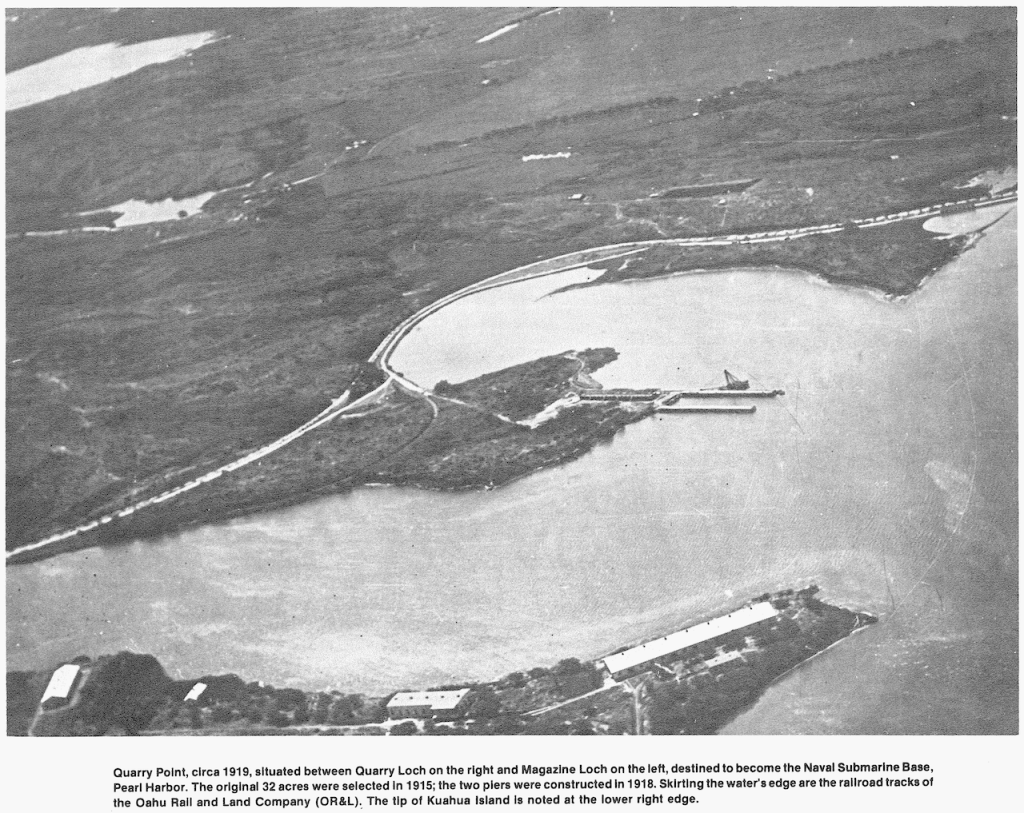
In March 1917, funds were allocated for the construction of two creosoted-timber piers at Quarry Point. This marked the beginning of submarine development at Pearl Harbor.
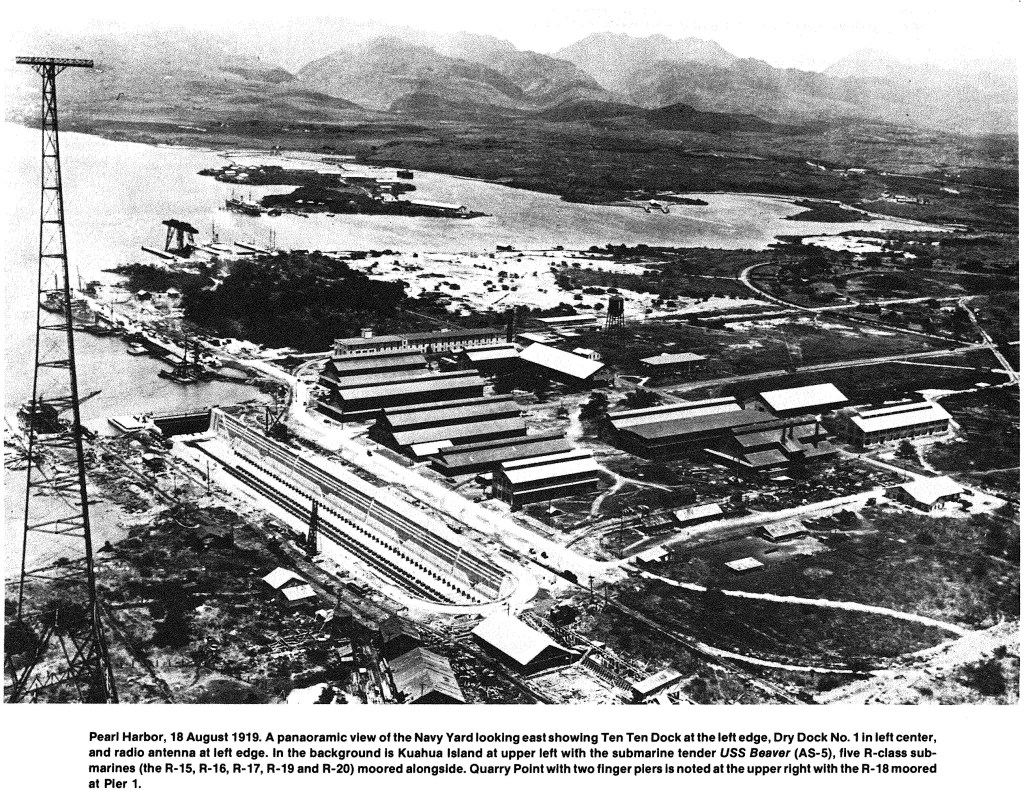
Shortly after the Armistice was signed in 1918, six R-class submarines were assigned to the Hawaiian area to establish the submarine base at Pearl Harbor. On 17 June 1919, the submarine tender USS Beaver (AS-5), a converted merchantman, and the six R-boats (R-15 through R-20), departed San Francisco for Hawai’i. This contingent comprised Submarine Division Fourteen under the command of Lieutenant Commander Felix X. Gygax, a pioneer submariner and first Officer in Charge of the Submarine School In New London, Connecticut.
The Honolulu Star-Bulletin of 25 June, described the arrival of the submarine division in Hawai’i. “The first unit of the new naval defense for these islands, consisting of the mother ship Beaver and six submarines of the R type, will make Oahu this afternoon, and will be berthed near the drydock at Pearl Harbor. The six subs form the advance guard of boats of this type to come here for permanent duty.”
Upon entering Pearl Harbor, all the submarine division found were two finger piers constructed at the site of today’s submarine base at Quarry Point. The R-18 moored at Pier 1 of the submarine base to charge air and batteries, thus becoming the first submarine to moor at the base. The Beaver and remaining fl-boats anchored nearby but would eventually moor at Kuahua Island.

Sometime after arrival of the squadron, land at Quarry Point began to be cleared of cactus, rocks and algaroba trees by the enlisted forces for the erection of temporary buildings. No funds had been appropriated for any construction, so the base force lived ashore in tents provided by the Beaver.
In August 1919, the battleship New York arrived with Secretary of the Navy Daniels and other dignitaries comprising a Special Board of Inspection of Naval Bases on the Pacific Coast. The Board recommended on 20 October, that a first class naval base, capable of taking care of the entire U.S. Fleet in time of war, be developed immediately in Pearl Harbor. Among the Board’s recommendations included an appropriation of over a million dollars for a complete submarine base which included dredging around the piers.
In October 1919, a building constructed from wartime wooden huts removed from Base No. 1 at Queenstown, Ireland, was commissioned as a sick bay at the submarine base. This complex included a second wooden building that served as a store and issuing facility. These structures served as the base dispensary until completion of a permanent building (Bldg. 665) in 1936. Hospital corpsmen were quartered in tents at Quarry Point.
The first Ship’s Service Department in the Fourteenth Naval District was established at the base in 1919. A Ship’s Service at the Naval Station did not commence operation -until a few years later. The volume of business in those early stores was certainly meager compared to the volume of business in today’s Navy Exchange facilities. Yet the services provided in the early stores were quite varied and included practically everything necessary or convenient for naval personnel. In many instances, credit provisions were so inclusive that naval personnel could have all charge accounts with commercial stores, including utility bills and house rent paid by the Ship’s Service Department, which, in turn would submit an invoice for the entire household expense at the end of the month.
On 18 November 1919, the Navy promulgated General Order No. 510 and was signed by Secretary of the Navy Josephus Daniels. This order (The Status of Shore-Based Submarine Organization), defined the status and directed the methods to be employed In administering and operating the shore-based submarine organizations. The intention was that all matters of personnel and material, within the submarine bases, should parallel as closely as possible that of mobile submarine tenders. This directive stipulated that “Commissioned and enlisted personnel of the bases not included in the crews of the vessels based thereon will be attached to the small tenders or other surface vessels assigned for exercise purposes. Officers commanding bases will command the vessels to which such personnel are attached. For instance, the officer in command at New London will command USS Fulton (assigned at present), and all personnel not attached to commissioned vessels of the organizations based thereon will be attached to Fulton.” As a result, Gygax assumed command of the resident tender, the USS Beaver.
General Order No. 510 defined the status of the submarine base at the time. The directive stated “Pearl Harbor (the Submarine Base) is within the naval station. Immediate senior is commandant of the fourteenth naval district.” The submarine base had not been officially established or commissioned.
On 19 December 1919, the protected cruiser USS Chicago (CL-14), arrived and anchored temporarily off-shore near the base. The old cruiser had once been commanded by the illustrious Alfred T. Mahan and was now relieving the Beaver as the resident tender. Chicago would eventually moor at the base to provide berthing accommodations for officer personnel.
In February 1920 the temporary facilities at Kuahua Island closed down and operations shifted to Quarry Point.
 Bowfin Pearl Harbor Base