
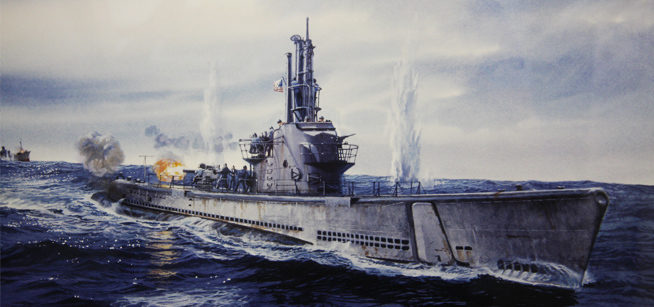
USS Bowfin (SS-287) is a fleet attack submarine that fought in the Pacific during WWII, and helped to make famous the term, “Silent Service.” Bowfin was launched on 7 December 1942, exactly one year after the attack on Pearl Harbor. She was nicknamed the Pearl Harbor Avenger, so it is fitting that her permanent home is at Pearl Harbor, Hawai’i.
PATROL SUMMARY
In World War II USS Bowfin conducted nine war patrols between 1943 and 1945. War patrols of WWII are similar to what we think of as deployments today. They were periods of about two months where a submarine would patrol a designated region of ocean for Japanese ships or boats. Bowfin served in the Pacific and spent most of her patrols in the South China Sea, Celebes Sea, off the East coast of Japan, and into the Sea of Japan.
LAUNCHING & COMMISSIONING
On 15 December 1941, eight days after the Japanese attack on Pearl Harbor, the Portsmouth Navy Yard was given the order to start construction on the new Balao class fleet submarines. The third boat of the class was to bear the name USS Bowfin (SS-287). Her keel was laid on 23 July 1942.
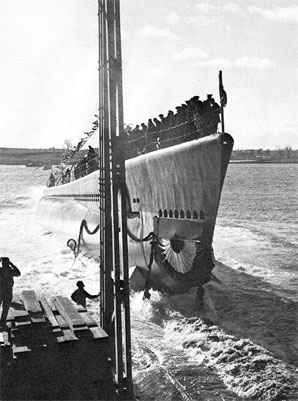
Construction proceeded smoothly, and Bowfin was launched at Portsmouth Naval Shipyard in Kittery, Maine on 7 December 1942, exactly one year after the Pearl Harbor attack. Due to this historic coincidence, and in hopes of future success against the enemy, she was appropriately dubbed the “Pearl Harbor Avenger.”
Bowfin was christened by Mrs. Jane Gawne, wife of Captain James Orville Gawne who was head of the Portsmouth Navy Yard.
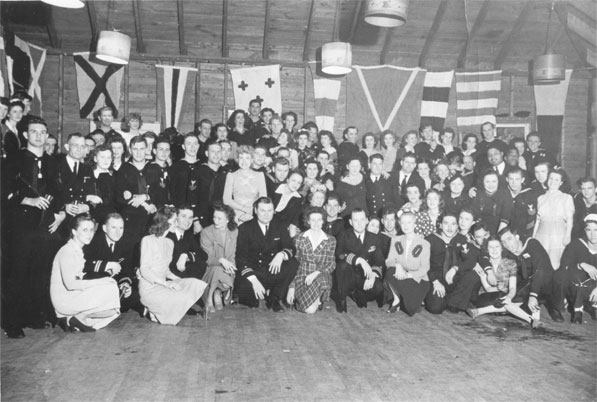
After a period of trial runs, Bowfin was deemed ready to begin her career as a U.S. Navy submarine. Her commissioning party was held on 24 April 1943 at the Pannaway Club in New London, CT, followed a week later by her formal Commissioning Ceremony held on her main deck on 1 May 1943.
USS Bowfin takes her name from the hard fighting, aggressive, and voracious fish found in fresh water from the Great Lakes down the Mississippi River, and as far south as the Gulf of Mexico. As the last survivor of the family Amiidae, which dates back to the Jurassic Period, this living fossil is at home in backwaters and marshy areas. Due to its primitive lung, it thrives in water with low oxygen content, and can survive for days at a time in little or no water. A more appropriate name could not have been found for an air-breathing diesel boat, this one soon to be legendary in the submarine force for her bold determination and insatiable appetite for enemy shipping.
POST-WAR SUMMARY
Bowfin’s four World War II commanding officers believed that she sank 179,646 tons (34 large vessels, plus 10 more under 500 tons) and damaged 33,934 tons (five large vessels plus two smaller ones) for a total of 213,580 tons sunk or damaged. The Joint Army-Navy Assessment Committee (JANAC) credited Bowfin with 67,882 tons sunk (16 vessels of that tonnage plus 22 smaller craft). JANAC’s reassessment dimmed Bowfin’s glory no more than that of most other submarines. JANAC’s reassessments continue to be challenged by many who believe that Japan’s remaining WWII records were less than accurate, and by some who know the JANAC’s reassessments in some instances disallowed claims even though trained observers saw the disputed vessels sink. Of the 317 U.S. submarines in commission during WWII, 269 boats had at least one official war patrol, and 188 of them had JANAC officially credited sinking records. USS Bowfin remains a legend, for among these 188 submarines, Bowfin ranks 17th in tonnage and 15th in number of ships sunk. Fifty-two of 317 commissioned submarines and 3,632 out of approximately 20,000 WWII U.S. submariners began their eternal patrols before Japan surrendered.
USS BOWFIN’S BATTLEFLAG
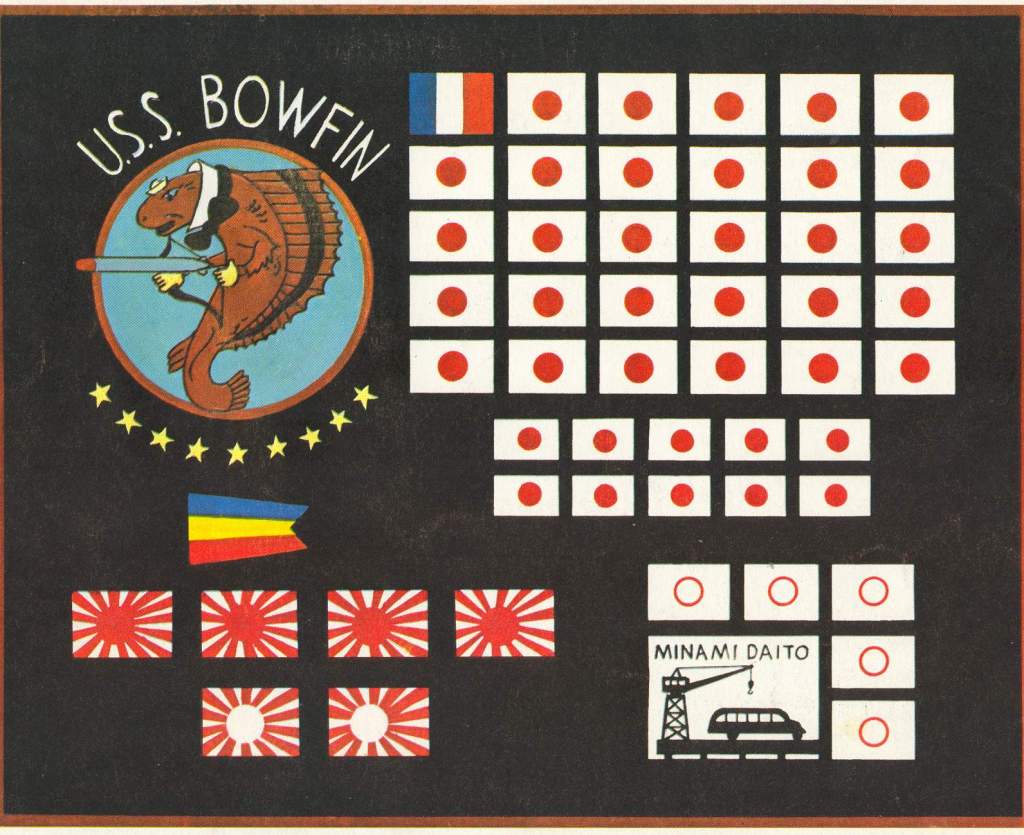
During WWII the crew of Bowfin made two battleflags of their own making that we are honored to house in our museum. Both were made from fabric that they had aboard at the time, and both are unique in their own ways. The third battleflag was made after the war by the Carleton Company from Rochester, NY who offered to make reproductions of flags for all crew members to have. The fourth battleflag is represented below and is the favorite among the WWII Bowfin crew. It was designed for them in the 1980s and represents the three major awards the boat received during the war: Presidential Unit Citation, Navy Unit Commendation, and Philippine Presidential Unit Citation.
USS Bowfin’s battleflag graphically depicts the successes of nine war patrols, which are represented by the nine stars located below the bowfin fish mascot firing a torpedo. Bowfin claimed 39 Japanese merchant ships and four Japanese military ships sunk, depicted by white flags with solid red circles (the national flag of Japan) and white flags with solid red rising suns (the Imperial Japanese Navy flag), respectively. The single French flag represents a French merchant ship – Van Vollenhoven – which was sunk off Saigon in convoy with Japanese ships. Flags with white centers are for ships that are claimed damaged, but not sunk.
SINKINGS OF THE USS BOWFIN
This table shows the 16 vessels that JANAC credited Bowfin with in 1946.
| DATE AND PATROL | NAME OF VESSEL | TYPE OF VESSEL | TONNAGE | LOCATION | COMMANDING OFFICER |
|---|---|---|---|---|---|
| 25 Sept 1943, Patrol 1 | Kirishima Maru | Passenger-Cargo | 8,120 | 9-44N, 111-56E | J. H. Willingham |
| 26 Nov 1943, Patrol 2 | Ogurasan Maru | Tanker | 5,069 | 12-48N,109-34E | W. T. Griffith |
| 26 Nov 1943, Patrol 2 | Tainan Maru | Cargo | 5,407 | 13-02N, 109-28E | W. T. Griffith |
| 27 Nov 1943, Patrol 2 | Van Vollenhoven | Cargo | 691 | 13-01N, 109-30E | W. T. Griffith |
| 28 Nov 1943, Patrol 2 | Sydney Maru | Passenger-Cargo | 5,425 | 12-46N, 109-42E | W. T. Griffith |
| 28 Nov 1943, Patrol 2 | Tonan Maru | Tanker | 9,866 | 12-46N, 109-42E | W. T. Griffith |
| 17 Jan 1944, Patrol 3 | Shoyo Maru | Cargo | 4,408 | 18-00N, 118-37E | W. T. Griffith |
| 10 Mar 1944, Patrol 4 | Tsukikawa Maru | Cargo | 4,470 | 1-30N, 128-17E | W. T. Griffith |
| 24 Mar 1944, Patrol 4 | Shinkyo Maru | Cargo | 5,139 | 5-27N, 125-38E | W. T. Griffith |
| 24 Mar 1944, Patrol 4 | Bengal Maru | Cargo | 5,399 | 5-27N, 125-38E | W. T. Griffith |
| 22 Aug 1944, Patrol 6 | Tsushima Maru | Passenger-Cargo | 6,754 | 29-32N, 129-31E | J. Corbus |
| 17 Feb 1945, Patrol 7 | Coast Defense Vessel No. 56 | Frigate | 750 | 33-53N, 139-43E | A. K. Tyree |
| 1 May 1945, Patrol 8 | Chowa Maru | Passenger-Cargo | 2,719 | 41-06N, 144-28E | A. K. Tyree |
| 8 May 1945, Patrol 8 | Daito Maru No. 3 | Cargo | 880 | 39-37N, 142-07E | A. K. Tyree |
| 11 Jun 1945, Patrol 9 | Shinyo Maru No. 3 | Passenger-Cargo | 1,898 | 39-23N, 128-59E | A. K. Tyree |
| 13 Jun 1945, Patrol 9 | Akiura Maru | Cargo | 887 | 39-13N, 128-07E | A. K. Tyree |
This table shows the sinkings of Bowfin based on research done by CDR John Alden, USN (Ret.). He published his research in his book United States and Allied Submarine Success in the Pacific and Far East During World War II.
| DATE AND PATROL | NAME OF VESSEL | TYPE OF VESSEL | TONNAGE | LOCATION | COMMANDING OFFICER |
|---|---|---|---|---|---|
| 25 Sept 1943, Patrol 1 | Kirishima Maru | Passenger-Cargo | 8,267 | 9-44N, 111-56E | J. H. Willingham |
| 26 Nov 1943, Patrol 2 | Ogurasan Maru | Tanker | 5,069 | 12-48N,109-34E | W. T. Griffith |
| 26 Nov 1943, Patrol 2 | Tainan Maru | Cargo | 5,407 | 13-02N, 109-28E | W. T. Griffith |
| 27 Nov 1943, Patrol 2 | Van Vollenhoven (Vichy French) | Cargo | 691 | 13-01N, 109-30E | W. T. Griffith |
| 28 Nov 1943, Patrol 2 | Tonan Maru | Tanker | 9,866 | 12-46N, 109-42E | W. T. Griffith |
| 28 Nov 1943, Patrol 2 | Sydney Maru | Passenger-Cargo | 5,425 | 12-46N, 109-42E | W. T. Griffith |
| 17 Jan 1944, Patrol 3 | Shoyo Maru | Cargo | 4,408 | 18-00N, 118-37E | W. T. Griffith |
| 10 Mar 1944, Patrol 4 | Tsukikawa Maru | Cargo | 4,673 | 1-30N, 128-17E | W. T. Griffith |
| 24 Mar 1944, Patrol 4 | Bengal Maru | Cargo | 5,399 | 5-27N, 125-38E | W. T. Griffith |
| 24 Mar 1944, Patrol 4 | Shinkyo Maru | Transport | 2,672 | 5-27N, 125-38E | W. T. Griffith |
| 14 May 1944, Patrol 5 | Miyama Maru | Cargo | 4,667 | 08-55N, 133-42E | J. Corbus |
| 10 Aug 1944, Patrol 6 | Seiyo Maru | Transport | 197 | Minami-Daito | J. Corbus |
| 22 Aug 1944, Patrol 6 | Tsushima Maru | Passenger-Cargo | 6,754 | 29-32N, 129-31E | J. Corbus |
| 4 Sept 1944, Patrol 6 | Hinode Maru #6 | Picket | 245 | 31-55N, 152-00E | J. Corbus |
| 17 Feb 1945, Patrol 7 | Coast Defense Vessel No. 56 | Frigate | 940 | 33-52N, 139-43E | A. K. Tyree |
| 17 Feb 1945, Patrol 7 | Nanshin Maru #28 | Picket Boat | 83 | Mikomoto Lt. | A. K. Tyree |
| 2 Mar 1945, Patrol 7 | Chokai Maru | Picket Boat | 135 | 34-16N, 139-39E | A. K. Tyree |
| 4 Mar 1945, Patrol 7 | Fukuyu Maru #1 | Picket Boat | 152 | Not Given | A. K. Tyree |
| 1 May 1945, Patrol 8 | Chowa Maru | Passenger-Cargo | 2,719 | 41-06N, 144-28E | A. K. Tyree |
| 8 May 1945, Patrol 8 | Daito Maru No. 3 | Fishing Vessel | 880 | 39-37N, 142-07E | A. K. Tyree |
| 11 Jun 1945, Patrol 9 | Shinyo Maru No. 3 | Passenger-Cargo | 1,898 | 39-23N, 128-59E | A. K. Tyree |
| 13 Jun 1945, Patrol 9 | Akiura Maru | Cargo | 887 | 39-13N, 128-07E | A. K. Tyree |
 Bowfin Pearl Harbor Base